



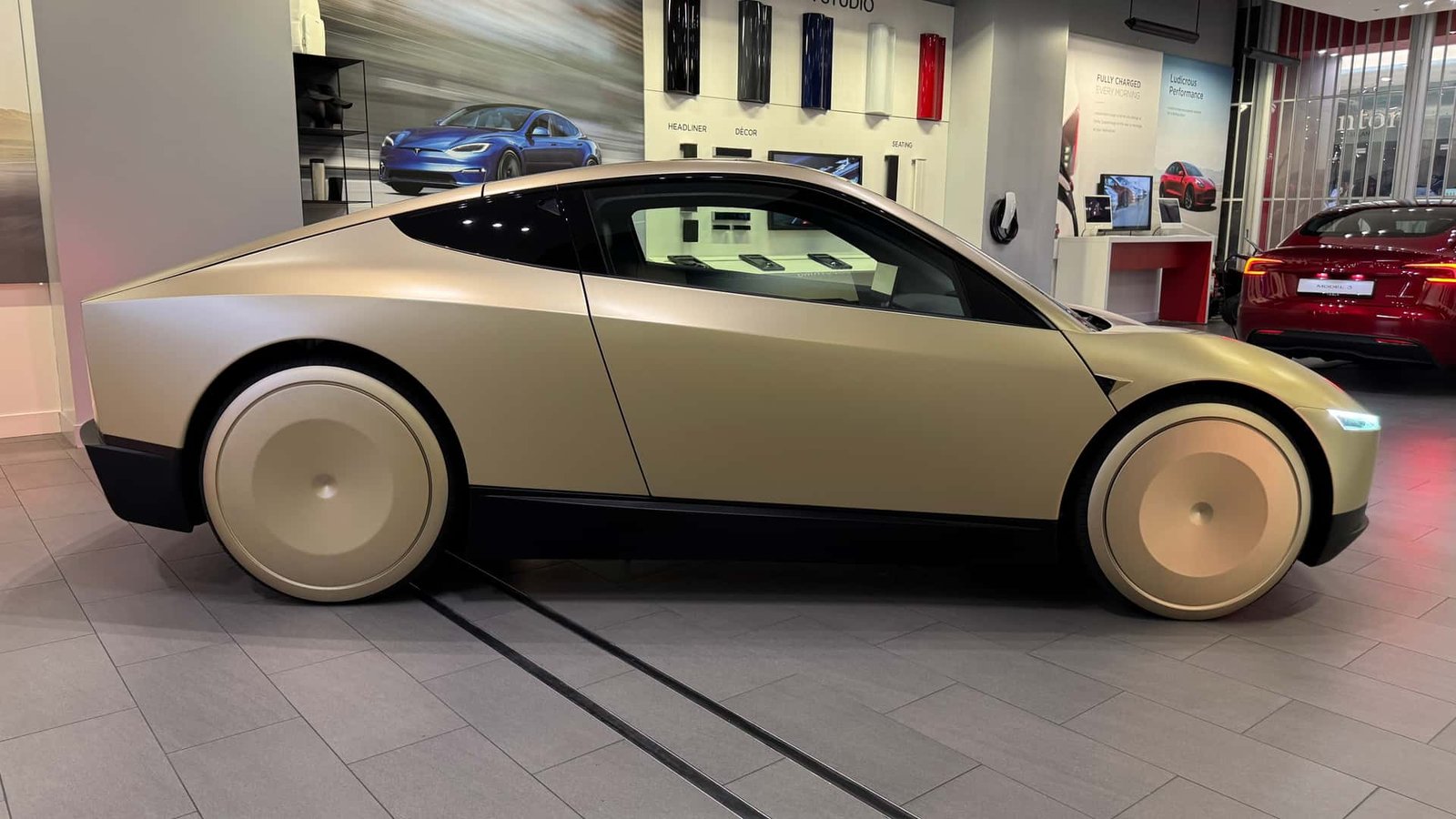
- Tesla confirmed a formal Cybercab launch event in Austin on September 3, 2026.
- The two-seat Cybercab has no steering wheel or pedals and relies on Tesla’s AI4 computer for full autonomy.
- The September 3 event is a product unveiling, not NHTSA approval, and public access will remain limited.
Tesla has locked in the date. The Cybercab, a two-seat robotaxi with no steering wheel and no pedals, gets its formal launch event in Austin on September 3, 2026. Invitations are going out to selected riders and fans, and coverage from outlets like Teslarati lines up with what invitees are seeing in their inboxes.
Some invitations went to riders who completed Robotaxi trips between August 17 and 23, with a sweepstakes drawing five winners from that group. Others arrived as direct “Exclusive Access” emails, giving recipients until August 30 at 11:59 p.m. Pacific to RSVP for the Austin event.
25
Source: Motor1.com
What’s Confirmed
Tesla’s own site calls this a celebration of “the launch of our Cybercab robotaxi,” and the guest list is tightly controlled instead of open to the public. Invitees must be at least 21 and will face ID checks at the door, pointing to a curated in-person demo instead of a giant fan gathering.
October 2024 brought an earlier taste of the idea, when Tesla let attendees ride in autonomous Cybercabs on a closed course in California. By now the company already runs driverless Model Y Robotaxis in limited parts of Austin, Dallas, Houston, Miami, Orlando, and Tampa, so September 3 is about folding Cybercab into that existing commercial service rather than starting from zero. Internal testing has also ramped up, with employee rides in Cybercab beginning in July 2026 as a step toward letting paying customers in.
Two Seats, No Wheel, No Pedals
Cybercab strips out traditional driving controls entirely. Two seats, a small cabin, and the total absence of a steering wheel or pedals mean the vehicle relies entirely on Tesla’s Full Self-Driving software for every mile. There is no way for a human inside to take over if the system misbehaves, which is a riskier gamble than any previous Tesla product.


The Tesla Cybercab interior
Photo by: Motor1.com
The work is handled by Tesla’s AI4 computer, the current hardware platform for the company’s Full Self-Driving software and robotaxi plans. Future AI4.5 and AI5 chips are already on the roadmap, but Cybercab’s first production wave in Austin will ride on AI4 while regulators and safety investigators keep watching real-world behavior after several high profile incidents.
The missing steering wheel and pedals are exactly what regulators are focused on. With no manual backup, all risk and control sit with the software, so designs that fit into parking spaces and match Cybercab’s compact-car specs and dimensions also have to satisfy federal rules for vehicles with no conventional driver position.
For everyday riders, Cybercab access after September 3 stays murky, and Tesla’s past Robotaxi launches suggest small trial groups and slow expansion long before hopping into a steering wheel free Cybercab becomes a normal part of getting around Austin.
Motor1’s Take: Tesla’s Cybercab launch signals a clear bet on fully driverless rides without a human fallback, a milestone in vehicle design and intent rather than an instant switch to mass service. The reveal pushes the hardware and software story forward but leaves big questions about regulation and everyday access hanging in the air.
Read the full article here