



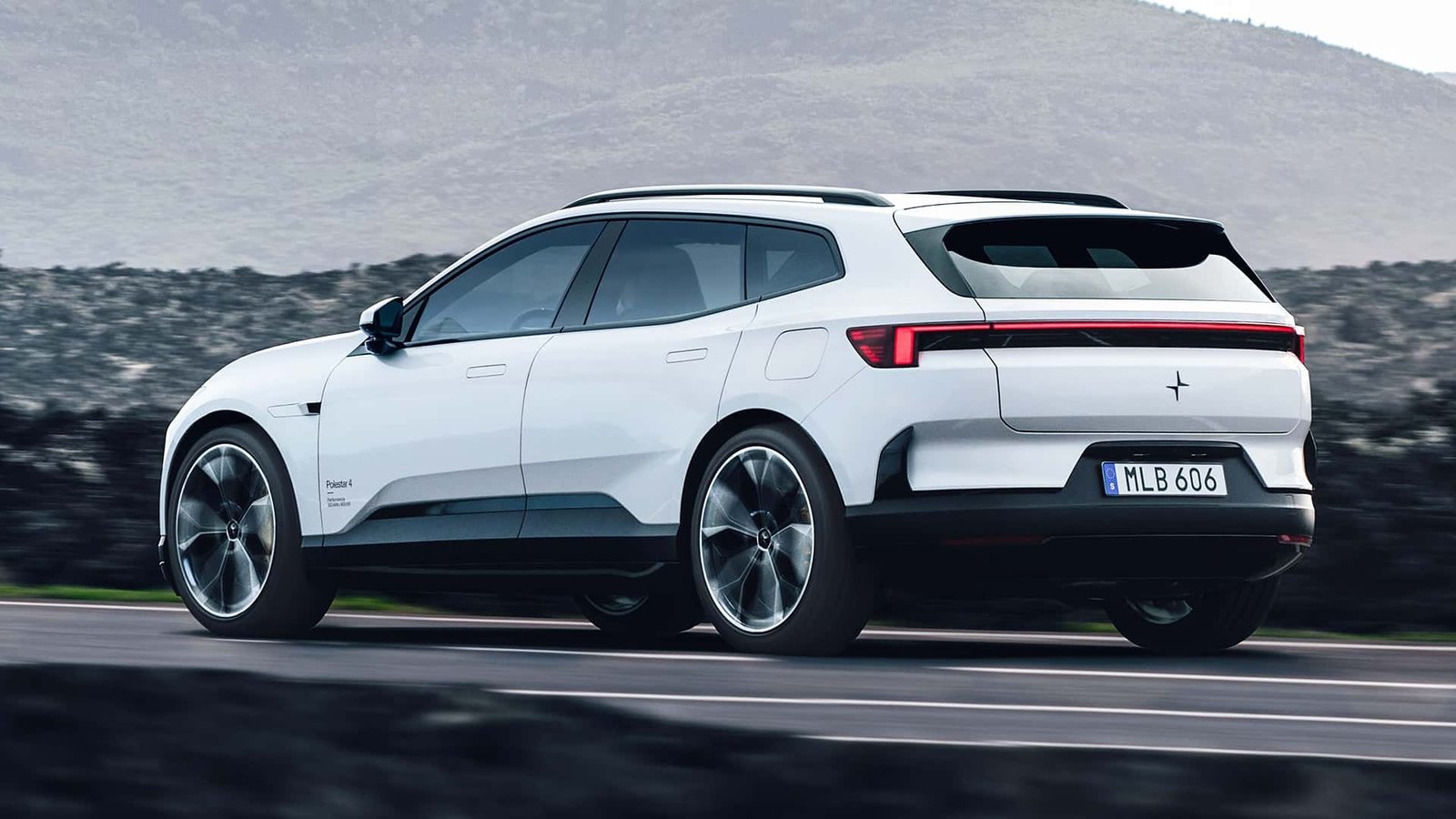
- The Polestar 4 spawns a more practical version that’s a wagon in all but name.
- It gets a taller rear section, boosting cargo capacity and making it easier to carry taller items.
- The SUV also adds common-sense features such as a glass rear window and wiper.
Welcome to 2026, when automakers are blurring the lines of what body-style definitions should mean. The Polestar 4 is officially labeled a coupe even though it’s essentially a four-door sedan with a rakish roofline. A new SUV version is now joining the range, but it would be better to call it what it really is: a wagon.
Confusing terminology aside, the Polestar 4 SUV is a handsome EV and, predictably, more practical, not just because of its taller rear section. Yes, it has a (heated) rear glass window like all cars should have, and better yet, it adds another newfangled feature: a rear wiper with a built-in washer. You can’t see it because Polestar was clever enough to tuck it away under the rear spoiler, preserving the electric wagon’s clean rear section.
With Polestar adding a rear glass window, the standard 4 SUV skips the digital rearview mirror its Coupe counterpart can’t do without. However, there is an option to put it back, and thankfully, it doesn’t stick out like a sore thumb as it does on the SUV. On the regular Polestar 4, it’s located where you would normally find a shark-fin antenna; here, it’s built into the edge of the roof spoiler, where it should be far less visible. A digital rear camera still makes sense because, with a regular glass mirror, the view through the back is obstructed if the rear seats are occupied and/or the cargo area is filled to the brim.
2027 Polestar 4 SUV profile
Photo by: Polestar
As is usually the case when a sedan morphs into a wagon, the overall length hasn’t changed. The new Polestar 4 SUV measures an identical 190.5 inches (4,840 millimeters). Width stays the same at 84.2 inches (2,139 mm), with only the height changing after the rear section was made taller. At 61.2 inches (1,556 mm), height increases by nearly 0.9 inches (22 mm), allowing taller items to fit in the back.
Since it’s essentially a wagon, people will be buying the 4 SUV for its practicality. It can swallow 655 liters (23.1 cubic feet) up to the inner roof with the rear seats in place, or a significant 129 liters (4.6 cu ft) more than the Coupe. Fill up the cargo area up to the seatbacks, and Polestar quotes a volume of 530 liters (18.7 cu ft), or 30 liters (1.1 cu ft) more than the Coupe. With the front unchanged, the extra trunk still holds 15 liters (0.5 cu ft) of smaller items.
Polestar is also giving the 4 SUV an electrochromic glass roof so you can control the amount of light entering the cabin using the center display. It’s a feature that was once exclusive to luxury automakers but has been trickling down to mainstream brands in recent years. Other changes include standard roof rails, new wheels (and tires), along with fresh body colors, including a couple of matte finishes.


2027 Polestar 4 SUV cargo area
Photo by: Polestar
The 4 SUV will be offered with single- and dual-motor configurations. Stick to the base model, and it’ll send 268 hp and 253 lb-ft (343 Nm) to the rear wheels. It takes 7.3 seconds to reach 62 mph (100 km/h) and tops out at an electronically capped 124 mph (200 km/h). Upgrading to the all-wheel-drive variant brings a combined output of 544 hp and 506 lb-ft (686 Nm), resulting in a ludicrously quick car. It sprints in just 3.9 seconds, but the top speed remains unchanged.
Both Polestar 4 SUV flavors share a 100-kWh lithium-ion battery pack with enough juice for 391 miles (630 kilometers) in the WLTP cycle for the single-motor variant. Its more potent dual-motor sibling should cover 373 miles (600 kilometers) before running out of juice. Once that happens, it’ll take about 30 minutes to DC charge at the maximum supported 200 kW, going from 10 to 80 percent.
The energy flows both ways, as bidirectional charging is on board. The Polestar 4 SUV has Vehicle-to-Load (V2L) to double as a mobile power bank and juice up external devices at up to 3.3 kW. There’s even a Camp mode where V2L might come in handy, along with the usual USB-C ports. The Camp mode, which apparently “transforms the vehicle into a retreat,” is initially exclusive to the SUV version, but it’s coming to all models with a future software update.
Back in February, Polestar CEO Michael Lohscheller told our sister site InsideEVs that the 4 SUV was “absolutely coming to the U.S.” Well, we all know how that turned out. The Geely-owned brand won’t be allowed to sell cars in the US starting with the 2027 model year because it fails to comply with the U.S. Connected Vehicles Rule. The regulation restricts the import and sale of certain vehicles equipped with connected technology linked to China or Russia. As a result, Polestar is pulling out of the US market.
27
Source: Polestar
Motor1’s Take: With Volvo still unsure whether wagons have a future beyond the aging V60, the Polestar 4 SUV is a welcome addition to the lineup. There’s certainly a need for more long-roof EVs that don’t sit as high as SUVs, and this one brings some undisputed advantages over its Coupe equivalent.
Read the full article here