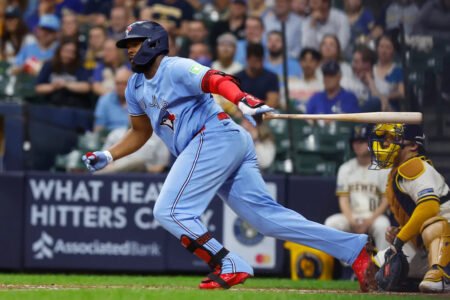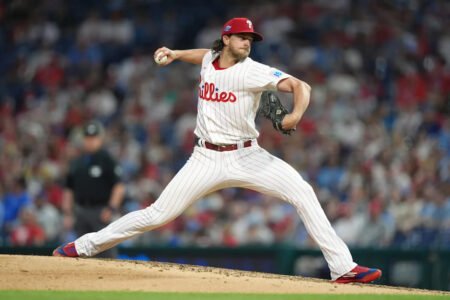


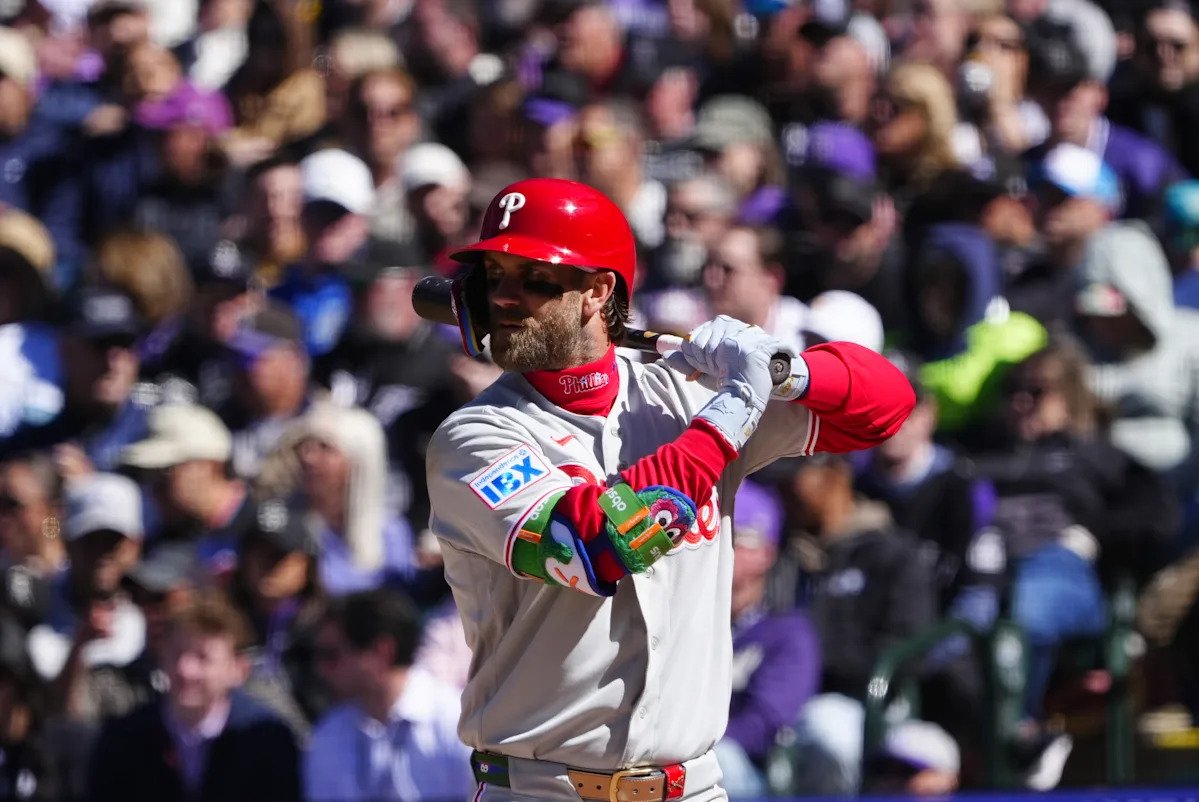
This is going to be a piece about patience and taking it slow. I was going to start it off with a joke about stopping to smell the flowers above the left field wall, but they removed those a season or two ago, and I couldn’t quite come up with another lede, so the seams are showing a bit. And not showing in an effective, “oh god, that’s a Zack Wheeler four-seamer coming at me”, way. Anyhow. Bryce Harper’s first pitch swing percentage is down almost double digits this year.
Specifically, it’s down 9.7%, to 44.4% (all stats cited are taken from before yesterday’s game). He’s gone from swinging at a majority of first offerings to passing on most of them, though he’s still quite eager to get the at-bat started with a mighty hack. Small sample size caveats apply, but that’s still a pretty big change. His overall swing rate is down by 3.4%, so this would seem to be more than a general decision to swing less— it’s concentrated on the first swing. Although Harper’s swing is lethal, you can see the logic in his starting fewer at-bats with one: pitchers really don’t like to give Harper pitches in the zone, and they’re increasingly reluctant to give him the fastballs he feasts on. So why not start off by taking one of those pitches outside, getting into a hitter’s count, and forcing them to give him the fastball?
Advertisement
That would be sensible strategy, but it’s also not what’s happening. His first pitch swing rate is way down, but his first pitch strike rate has barely changed from last year (up 0.8%). Any benefit he’s getting with fewer first pitch whiffs and fouls is being offset by something. The only thing it could be, really, is that he’s getting more pitches in the zone, and thus taking more called strikes. His overall in zone percentage is actually down a bit from last year, though only by the small margin of 2.5%.
But if we look only at pitches on a 0-0 count, his in-zone percentage has increased from 45.8% to 52.8%. As Bryce has dropped his first pitch swings to under 50%, pitchers have raised their first pitch offerings in the zone to over 50%. Hence the lack of change in his first pitch strike rate. Pitchers have also changed which pitches they’re offering him on 0-0 counts: last year he got fastballs for the plurality of his initial offerings, but this year, and for the first time in his career, he’s getting more breaking balls than fastballs to start. Pitchers are starting to pitch Bryce backwards. He seems to be making an effort to swing less at breaking balls this year, and not just in 0-0 counts: overall, his swing rate against the moving stuff has dropped by 10%.
All this raises a question about what we’re seeing. Are pitchers offering Harper more first pitches in the zone because he’s swinging at them less? Or is Harper swinging less at first pitches because of what pitchers are offering him? Unlike the question of the chicken and the egg, we can make some progress towards answering this (also, did the Phanatic, being a bird, come from an egg? That’s beyond the purview of this piece, and also a little uncomfortable to think about).
See, Bryce isn’t alone. Taken as a team, the Phillies have dropped their first pitch swing rate by 7.7%, more than any other team in baseball. In part, that’s the product of a change in team composition: the Phillies parted ways with Nick Castellanos, who swung at a greater proportion on first pitches than anyone else in baseball in 2025, and replaced him with Adolis García, who ranked 100th for first pitch swing %. But it’s not just about the change in personnel:
|
Player |
First Pitch Swing %, 2025 |
First Pitch Swing %, 2026 |
Change, Year over Year |
|---|---|---|---|
|
Bryce Harper |
54.10% |
44.40% |
-9.70% |
|
Trea Turner |
38.40% |
30.70% |
-7.70% |
|
Alec Bohm |
35.30% |
28.80% |
-6.50% |
|
Adolis García |
33.20% |
15.90% |
-17.30% |
|
Brandon Marsh |
32.10% |
28.60% |
-3.50% |
|
J.T. Realmuto |
29.50% |
28.60% |
-0.90% |
|
Kyle Schwarber |
27.50% |
22.70% |
-4.80% |
|
Bryson Stott |
13.40% |
11.90% |
-1.50% |
All of the Phillies starters have dropped their first pitch swing rate from last year. Even Bryson Stott, who swings at first pitches about as often as blue moons appear on leap years, has somehow found a way to do so less often. Part of this is (like everything else in April), small sample size. Case in point, during the time between my starting to poke around this topic and actually writing this, Stott’s decrease in first pitch swing % went from “wow, that’s a big drop” to “that’s a small, but notable drop” to “I’m pretty sure this doesn’t mean anything”. Realmuto’s drop also seems small enough to be negligible. But given that the growing reluctance to swing at the first offering is spread out across the entire team, it seems like there may be something real here.
Advertisement
The Phillies may be telling their hitters to take a more patient approach, to swing less at the first pitch (and not just at the first pitch— they’ve dropped their overall swing rate by 3.1%, more than all but five other clubs). That’s decreased their first pitch strike percentage by a bit (2.8%). I’m not so convinced that the decline in first pitch swing rate for the Phillies with small declines is all that meaningful; Realmuto and Stott’s declines are small enough to be noise, and Marsh and Schwarber’s drops could also turn out to be the same. But Harper and García seem to be genuinely more reluctant to swing at the opening offering, at least in the early going. It’s clear to me why Harper might want to make that change; only Castellanos was more likely to swing at first pitches last year, and pitchers are happy to exploit that. García’s change in approach is a little more surprising, both because of the size of the drop, and because he wasn’t unusually likely to swing at first offerings last year. But García is looking to return to form after an underwhelming 2025, and finding a way to get into more hitters counts certainly couldn’t hurt.
And on a team-wide level, the reasoning may be simple: no team in baseball was less likely to get a pitch in the zone last year. If pitchers aren’t inclined to give you something in the zone, taking fewer swings on first pitches gets you more 1-0 counts, and thus more pressure for the next pitch to be in the zone. Eventually, if pitchers realize giving a Phillie an out of the zone pitch on 0-0 is likely to get them a 1-0 count, then they’ll start off more at-bats with pitches in the zone.
It’s early. Not enough time has passed to gauge precisely how much of this is intentional strategy that’ll stick, and not enough time has passed to see how opposing pitchers will respond. So far, the Phillies are actually somewhat less likely to get pitches in the zone than they were last year. A lot of this could turn out to be noise. Still, it’s worth taking a swing at the first offering of early season data— even the Phillies are taking the opposite approach.
Read the full article here