



- VW is about to replace the first-generation Amarok in Latin America with a new truck of Chinese origin
- An Amarok-based SUV with three-row seating may follow.
- The Ford Ranger-based Amarok will continue in global markets.
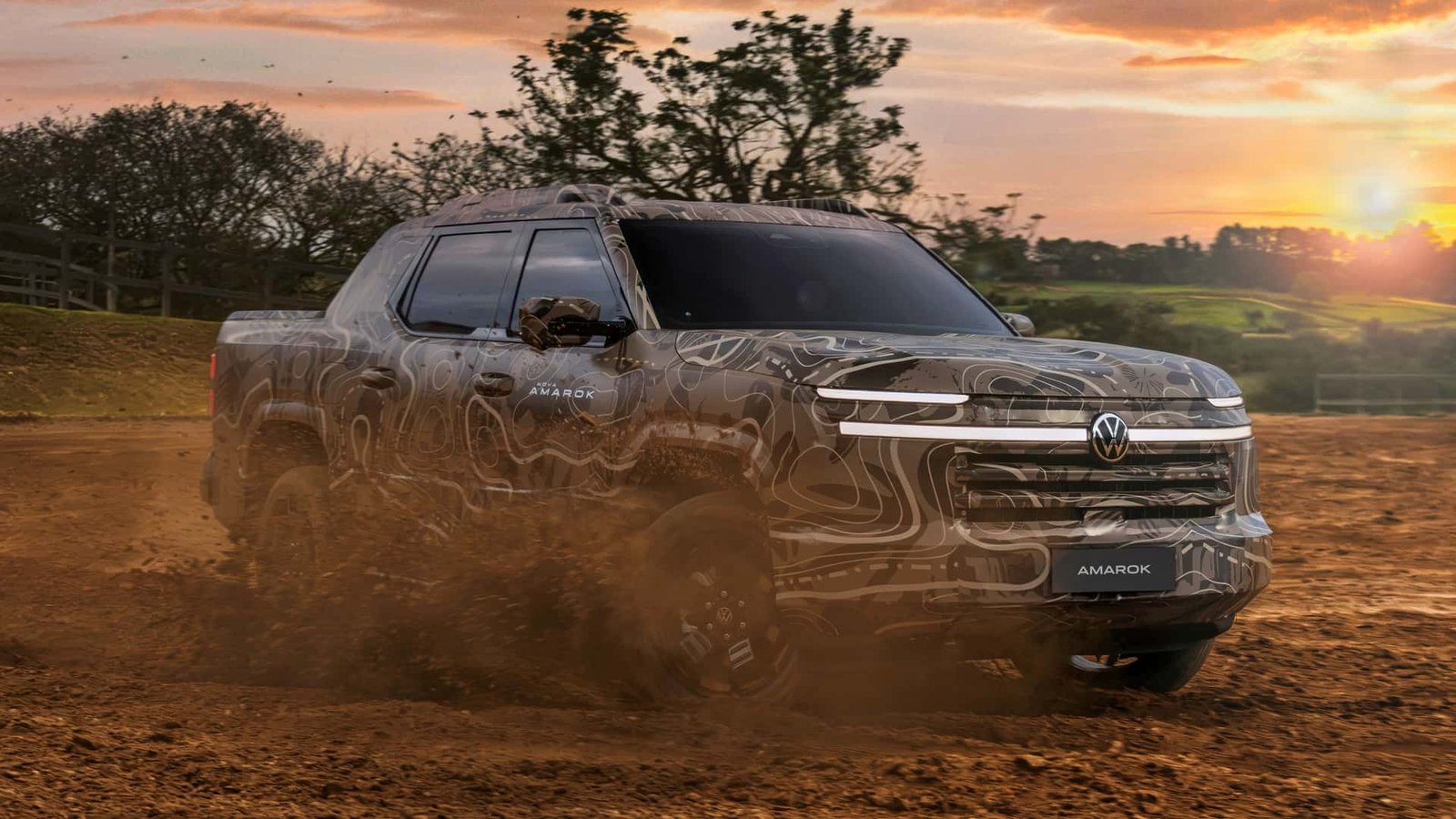
Volkswagen used the opening night of the 2026 Festa do Peão de Barretos, Brazil’s major rodeo festival, to showcase its pickup offensive in the center of the arena. Just hours after revealing the all-new Tukan, the brand officially presented the next-generation Amarok, still covered in an artistic camouflage wrap. The midsize pickup will launch in 2027 and will come from Argentina to take on the Toyota Hilux, Ford Ranger, Chevrolet S10, Mitsubishi Triton, and others.
VW shared few technical details, but it did confirm one important point: this will be the most powerful Amarok ever. The automaker also acknowledged that the new generation will be electrified, supporting earlier exclusive reporting by Motor1 Brazil on the future Amarok 800 TSI, a plug-in hybrid version expected to exceed 464 hp and deliver 590 lb-ft (800 Nm) of peak torque.
Photo by: Volkswagen
Volkswagen Kicks Off Its Pickup Offensive In Barretos
Choosing Barretos to present the Tukan and Amarok puts both products in front of an especially important audience for the segment. Brazil’s largest sertanejo country music and rodeo event also serves as one of the auto industry’s key showcases for farmers, business owners, and consumers tied to agribusiness, a sector that accounts for a significant share of pickup sales in Brazil.
The Tukan was revealed in Robust and Extreme versions, with single- and double-cab body styles, respectively. Built in São José dos Pinhais, Paraná, it will arrive in the first half of 2027 to replace the Saveiro and compete with everything from work-oriented Fiat Strada configurations to more expensive double-cab versions.
The Amarok will sit above it, keeping VW in the midsize pickup segment. The project will be built in General Pacheco, Argentina, the same plant responsible for the current generation since 2010. Units destined for the Brazilian market will continue to be imported from the neighboring country.


2027 VW Amarok camouflaged prototype
Photo by: Fábio Trindade
Amarok 800 TSI Expected To Top 464 HP
VW has not yet disclosed engine details, battery capacity, or electric driving range. The brand only confirmed that the new Amarok will combine electrification, technology, and the highest power output ever offered by the model. The information officially previewed so far, however, lines up with reports published by Motor1 Brazil in recent months.
According to an exclusive report by our Fábio Trindade, the most powerful configuration will be called the Amarok 800 TSI. The name will refer to the plug-in hybrid system’s combined 590 lb-ft (800 Nm) of torque. Output is expected to exceed 464 hp, with four-wheel drive and 0–62 mph (0-100 km/h) acceleration in under five seconds.
Those figures are far beyond the current Amarok, which uses the familiar 3.0-liter V6 turbodiesel engine. In Extreme trim, the setup delivers 254 hp and 427 lb-ft (580 Nm) of torque, paired with an eight-speed automatic transmission and permanent all-wheel drive. Despite the project’s age, performance and drivability remain among the pickup’s main strengths.
With more than 464 hp, the new Amarok should also outgun every midsize rival currently sold in Brazil. During a meeting with journalists in Peru, Alexander Seitz, executive chairman of VW South America, even compared the future pickup’s performance to that of a Porsche Panamera. At the time, the executive said the model could keep up with the sport sedan under acceleration.
SAIC Maxus Interstellar X
Photo by: Motor1 Argentina
New Generation Will Be Based On A Chinese Pickup
The statement released in Barretos does not mention the origin of the architecture used for the new Amarok. VW is focusing its presentation on the involvement of its South American design, engineering, testing, and validation departments, while also emphasizing that the pickup will retain dynamic traits associated with the German brand.
In practice, however, the new generation will be directly related to the Maxus Interstellar X, a pickup developed by China’s SAIC. Spy shots published by Motor1 Brazil have already shown prototypes with bodywork, headlights, bumpers, doors, and proportions very similar to the Asian-market model.
VW and SAIC have a long-running partnership in the Chinese market, where they have operated jointly since the 1980s. That cooperation will now allow the German automaker to reduce development time and costs by using a modern architecture designed from the outset for combustion engines, hybrid systems, and fully electric powertrains.
At the same time, VW is looking to increase its engineering input to better differentiate the Amarok from the Interstellar X. Suspension, steering, driving dynamics, electronic-system calibration, and part of the design will be tailored to South American use conditions while preserving the drivability that helped establish the current generation.
Bigger Than Today’s Amarok
The Maxus Interstellar X gives a good indication of the next Amarok’s size. The Chinese model measures approximately 216.5 inches long, 79.1 inches wide, and 73.2 inches tall, with a 129.9-inch wheelbase. By comparison, the current pickup is 210.6 inches long and has a 122.0-inch wheelbase.
The roughly 7.9-inch difference between the axles should translate mainly into more cabin space, an area where the current generation already trails newer designs. The wider body should also better accommodate three passengers in the rear seat, while increasing the feeling of space for front occupants.
The Interstellar X architecture uses a reinforced unibody structure combined with elements similar to those of a ladder frame. The solution aims to deliver car-like comfort and torsional rigidity without sacrificing the durability needed to carry up to 2,205 pounds and tackle rough terrain.
The Design Is Still Under Wraps
The first two official images show the Amarok completely camouflaged. The regional design team created the wrap, which brings together references to different South American landscapes and cultures, including Monte Fitz Roy, Iguazu Falls, the Amazon, the Nazca Lines, the Copacabana sidewalk pattern, and the Moai statues of Easter Island.
Elements tied to rural life and regional culture also appear, including boots, a hat, an ox, cacti, cordel-style artwork, and topographic lines. According to VW, some of these drawings will become “easter eggs” on the final bodywork, but their location and appearance remain secret.
Despite the camouflage, the connection to the Maxus is visible in the cabin’s general shape, the window line, and the body proportions. The front end should receive the biggest visual changes, with a redesigned grille, bumper, and lighting signature to bring the pickup closer to the identity of VW’s latest launches.
Customer Testing Across South America
As with the Tukan’s development, VW is evaluating the new Amarok in real-world use. Prototypes are running in cities, on highways, across rural properties, and on unpaved roads in several South American countries.
The program includes testing in heat, cold, altitude, and high-dust conditions. The variety of terrain is being used to calibrate the suspension, steering, cooling, sealing, and electronic systems, as well as to verify the pickup’s behavior with different loads.
This stage will be especially important in adapting the Chinese platform to the demands of the Brazilian and Argentine markets. The goal is to deliver a distinct driving character, even with structural and technological sharing with the Maxus Interstellar X.
Production Will Remain In General Pacheco
VW will invest 4 billion reais in its Argentine operations as part of a 20 billion-real program earmarked for South America through 2028. The investment includes modernization of the General Pacheco plant, assembly-line updates, and new processes required to build the electrified generation.
The facility has produced 800,000 Amaroks since 2010, making the pickup the most-produced vehicle in VW Argentina’s history. Of that total, more than 465,000 units have been exported to more than 100 markets.
The plant will continue supplying Brazil and other countries in the region when the new generation enters production. Until then, the current Amarok will remain on sale with a V6 turbodiesel engine, keeping alive for a while longer a mechanical combination that will likely lose ground to electrification in the future lineup.
Launch Confirmed For 2027
VW has not yet said when in 2027 it will begin selling the new Amarok. Versions, equipment, final dimensions, and plug-in hybrid powertrain details will be revealed gradually over the coming months.
The first appearance in Barretos does confirm the positioning chosen for the pickup. The new Amarok will be larger, electrified, and significantly more powerful, even though it starts from an architecture shared with SAIC. If the reporting on the 800 TSI is confirmed, VW will have a pickup with performance that is virtually unheard of today among midsize trucks sold in Brazil.
An Amarok SUV Is Increasingly Likely
Our colleagues at Motor1 Brazil have it on good authority that VW has also green-lit an SUV version of the new Amarok. It’s expected to feature three rows and seven seats, enabled by a massive wheelbase reportedly stretching to an unconfirmed 130 inches (3.3 meters).
Known internally as the “Atacama Project,” the SUV could borrow the Amarok’s hybrid powertrain. However, VW remains tight-lipped about the model, so its market launch likely won’t happen shortly after the new truck arrives next year.
Motor1’s Take: It’s interesting that VW will continue to sell two Amarok pickup trucks, one with Chinese roots and the other based on North American DNA. We don’t expect the two to coexist in the same country, as the replacement for the first-generation model will mostly be a Latin American affair. Elsewhere, the Amarok will soldier on as a VW-ified version of the Ford Ranger.
As long as the new one is as capable as the early signs suggest and comes at a competitive price, we don’t think its Chinese underpinnings will alienate buyers. VW is putting in the effort to differentiate it significantly from the Maxus Interstellar X, rather than simply swapping badges and calling it a day.
Read the full article here