


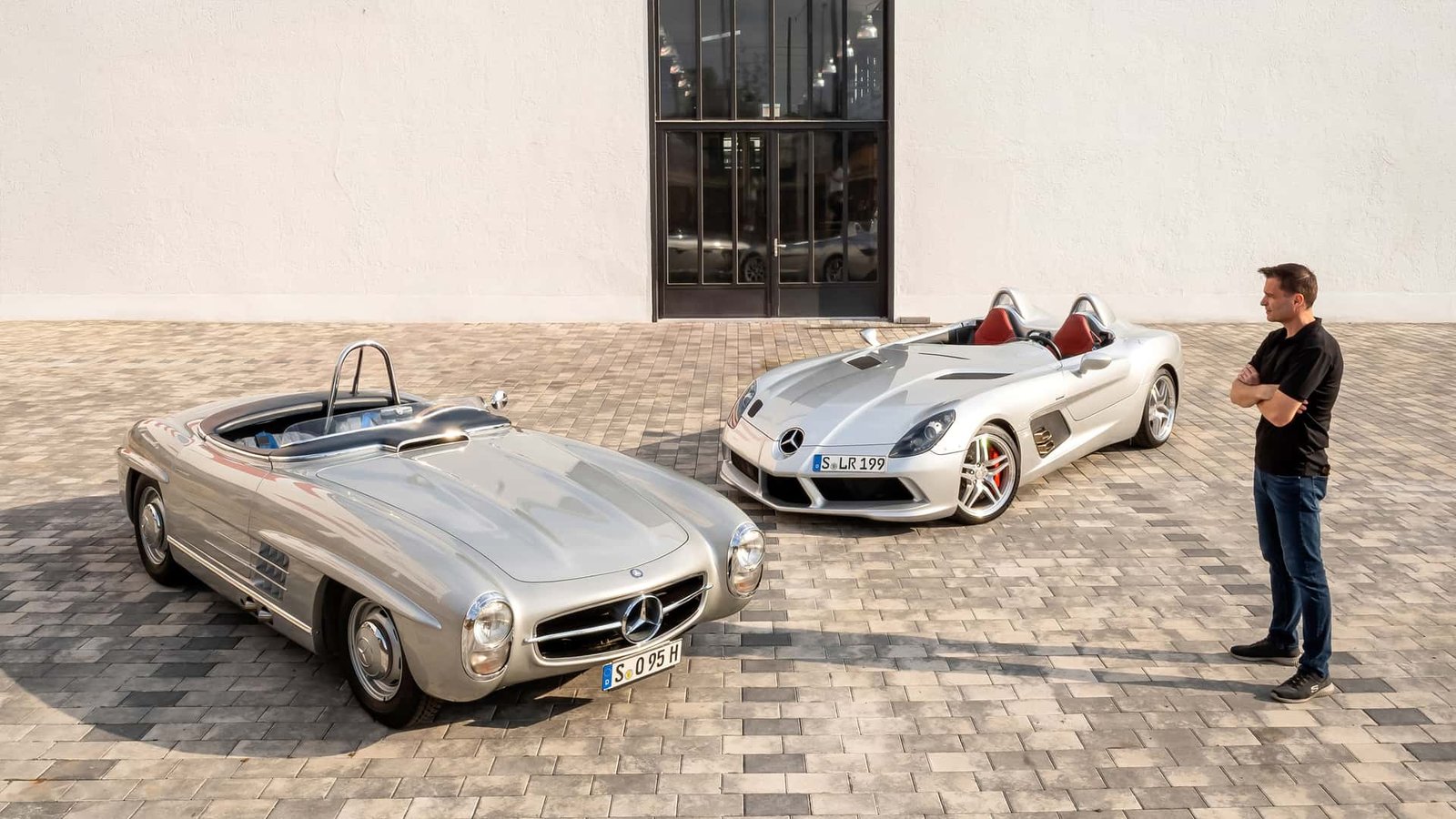
- Mercedes-Benz brought its legendary 300 SLS and SLR Stirling Moss together for a special driving experience.
- The SLR Stirling Moss is an ultra-rare, roofless supercar with 650 horsepower and only 75 examples built.
- The 300 SLS and SLR Stirling Moss showcase Mercedes’ deep connection between historic racing and modern performance.
There are some appointments you never forget as an automotive journalist. Not because of a spectacular world premiere or an especially exotic racetrack, but because two cars are suddenly sitting in front of you that you usually know only from museums, books, or old factory photos. Waiting at the Mercedes-Benz Classic Center are the 300 SLS and the SLR McLaren Stirling Moss. More than five decades separate them. And yet both tell the same story.
Even before the first engine fires up, it’s clear this day will be different. Parked between the halls of Mercedes-Benz Classic are two of the most uncompromising open-top sports cars the company has ever built. The thought of being allowed to drive them myself brings both excitement and reverence. After all, these are not ordinary classics or collector cars, but vehicles with a historical value that’s nearly impossible to quantify.
The obligatory insurance and vehicle handover paperwork is somewhat reassuring. Full coverage with no deductible removes most of the financial pressure. Even so, the feeling remains that you really do not want to make a mistake here. These cars are far more than sheetmetal and engineering. They tell motorsports history. Some components simply can’t be replaced today.
The Nearly Forgotten Predecessor
I get to start with the older of the two: the Mercedes-Benz 300 SLS. Even though many Mercedes fans barely know its name, it belongs among the most extraordinary vehicles in the brand’s history.
In 1957, Mercedes built just two examples of the open racing sports car. It was based on the then-new 300 SL Roadster. Because the Sports Car Club of America did not allow the production roadster in the desired class, Mercedes developed a no-compromise racing version. The bumpers disappeared, weight was cut wherever possible, and a small racing screen replaced the windshield. In the end, the 300 SLS weighed around 794 pounds less than the Roadster while also producing more power. Paul O’Shea used it to convincingly win the American sports car championship in D class.
Photo by: Mercedes-Benz Classic
Today, neither of those two originals is considered freely accessible. Mercedes-Benz Classic therefore built a car based on the historical records to reproduce the character of the original race car as faithfully as possible. That exact car is now sitting in front of me.
The Ultimate Time Machine
Just getting in feels like an extreme trip back in time. No driver-assistance systems. No displays. No drive modes. Just a large steering wheel, a handful of gauges, and two sport seats. The inline-six fires on the first turn of the key as if it had only been parked yesterday.


Photo by: Mercedes-Benz Classic
At a standstill, everything feels predictably rustic. The transmission is initially a bit notchy, and the steering requires a fair amount of effort. For a moment, I wonder whether that might become tiring over the next few miles. But as soon as the car is rolling, those doubts almost completely disappear.
Suddenly, the 300 SLS feels surprisingly light on its feet. The large steering wheel delivers a wonderfully direct sense of the front axle. Every small input goes straight to the road. At the same time, the car demands attention. The narrow tires set early limits on what physics will allow, and the brakes are a reminder that we’re in 1957.
Photo by: Mercedes-Benz Classic
But that is exactly what makes it so appealing. The driver works with the car. Every corner, every shift, and every braking zone must be approached deliberately. Nothing happens casually. Everything feels mechanical, honest, and immediate. Add to that the hard rush of wind directly in your face, along with everything flying through it, and that turns out to be more than you might expect…
Sound Check Passed
Almost even more impressive than the way it drives is the sound. On the right side of the car, the virtually unmuffled exhaust protrudes from the rocker panel. Even at idle, the inline-six has a deep, purposeful tone. Under acceleration, it develops into a soundtrack that has become almost foreign to modern sports cars. It gets even better when you lift off the throttle. Then the exhaust crackles and pops all on its own. What many manufacturers electronically imitate today happens here completely naturally.
Photo by: Mercedes-Benz Classic
Because you’re sitting entirely out in the open, you experience the whole spectacle unfiltered. The same goes for the smell, one many people have long since forgotten. Warm oil, unburned fuel, and hot mechanical components are constantly in the air. This must be exactly what motorsports smelled like in the 1950s. Following behind it, however, is nowhere near as enjoyable, as we learned later.
A Completely Different World, Yet Strangely Similar
The switch to the SLR McLaren Stirling Moss could hardly be greater. And at the same time, it feels surprisingly familiar. Fifty-two years of development separate these two cars. Steel gives way to carbon fiber, and a naturally aspirated inline-six gives way to a brutal supercharged V8. Output climbs from 235 to 650 horsepower.
Photo by: Mercedes-Benz Classic
But the basic idea remains strikingly similar. Two uncompromising roadsters that subordinate everything to the driving experience. No roof. No real windshield. As little ballast as possible. In return, maximum driving enjoyment. The Stirling Moss was conceived as a tribute to the legendary racing driver and his Mille Miglia victory in the Mercedes 300 SLR in 1955.
The Stirling Moss already impressed me back in 2009. At the time, it sat on auto show stands like a car from another world. I could hardly stop looking at that endlessly long hood, the side-exit exhaust pipes, and the radical roofless shape. Back then, I never would have expected that years later I would actually get to drive this car myself.
Photo by: Mercedes-Benz Classic
Just climbing in makes it clear that nothing here is ordinary. You step over the extremely wide carbon-fiber sills into the deeply mounted bucket seat. The seating position feels more like a formula race car than a road car. The steering wheel can be adjusted perfectly, even though the seat itself has only limited adjustment. There is no windshield in the traditional sense in front of you. Really, it’s just a small wind deflector.
Helmet? Better to Experience It Raw
The Mercedes-Benz Classic staff recommend wearing a helmet as a precaution. I decide against it. In hindsight, that may have been a bit brave. So sunglasses have to do the job of keeping out flies and small stones, just as they did in the 300 SLS. That direct, unfiltered experience is what makes this car so compelling in the first place.
Photo by: Mercedes-Benz Classic
One push of the start button is enough, and the supercharged V8 wakes up with a deep snarl. The exhaust pipes jutting out from the side sills remain one of the most beautiful details of this car. They look like a design object, while at the same time making it unmistakably clear what is about to happen.
A Real Character
From the first few yards, the SLR demands concentration. The steering is extremely direct and surprisingly heavy. The suspension offers very little compliance. Even so, nothing feels nervous. Everything feels precise and high-quality. You sit low, almost level with the rear axle, while the giant hood seems to stretch all the way to the horizon. When maneuvering, there’s no camera and no parking sensors to help. At that point, I’m definitely glad to have a helpful Mercedes employee standing by as a spotter.
Photo by: Mercedes-Benz Classic
In normal city traffic, the Stirling Moss then reveals a completely different side. In automatic mode, it drives almost politely. You could almost forget that 650 horsepower is waiting under the long hood. Only when you press the accelerator more decisively does the supercharger return with its unmistakable voice.
But the real magic begins on open roads. A pull on the left paddle, down two gears, and full throttle. First you hear the whirring shriek of the supercharger building boost without any delay. A brief moment later, the V8 takes center stage. What then pours out of the side pipes is hard to describe.
Photo by: Mercedes-Benz Classic
It’s not a deep rumble, but a metallic, bright roar that grows more intense as the revs climb. Every tunnel suddenly becomes a stage. Every load change becomes a small concert. You catch yourself repeating the same acceleration run again and again, sometimes encouraged by enthusiastic onlookers in a Mercedes-Benz Sprinter in the right lane.
Two Icons, Side by Side
This is exactly where it becomes clear why both cars feel so similar despite the age gap. Both engage all the senses. The 300 SLS thrills with smell, vibrations, and raw mechanical honesty. The Stirling Moss adds seemingly limitless power and modern handling to that mix. Neither car tries to isolate its driver. On the contrary, both pull you right into the middle of the action.
Photo by: Mercedes-Benz Classic
Maybe that is the greatest compliment you can pay these two Mercedes models. Despite their historical significance, they do not feel like museum pieces. They want to be driven. That is exactly what they were built for. You feel it in every corner, every shift, and every hard push of the accelerator.
For me, this day was much more than a test drive in two extraordinary automobiles. It was a journey through two eras of Mercedes sports car history. The 300 SLS shows how uncompromisingly the brand was already thinking in the 1950s. The SLR McLaren Stirling Moss translates that philosophy into the 21st century more radically than almost any other production vehicle.
Photo by: Mercedes-Benz Classic
During our drives around the Stuttgart area, the original home turf of these cars, the reaction from passersby—many of them clearly knowledgeable and perhaps a bit spoiled—was nothing but open enthusiasm. When Mercedes-Benz Classic brings out treasures like these, smartphone cameras naturally go into overdrive.
As I hand back both keys at the end of the day, what remains above all is gratitude. Gratitude that Mercedes-Benz Classic not only preserves these automobiles, but also exercises them regularly. History does not live behind velvet ropes. It only truly comes alive when a large Bakelite steering wheel starts to turn, an inline-six smells of hot oil, or a supercharged V8 charges toward the rev limiter at full force. It’s hard to get much closer to the soul of a brand than that.
Motor1’s Take: The pairing of the 300 SLS and SLR Stirling Moss is a great reminder of how Mercedes-Benz has turned its racing heritage into some truly special road cars. The SLR Stirling Moss remains one of the brand’s most extreme creations, combining a supercharged 650-horsepower V8 with an almost completely open driving experience. Its rarity and multimillion-dollar value make it far more than just a fast car. Together, these two machines show how strongly the spirit of the legendary 300 SLR still influences Mercedes’ most exclusive performance cars.
Read the full article here