



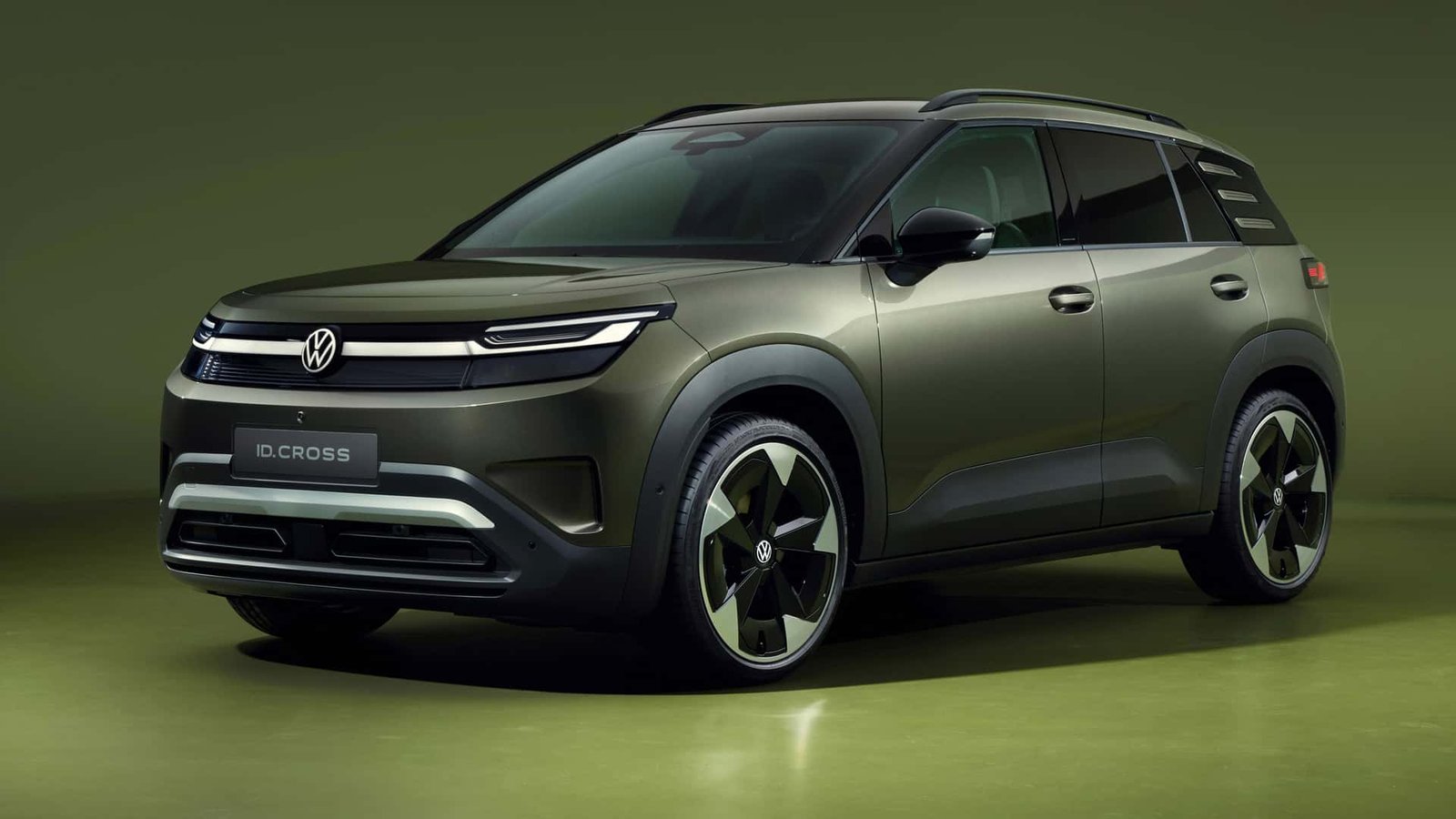
- The ID. Cross is essentially an SUV version of the electric Polo supermini.
- VW will offer two battery options: 37 kWh and 52 kWh.
- Customers can pick from three power levels: 114 hp, 133 hp, and 208 hp.
It’s been less than a year since Volkswagen previewed the ID. Cross, and now the concept has evolved into a production model. Positioned below the ID.4, the subcompact electric crossover is cut from the same cloth as the new ID. Polo supermini, riding on the same MEB+ platform with a front-wheel-drive layout. It was developed from the ground up as an EV and therefore has no ties to the similarly sized T-Cross powered by combustion engines.
At 163.5 inches (4153 millimeters) long, 77.7 inches (1974 millimeters) wide, and 62.2 inches (1581 millimeters) tall, the ID. Cross slots neatly into Europe’s subcompact segment. Even though it’s a small crossover, nicer versions can be had with wheels as large as 20 inches while the base model gets a 17-inch set as standard.
Thanks to the EV underpinnings, VW’s engineers were able to stretch the wheelbase to 102.4 inches (2601 millimeters), or 1.5 inches (38 millimeters) more than the T-Cross. Another benefit of the dedicated EV architecture is the front trunk, which can hold up to 25 liters (nearly 0.9 cubic feet).
Photo by: Volkswagen
Compared with the conventionally powered T-Cross, the new ID. Cross also offers a larger rear cargo area, with 475 liters (16.7 cubic feet) of capacity, or 25 liters (0.9 cubic feet) more than the ICE model. Of course, the biggest advantage of the MEB+ platform is interior space, with VW saying the cabin offers extra room in length, width, and height.
Given how recent the concept is, the ID. Cross’ appearance comes as no surprise. VW has introduced a new design language dubbed “Pure Positive,” featuring cleaner lines and light bars at both ends. As opposed to the ID. Polo, where the rear door handles are “tucked away” in the C-pillars, its high-riding counterpart has them in the usual place. It’s a design choice that will be appreciated by those who prefer a symmetrical look from front to rear.


Photo by: Volkswagen
Buttons Are Back, Baby
Everything we liked about the ID. Polo’s interior is thankfully found in the ID. Cross as well. VW is bringing back physical buttons and ditching the touch slider. There are four window switches on the driver’s door, a volume knob between the seats, and conventional buttons on the steering wheel. The 12.9-inch infotainment screen isn’t overly large and is paired with a 10.25-inch digital instrument cluster featuring retro graphics inspired by the original Golf.
The row of buttons below the central screen provides quick access to frequently used functions, including temperature control, fan speed, air conditioning on/off, automatic climate control, air recirculation, the windshield defroster, the rear window heater, and the hazard lights. As with the electric Polo, the ID. Cross offers some surprisingly upscale features, including 12-way power-adjustable front seats with massage and memory functions. Higher-end versions also get a 425-watt, 10-speaker Harman Kardon sound system with a subwoofer.
Predictably, the ID. Cross uses the same batteries as its hatchback sibling. Customers can choose between 37- and 52-kWh packs, offering WLTP ranges of 196 miles (316 kilometers) and 271 miles (436 kilometers), respectively. The smaller battery is a lithium-iron-phosphate (LFP) pack that supports charging at up to 90 kW, while the larger nickel-manganese-cobalt (NMC) battery can charge at up to 105 kW. Both take about 23 to 24 minutes to recharge from 10 to 80 percent.
The front wheels are driven by an electric motor available in three output levels: 114 hp, 133 hp, and 208 hp. For now, VW isn’t saying whether the ID. Cross will also receive the ID. Polo GTI’s more potent 223-hp motor. We do know the electric SUV weighs as little as 3,393 pounds (1,539 kilograms) with the smaller battery and 3,413 pounds (1,548 kilograms) with the larger pack, with both figures excluding the driver.
The VW ID. Cross goes on sale this fall in Europe and starts at around €28,000 in Germany. It significantly undercuts the base ID.4, which is available in its home market for a much higher €46,765. The recently facelifted ID.3 Neo hatchback slots between the two, at €33,995.
42
Source: Volkswagen
Read the full article here