



The Anaheim Ducks are about to embark on a journey into waters uncharted for the better part of a decade for their franchise: the Stanley Cup Playoffs. For their first series in eight years, they didn’t do themselves any favors, backing into third place in the Pacific Division, after holding a five-point lead with ten games to go.
They will now be in the crosshairs of a juggernaut club with Stanley Cup aspirations that represented the Western Conference in each of the last two Stanley Cup Finals. They’ll have to defeat Connor McDavid, Leon Draisaitl, and the Edmonton Oilers four times in the next seven games if they’re to continue playing hockey this spring.
Advertisement
Can Ducks Beat Oilers? Yes, If They Keep Things Simple
Five Storylines for the Anaheim Ducks First Round Series vs the Edmonton Oilers
For the Ducks to escape this series with four wins, head coach Joel Quenneville will have to be on the winning side of (at least) three specific matchups:
Kiyoshi Mio-Imagn Images
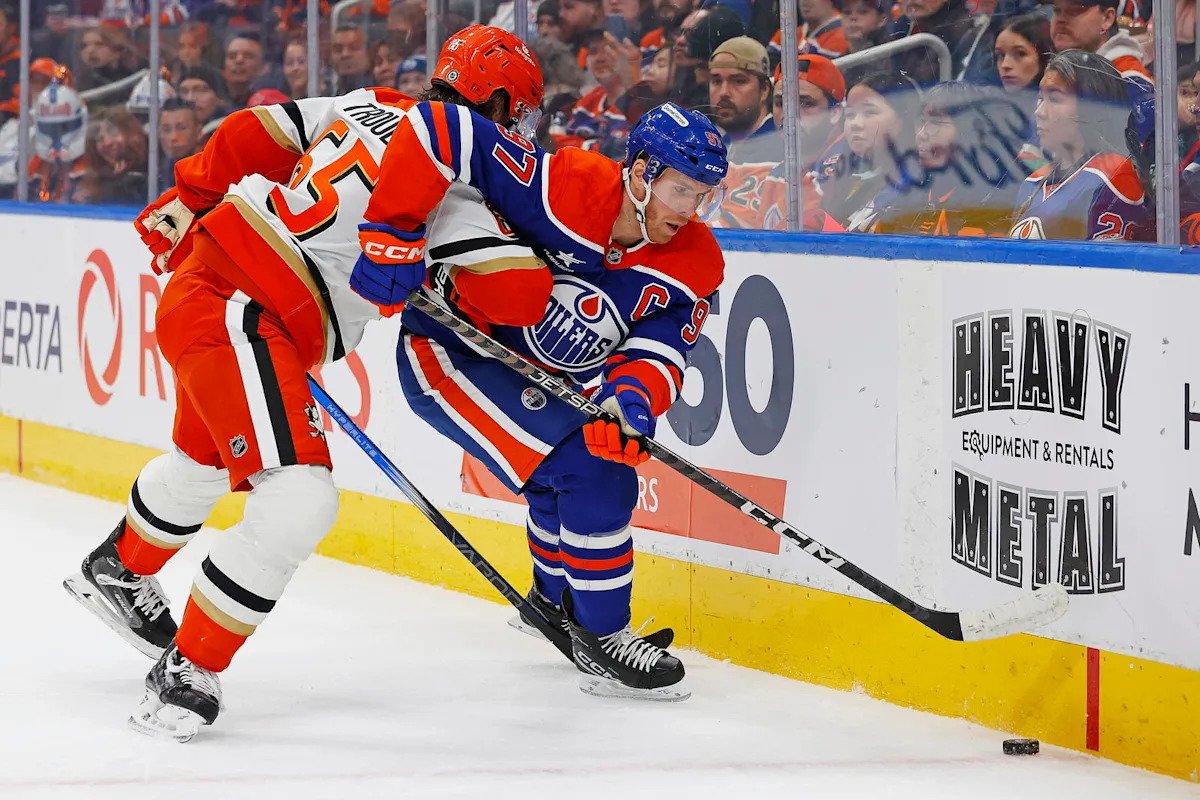
Quenneville typically doesn’t elect to hard-match a forward line against an opposing top line. When called for, he has instead deployed his top pair (LaCombe-Trouba) against an opposing top line or player.
Shutting down Connor McDavid is a fool’s errand, as one can only hope to contain the greatest offensive player to ever lace up a pair of skates. It will be a five-man effort, over the entire 200-foot sheet, to deny him pucks as much as possible and minimize his ability to gain speed.
Advertisement
By the time McDavid has the puck in LaCombe and/or Trouba’s vicinity, it would benefit their focus to be on, to the best of their abilities, keeping him away from the middle of the ice with clever angles and maintaining steady gaps, not committing too much or allowing too much ice between.
Smart and quick sticks to influence, take lanes away, and disrupt shot or pass attempts will be key when LaCombe or Trouba is engaged with McDavid. In plain terms, they have to be perfect.
“You don’t want to play run-and-gun hockey with this team,” Trouba said. “They got a lot of high talented offensive players. Defending is going to be a key part for us in the series.”
Against the San Jose Sharks on home ice, Quenneville deployed center Ryan Poehling against Macklin Celebrini, notching a rare pointless night for the phenomenal Sharks sophomore. That’s a card Quenneville can play should he see fit, when the series returns to Honda Center for game three.
Advertisement
Then, of course, even if the Ducks successfully contain McDavid, Leon Draisaitl will be waiting in the wings to pick up any slack left behind by #97. One shudders to speculate on what McDavid can accomplish given how motivated and determined he will be heading into these playoffs, following back-to-back Stanley Cup finals losses and losing in the 2026 Olympic gold medal game.
“The regular season has become a little bit monotonous for this group,” McDavid said. “I think you see that through the day-to-day. But this is what we get excited for.”

Gary A. Vasquez-Imagn Images
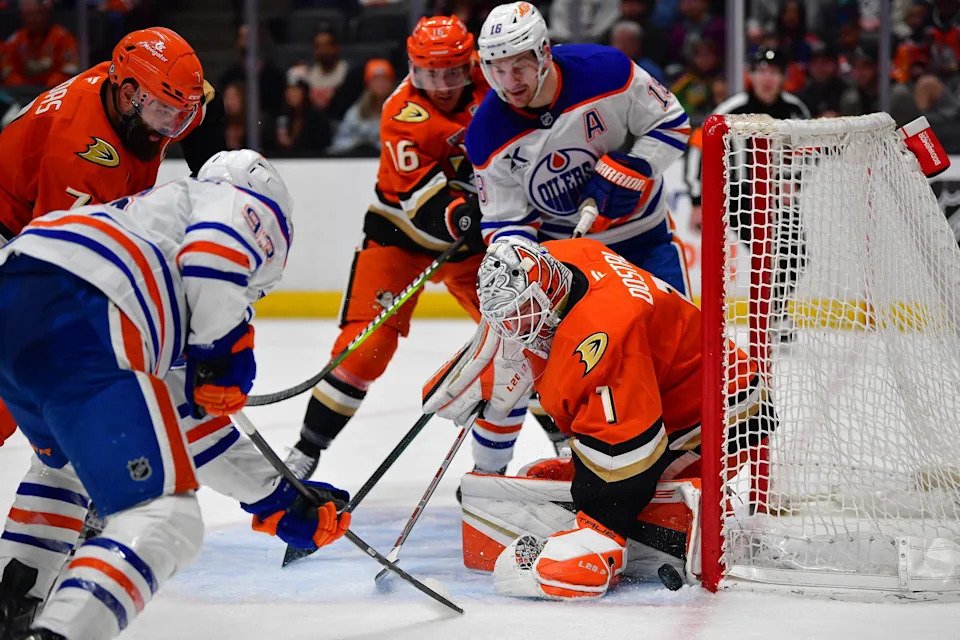
If there’s an “x-factor” in this series for the Ducks, it will be goaltender Lukas Dostal. Though numbers would suggest his season was unspectacular and his play faltered toward the end of the regular season, the Ducks simply would not be where they are, in the playoffs for the first time since 2018, had it not been for Dostal’s heroics earlier in the season.
Advertisement
With a new coach, a new defensive system was implemented. That new system, compounded with a lack of overall defensive talent and habits on the Ducks’ roster, gave way to one of the worst environments in the NHL for a goaltender.
On a nightly basis, the Ducks were allowing a variety of high-danger chances to their opponents, whether those chances were born from poor pinches in the offensive zone, poor backchecking effort, poor backchecking technique, d-zone coverage lapses, lost net-front battles, etc.
Dostal made more saves and more difficult saves than should have been required, kept the Ducks in more games than they deserved, allowing them to “outscore their problems,” and get needed wins to achieve their goal of making the playoffs.
“It’s a different experience,” Dostal said. “I’ve had a chance to play in big games before, but this is a little different because you get to play the same team on multiple occasions. You’re going to try to expose them. They’re going to try to expose you. It’s going to be a fun experience.”
Advertisement
He’s traditionally performed his best when the lights are brightest, whether that be the Olympics, World Championships, or World Juniors. This will be a completely different challenge for Dostal, playing in the Stanley Cup playoffs against two of the most potent offensive centers in this generation (McDavid and Draisaitl), a Norris-caliber offensive defenseman (Evan Bouchard), and one of the deepest teams the Oilers’ front office has surrounded them with in their cup-contending era.
Gary A. Vasquez-Imagn Images
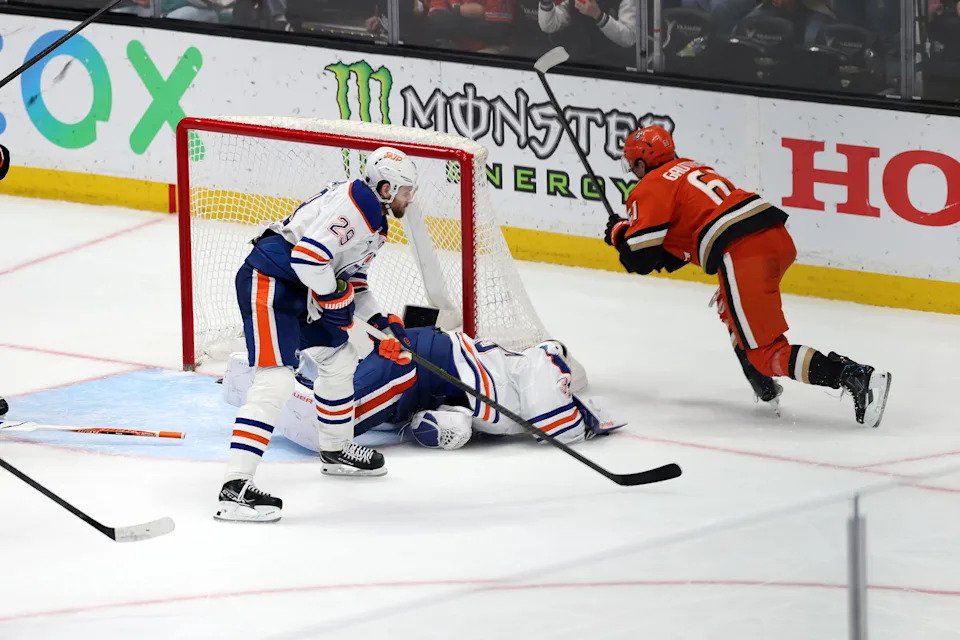
The instinct would be to fixate on the Oilers’ power play and how to contain, neutralize, or limit it. However, Edmonton’s power play is such a well-oiled (pun intended) machine that seems to be firing on all cylinders every spring. In their last three playoff runs, the Oilers have converted on 31.6% of the power play opportunities, and in the 2025-26 regular season, they were the NHL’s best, converting at 30.6%.
Advertisement
Edmonton’s power play is going to score, and probably score a lot. Their penalty kill, however, is an area the Ducks will need to exploit in order to put goals back on the board. In the 2025-26 regular season, Edmonton’s penalty kill was successful 77.8% of the time, good enough for 20th in the NHL. Their underlying numbers reflect similarly, as their 9.57 expected goals allowed per 60 minutes ranked 24th in the NHL.
Over their last three postseason appearances, the Oilers PK has killed 79.5% of penalties taken. That number is roughly league-average annually. However, how they got to that total could give pause, as in the 2022-23 playoffs, they killed 34 of 45 (75.5%), in the 2024-25 playoffs, they killed 66 of 70 (94.3%), and last year, they killed just 47 of 70 (67.1%). To call their PK “inconsistent” would be an understatement.
Despite having plentiful talent and a potent 5v5 offense, Anaheim’s power play didn’t convert at an encouraging rate this season, despite a quality process at times and generating roughly league-average underlying numbers.
The Ducks 18.6% conversion rate on the power play was good enough to rank 23rd in the NHL and was their best since the 2021-22 season (21.9%). They generated 8.68 expected goals per 60, ranking 18th of the 32 teams in the NHL.
Advertisement
Anaheim has the talent and has shown flashes of deploying a lethal power play, but have inexplicably been unable to put the pieces together. They’ll have to figure it out quickly, as a few extra power play goals could be the difference in a playoff series like this one.
This series will be the last to begin and will see the first puck drop at 7 PM PST in Edmonton, Alberta.
How Ducks GM Pat Verbeek Built Roster with Playoffs in Mind
Ducks to Face Oilers in Round One of 2026 Stanley Cup Playoffs
Ducks Extend Gulls Head Coach Matt McIlvane
Anaheim Ducks Clinch Playoffs for First Time in Eight Years
Read the full article here