

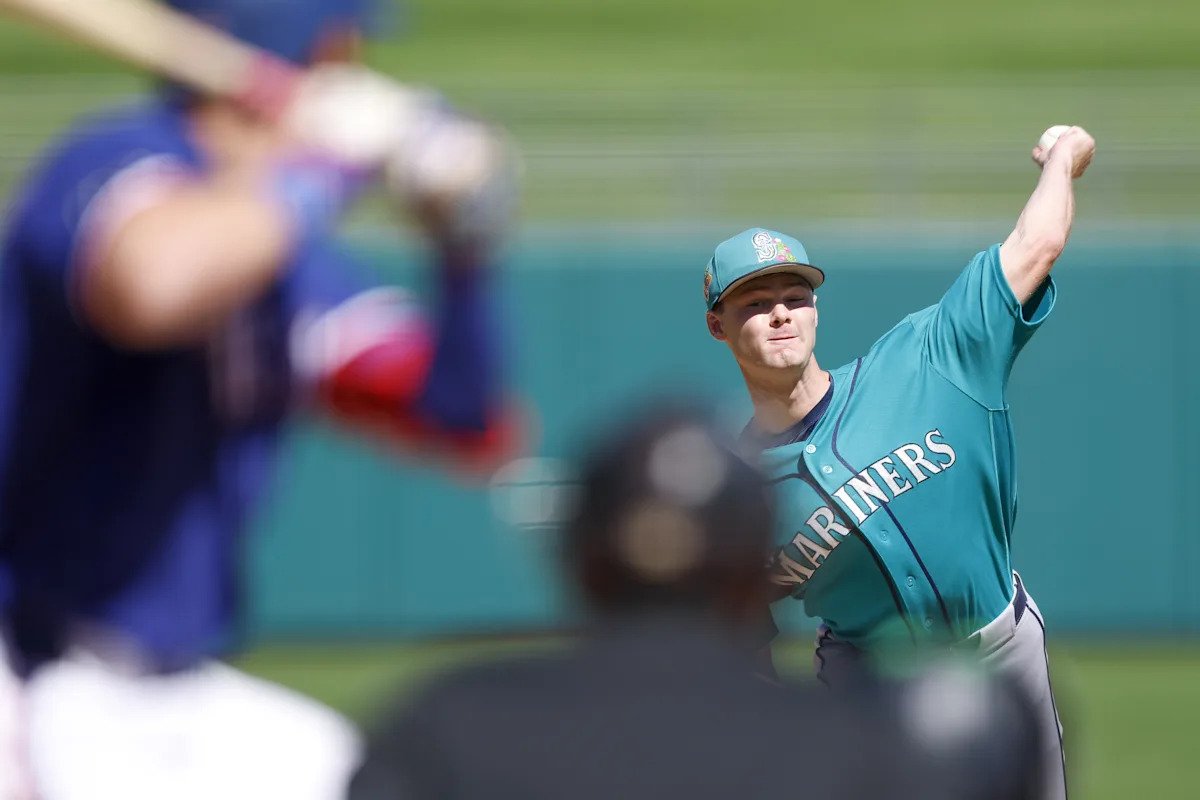
Afforded the third overall pick in last year’s draft, the Seattle Mariners entered draft day with long odds of selecting Kade Anderson. The player many considered the best of the 2025 talent pool, Anderson was undoubtedly the best pitcher in college baseball last year and dominated opposing hitters all season long. In one of the more shocking draft day happenings of recent memory, both the Washington Nationals and Los Angeles Angels passed on Anderson in favor of money saving options, sliding the left hander down to the number three spot for the Mariners to capitalize and secure a premium talent. A series of incredibly unlikely events needed to occur in order for Anderson to end up in the PNW, but fortunately for Mariners fans, that improbability became reality.
Anderson possesses a level of polish most 21 year olds will never have on the mound, defining his success as a pitcher through deception, pitchability, and tunneling. His fastball, typically sitting around 93-94 mph, gets solid carry through the zone and is a perfectly fine offering, though its primary utility is to set up his excellent secondary offerings. His changeup kills velocity well and gets good fade to his arm side, serving as a weapon he can deploy against righties to get swing and miss. His slider, a sweeping breaker that’s in the mid to upper 80’s, is hellish on lefties and is probably his best overall pitch considering its raw metrics. Finally, Anderson has a curveball at his disposal, a pitch he can both bury for whiffs or sneak in early to steal a strike. The velocity isn’t going to jump off the page, but it’s enticing stuff nonetheless.
Advertisement
Raw “stuff plus” models anyone can seemingly screenshot and share are probably not going to like Anderson very much, but these numbers lack full context of what makes a pitcher good, and punishing a player that’s done nothing but dominate because of that would be foolish. How an arsenal works together, how deceptively it’s deployed, and where these offerings are located are just a few of the many factors that raw “stuff” models don’t account for, and they’re a big part of why Anderson is so dominant on the mound. Models can be helpful tools, but it doesn’t make them gospel.
Plus command with above average stuff from the left side is always going to play, and he’s proven that thus far in his brief introduction to professional baseball. Over his first two games for Double-A Arkansas, Anderson has pitched to a line of 9 IP/ 5 H/ 0 ER/ 17 K/ 3 BB, a truly ridiculous start to a career at a level where he’s ~3.5 years younger than the average player. Having already been the best pitcher in the SEC for a full season and now mowing through the Texas League, perhaps the likelihood we see a 2026 major league debut for Mr. Anderson is far more likely than it was six months ago. The organization doesn’t have to (nor should they) rush him to the majors, but if he forces their hand, Anderson would provide the team yet another home grown arm that could contribute to this team’s success for years to come.
Read the full article here