

- The Santa Fe EREV will have a driving range of more than 600 miles (965 kilometers).
- Genesis is targeting an even higher range of more than 640 miles (1,030 kilometers) for its first extended-range electric vehicle.
- These EREVs will achieve their long driving ranges with less than half the battery capacity of an equivalent EV.
The biggest news to emerge from Hyundai’s CEO Investor Day is the surprise announcement of a new series of cheaper performance cars. However, a few other slides in the mammoth 101-page presentation caught our attention. The Korean brand is about to dip its toes into the extended-range electric vehicle segment with two models, one for the core brand and the other for its luxury spin-off, Genesis.
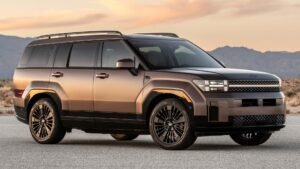
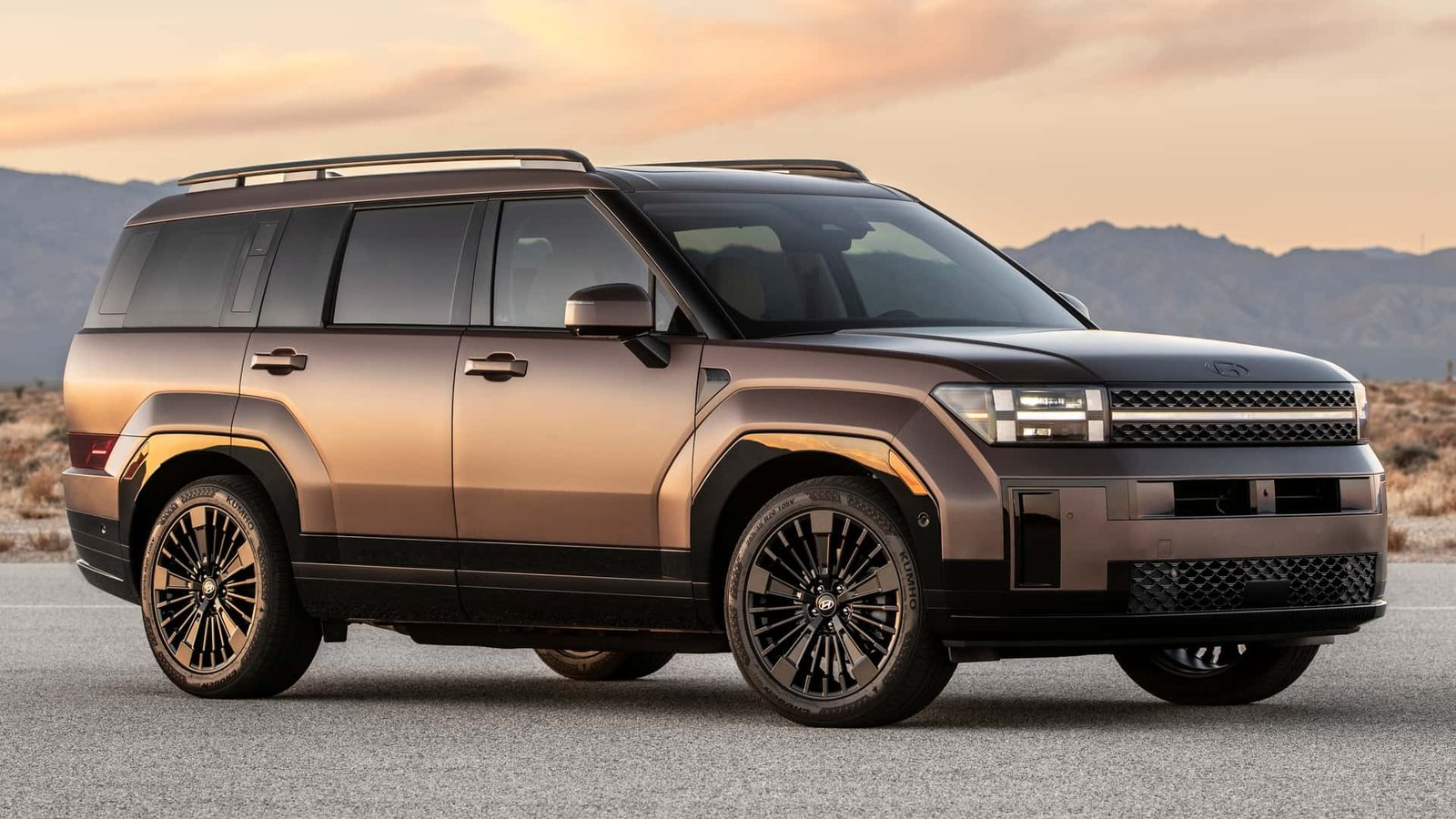
The Santa Fe will get the EREV treatment in the United States in the first half of 2027. It’ll be assembled starting early next year alongside regular versions of the midsize SUV at the Alabama plant. Until it arrives, Hyundai is sharing some preliminary technical details. The headline-grabbing figure is a driving range of more than 600 miles (965 kilometers), which the company says is about 1.6 times higher than that of a conventionally powered version.
Developed in-house, the battery will have half the capacity of what a fully electric Santa Fe would have if Hyundai built one. That suggests the weight penalty won’t be nearly as severe. Combined with a generous range, it makes a compelling case for EREVs, especially in a vehicle as large as the SUV. Range anxiety in an equivalent EV would be a concern in areas with underdeveloped charging infrastructure, so having a gas engine as a backup should alleviate those concerns.
Photo by: Hyundai
Two Electric Motors, Likely AWD
We also know that it will have two electric motors, presumably one at each axle for an all-wheel-drive setup. The unspecified combustion engine is unlikely to drive the wheels, as it typically serves as a generator in EREVs to produce energy and charge the battery without having a mechanical connection to the wheels.
That’s probably what the Santa Fe is getting, considering Hyundai says the dual-motor setup will deliver an “EV-like driving experience and acceleration.” The fifth-generation Santa Fe has been around for about three years, so we won’t be surprised if the EREV version is based on a mid-cycle facelift.

Photo by: Hyundai
EREV Tech Coming To Other Models
The technology won’t be limited to the Santa Fe, as Hyundai plans to launch extended-range electric vehicles across all market segments. The recently launched Ioniq V (yes, with a numeral) is also getting an EREV version in China, where a compact crossover with the same type of powertrain will follow next year.
Photo by: Genesis
Genesis EREV Incoming
Genesis is also getting in on the EREV action shortly after launching its first hybrid, the GV80 Hybrid. The teaser image released today also suggests the extended-range electric vehicle is based on the GV80.
It’s going into production early next year with an “all-new high-performance battery” delivering even more range than the Santa Fe EREV. It’ll go more than 640 miles (1,030 kilometers) on a single tank of gas and a battery charge.
Photo by: Hyundai
Motor1’s Take: Hyundai’s decision to embrace EREVs makes a lot of sense, particularly for larger SUVs. A relatively small battery can provide the instant response and smoothness of an EV without the enormous battery pack needed to deliver a comparable driving range. For buyers who aren’t ready to give up gasoline entirely, it also eliminates much of the range anxiety associated with a pure EV.
The big question is whether the real-world benefits will justify the added complexity of combining an electric drivetrain, a battery, and a combustion engine. If Hyundai can deliver more than 600 miles of range while keeping weight, pricing, and efficiency in check, the Santa Fe EREV could make a strong case for this middle-ground approach. Genesis going even further with its 640-plus-mile range suggests Hyundai sees plenty of potential in the technology.
Read the full article here