


Before Tuesday’s game against the Yankees, Sam Kennedy joined Tom Caron on the NESN pregame show and gave us the following answer when asked about the team’s lack of power:
“We gotta start hitting the ball out of the ballpark. I think a lot of guys are gonna start to heat up. I was actually talking to folks from the other side, and they said after this cold weather you’re gonna see a lot more home runs. They hit a lot of home runs last week when it was 80 degrees in New York City. So let’s get a little home cooking, a little warm weather, and hopefully we get going.”
Moments later, the game began with a first pitch temperature of 47 degrees, and in the top of the second inning, Giancarlo Stanton did this:
Advertisement
View Link
It’s a good thing it wasn’t 80 degrees, right Sam? Otherwise that ball might have gone 500 feet. Really dodged a bullet on that one!
See, the problem isn’t just that the Red Sox don’t hit the ball out of the park when it’s cold, it’s that they don’t do anything well when it’s cold! If it’s so hard to hit for power when the mercury is low, why is Garrett Crochet giving up bombs to the Tigers? Or going back to the previous homestand, why was the defense throwing the ball all over the place against the Padres in the cold? This isn’t a reflection on the bad weather. It’s a reflection of how the Red Sox play in bad weather.
Here’s the reality: Is it harder to hit home runs in cold weather? Yes. But it’s also harder to pitch, field, grip the ball, maintain focus and get warmed up. The only way it becomes easier to do these things is if your opponent is soft and bothered by these conditions. And guess what? The Red Sox are that opponent.
Advertisement
Over the last three seasons, Boston is now 7-17 in the 24 games they’ve played with a first pitch temperature at 50 degrees or below (with one exception, which we’ll get to in a moment). That’s an abysmal .292 wining percentage, and would extrapolate out to a 47-115 record over a 162 game season.
But the play in cooler conditions isn’t just bad overall, it’s specifically getting worse by the year. So far in 2026, the Sox are sporting a vile 2-8 record in these circumstances. Here’s how it breaks down in detail over the last three seasons:
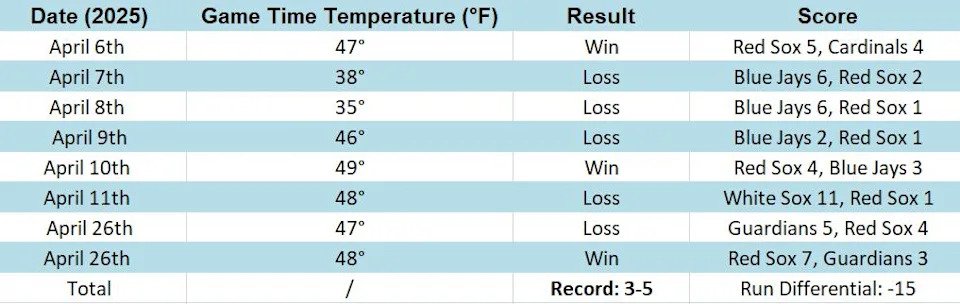
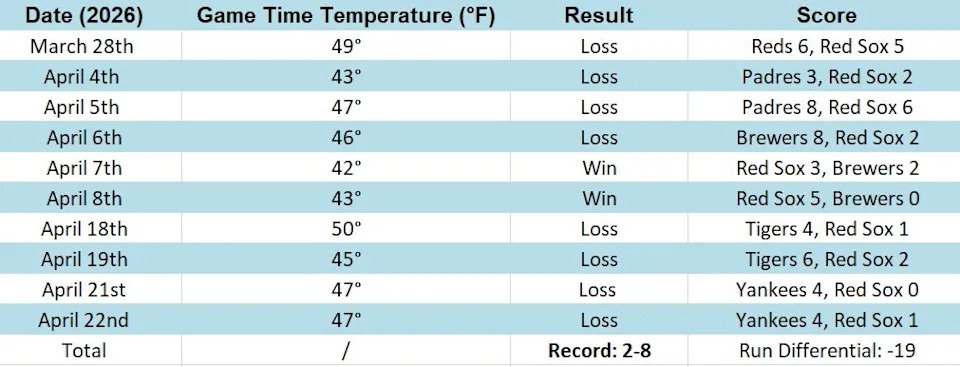
(Eagle eyed readers might notice I’m actually missing a game from the 2026 sample, and that’s the exception I mentioned above. Technically, the Marathon Monday match up belongs on this list with a first pitch temperature of 47 degrees, but I removed it because with the 11am start time, temperatures were actually rising through the 50s as the game progressed. In other words, it’s not comparable to your 1:30pm afternoon starts where the first pitch temperature will be close to the high for the day; and it’s the exact opposite of your evening April starts where it will keep getting colder as the game goes on. So for the spirit of this exercise, I dropped it from the analysis.)
Advertisement
There are two schools of thought you can take from the tables above: One is it doesn’t really matter as once you get beyond April, you just don’t see many more of these games. (Even October averages a full six degrees warmer than April in Boston.)
The other perspective? The cold weather data provides an early window into the team’s “give a damn” meter. In a sport where everything has to be at least partially tailored to surviving the grueling season, it would be so, so easy for any player to get in these conditions, conclude “yeah, this sucks!” and let go of the rope mentally for the evening knowing they’ve got 150 more games to iron things out.
This is where I’d like to bring everybody’s attention to the April 7th through April 10th games in the 2025 table above. That was a four game series at frigid Fenway against Toronto. And despite coming in as a dome team, the Blue Jays nearly swept the Sox. This is even more impressive when you consider that the Red Sox were really solid at Fenway in 2025, going an imposing 48-33. But it was Toronto who proved better at dealing with adversity from Mother Nature in Boston — and this is of course noteworthy because the Blue Jays ended up going all the way to Game 7 of the World Series. Perhaps that series in Fenway was just a little glimpse into their DNA, and a harbinger of what was to come.
Meanwhile, here was Alex Cora’s quote from the middle of that series explaining why his pitchers didn’t throw well in the first two games.
“I went out to the mound twice and I felt it. It was windy too. In the dugout it was OK, but then you go out there and it’s tough,”
Need more evidence about the barometer that is Fenway Park in April and its relationship to the season as a whole? Let’s look at the Red Sox record through 30 games in their four most recent World Series championship seasons:
Advertisement
2004: 19-11
2007: 20-10
2013: 20-10
2018: 22-8
I won’t overwhelm you with more tables about specific games, but the pattern here is overwhelmingly clear. When the Red Sox win the World Series, they come storming out of the gate despite dealing with the Fenway’s early chill. All four of these teams posted a higher winning percentage in their first 30 games than they did over the 162 game season, and I think that’s at least in part due to the fact that they were just more ready to go than their opponents. So when that hideous east wind kicked up off the Gulf of Maine and made conditions miserable at Fenway, they were more adept to deal with it, and it turned into an advantage.
Advertisement
(Funny how that happened in the era where the team appeared more championship driven and less profit driven, private equity driven, and return on investment driven. It’s almost as if the culture trickles from the top down.)
Lastly, I think it’s worth discussing what makes Fenway’s early season cold unique and why it may provide a better litmus test of which teams have the most moxie compared to pretty much any other location. Sure, it’s a northern city, which is probably the first direction that comes to mind when thinking about cold air, but what really separates Fenway in this conversation from all the other ballparks is that it’s so far to the east. This means it both sticks out into the ocean, and is on the front lines when the wind has any inkling of blowing off it. Just take a look at the temperatures yesterday when the wind was out of the south and notice how New England is the only area in the northeast and Great Lakes that didn’t benefit from that.
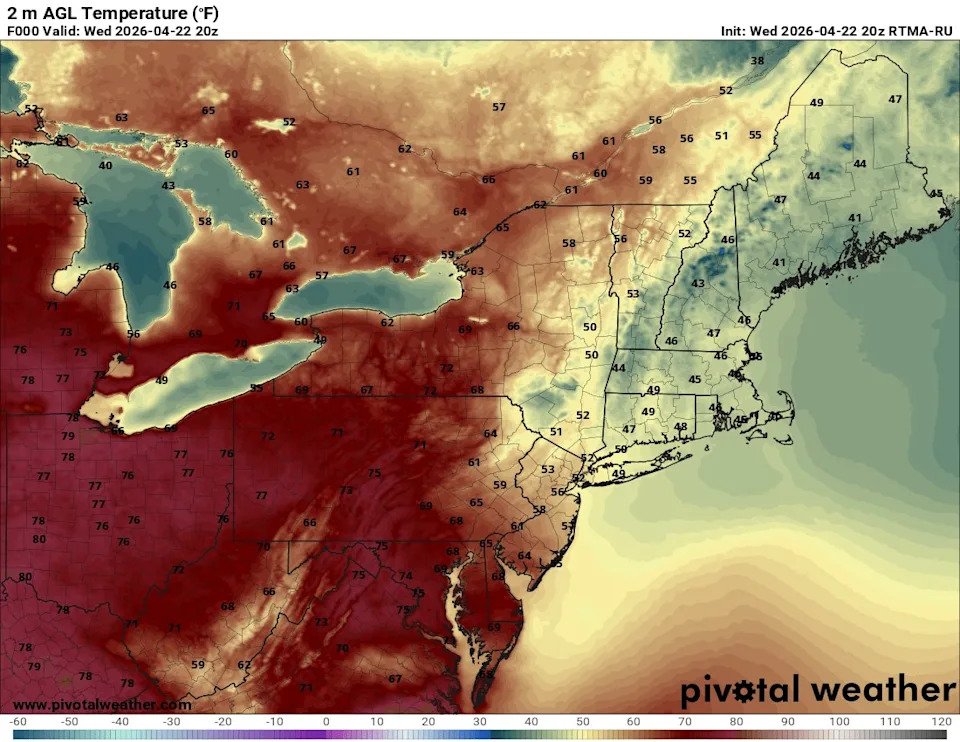
But the connections between Fenway, April, and cold ocean water run much deeper than you might ever imagine. The park opened in April of 1912, the same week the Titanic sank in icebergf waters — But perhaps even more amazing; the Titanic wreck site is on a latitude line located slightly SOUTH of Boston (41°43 N compared to Fenway’s 42°34 N).
Advertisement
As it turns out, that same Labrador Current that comes down from the Arctic and sends icebergs down the east side of Canada’s waters ends up turning west before flowing in the Gulf of Maine, where it waits for the chance to blow into Fenway Park before things warm up later in spring.
Even to this day you can look at a sea surface temperature map and see how this plays out:
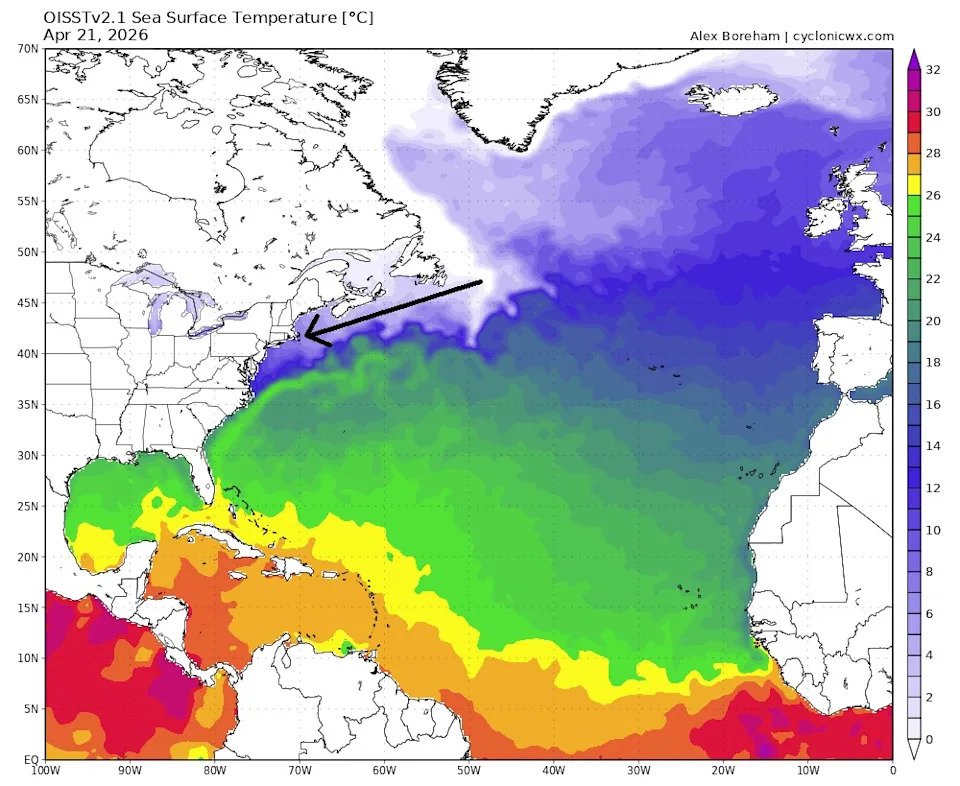
The is all a long way of saying that the uniqueness of this phenomenon should be an advantage for the Red Sox! Sam Kennedy spoke about how it was already 80 degrees in New York for the Yankees for a few games this season, and that’s just not going to happen very often for the Red Sox in April. Instead, this period should be used each year as an opportunity for the guys to get close, learn to play for each other, and tough it out for the betterment of the group. It’s not going to be pleasant, but that’s the point. If done successfully, it means you have a little something extra inside the walls of the clubhouse for when those warmer and brighter days inevitably do show up and you’re tested in other ways.
Advertisement
Unfortunately, the 2026 Red Sox completely failed this experiment. Now, they’re going to have to buck a 9-15 start, and the weight of history is working against them. Unless they’re made of much sterner stuff than they appear, that’s going to be a much more difficult task to play through than the cold air they just endured.
Read the full article here