



”
], { type: “text/html” }
);
const iframe = document.createElement(“iframe”);
iframe.src = URL.createObjectURL(blob);
iframe.style.cssText = “width:100%;height:100%;border:0;”;
container.appendChild(iframe);
attachIframeMessageListener(iframe);
}
const observer = new IntersectionObserver((entries, obs) => {
const entry = entries[0];
if (entry.isIntersecting) {
obs.unobserve(entry.target);
requestIdleCallback(() => {
initWidget(entry.target);
}, {
timeout: 200
});
}
}, {
root: null,
rootMargin: “300px 0px”,
threshold: 0.01
});
requestIdleCallback(() => {
$all(“.nl-inline-form-container”).forEach((c) => {
observer.observe(c);
});
});
})();
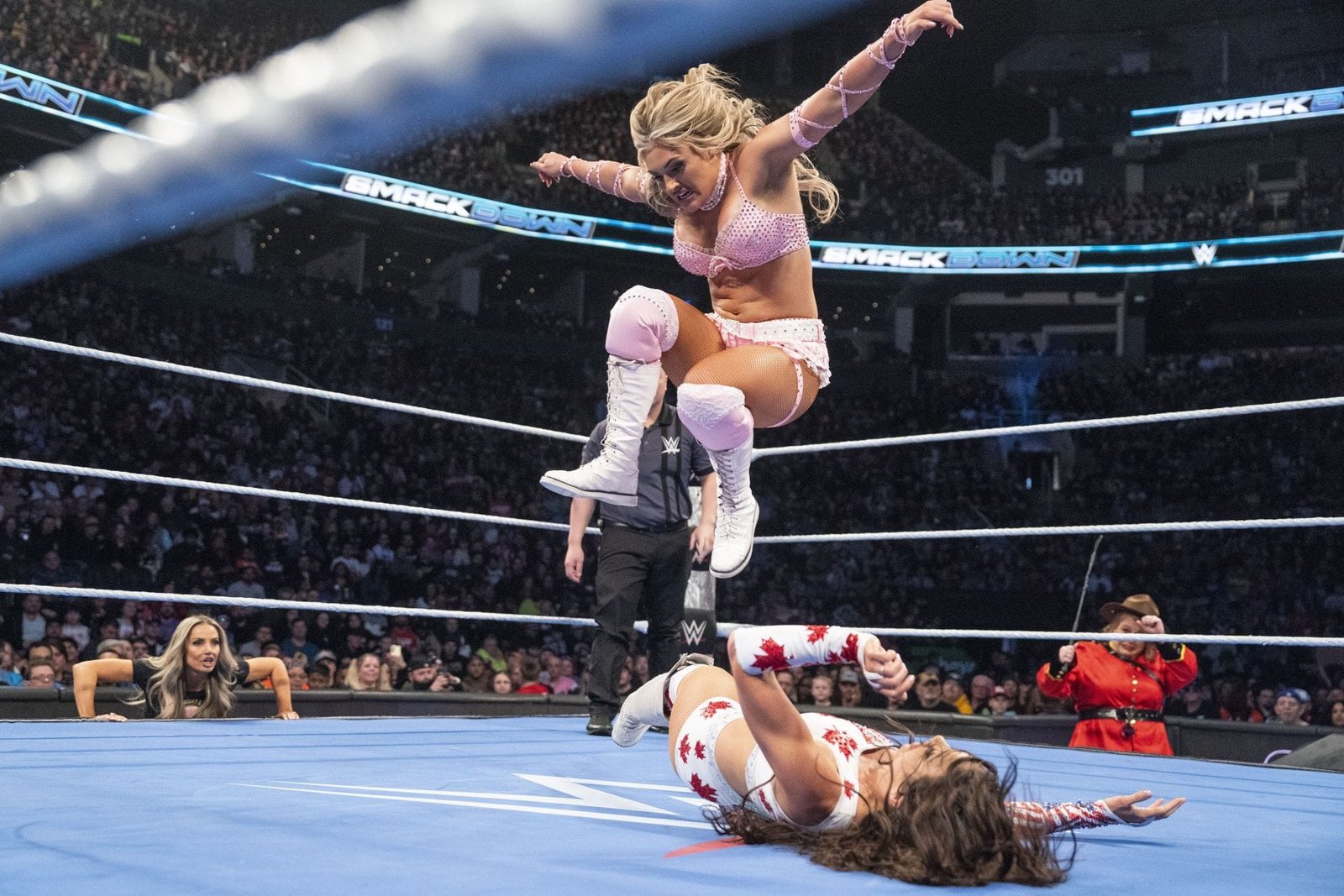
Stratton has already shown that she is perfectly capable of standing on her own. Meanwhile, Green has become one of the most prominent women on the SmackDown roster after winning the Interim WWE Women’s Championship at SummerSlam. With their ambitions potentially colliding, Stratton could eventually turn against the champion.

That said, in this article, we look at four reasons why Tiffany Stratton could eventually turn against Chelsea Green.
#4. Tiffany Stratton could become tired of Chelsea Green taking the spotlight
Chelsea Green has an unmistakable personality, and that can make it difficult for anyone around her to receive equal attention. Since becoming the Interim Women’s Champion, she has naturally become one of SmackDown’s biggest talking points.
Stratton could eventually feel that she is being reduced to Green’s sidekick rather than treated as a major star in her own right. That would be particularly believable because The Buff Barbie has already established herself as a former Women’s Champion and a major singles competitor.
The situation could become even more frustrating if Chelsea Green repeatedly takes credit for their victories or presents herself as the reason Tiffany Stratton succeeds. One arrogant comment from Chelsea could eventually push Tiffany over the edge and trigger a shocking betrayal.
#3. Tiffany still wants to prove she can be the top star
Tiffany Stratton’s ambition is one of her defining characteristics. She has spent the past several years building herself into one of WWE’s most recognizable young stars. Thus, she is unlikely to be satisfied playing second fiddle indefinitely.
Chelsea Green currently possesses something Stratton wants: the Women’s Championship. WWE has already shown that the two can coexist. However, their relationship could change dramatically if The Buff Barbie decides that the championship belongs around her waist.
Thus, a singles match between the two would have a straightforward story. Tiffany Stratton could argue that she helped Green survive difficult situations, only to watch Chelsea Green become the face of the division. Eventually, gratitude could give way to ambition, with Stratton deciding that eliminating Green is the quickest route back to the top.
#2. Chelsea’s personality could eventually clash with Tiffany’s ego
The biggest strength of their partnership could also become its biggest weakness. Both women are confident, outspoken and convinced that they deserve recognition. That creates plenty of room for friction.
Chelsea Green has a tendency to make situations about herself. Meanwhile, Tiffany Stratton has the confidence and star power to demand attention. As long as they are benefiting from working together, those differences can be ignored. However, the moment one believes the other is holding her back, the alliance could collapse.
WWE could slowly build this story through disagreements rather than immediately booking a betrayal. Green could refuse to help Stratton in a crucial match, take credit for a victory, or make a decision without consulting her. The Buff Barbie could gradually become more frustrated until she finally attacks Chelsea.
That would make the eventual turn feel earned instead of random.
#1. A championship feud between them could be too valuable to ignore
Ultimately, WWE has a compelling singles program sitting in plain sight. Tiffany Stratton and Chelsea Green have history, contrasting personalities, and enough credibility to headline a major women’s storyline.
Their alliance has already given Triple H a reason to keep them connected. That means the company can eventually turn the partnership into a feud without needing to manufacture a complicated backstory. One disagreement over the Women’s Championship could be enough.
The timing could also be ideal if Green eventually becomes fit to defend the title. Stratton could emerge as the former ally who believes she deserves the next opportunity. Thus, if Chelsea dismisses her, Tiffany could respond by turning on her spectacularly.
The feud would give both women something meaningful. Chelsea Green could play the condescending champion who believes Tiffany Stratton needs her. Meanwhile, Tiffany could portray herself as the ambitious star who realizes she no longer needs Chelsea.
More from Sportskeeda
${getStoryActionHTML(story, storyTitle, permalink)}
`;
if (index == 3 && isOpera) {
storyHTML += `
`;
}
recommendedArticlesContainer.innerHTML += storyHTML;
});
}
}
function getStoryActionHTML(story, storyTitle, permalink) {
if (shouldHidePostActions) return “”;
return `
`;
}
function recommendedArticles() {
var baseUrl = “https://cf-gotham.sportskeeda.com/recommendations/post/4-reasons-tiffany-stratton-could-eventually-turn-against-chelsea-green?lang=en&category=wwe”;
pureJSAjaxGet(baseUrl, function(data) {
renderRecommendedArticles(data);
if (isOpera) {
renderOperaFeedAd();
}
}, function() {}, false);
}
var options = {
root: null,
rootMargin: “0px 0px 70% 0px”,
threshold: 0.1
};
var observer = new IntersectionObserver(function (entries) {
entries.forEach(function (entry) {
if (entry.isIntersecting) {
recommendedArticles();
observer.unobserve(entry.target);
}
});
}, options);
var targetElement;
if (showAlsoReadSection && !showAlsoReadSectionV2) {
targetElement = document.querySelector(‘.also-read-articles-container’);
} else {
targetElement = document.querySelector(‘.recommended-posts’);
}
if (targetElement) {
observer.observe(targetElement);
}
function renderOperaFeedAd() {
var operaFeedArticleAd = $(“.opera-article-feed-ad”);
if (!operaFeedArticleAd) {
return;
}
var firstScript= document.createElement(‘script’);
firstScript.setAttribute(“type”, “text/javascript”);
firstScript.setAttribute(“src”, “https://pagead2.googlesyndication.com/pagead/js/adsbygoogle.js?client=ca-pub-1883810847636355”);
firstScript.setAttribute(“async”, true);
firstScript.setAttribute(“crossorigin”, “anonymous”);
operaFeedArticleAd.appendChild(firstScript);
operaFeedArticleAd.innerHTML += `
`;
var secondScript = document.createElement(‘script’);
var secondScriptCode=””;
try {
secondScript.appendChild(document.createTextNode(secondScriptCode));
operaFeedArticleAd.appendChild(secondScript);
} catch (e) {
console.error(e);
}
}
})();
Fetching more content…


Read the full article here