


Every year, golf’s most significant tournaments arrive with their own slate of guaranteed storylines: inexpensive food at the Masters, punishing rough at the U.S. Open, wind and rain at The Open Championship, vicious criticism of the venue at the PGA Championship.
Advertisement
For The Players Championship, which tees off later this week, each year brings a new crop of “should The Players be a major?” stories. So it’s gone this year — see: the article you’re reading now — with the notable difference that this time around, the PGA Tour itself kickstarted the conversation.
On February 5, the Tour released one of those get-your-blood-pumping promotional spots highlighting both the players and, well, The Players. Throughout the spot, Rory McIlroy, Scottie Scheffler, Justin Thomas and more celebrated, alongside gorgeous shots of TPC Sawgrass that hit extra hard in the doldrums of gray winter. But tucked into the 28th second of the 30-second spot were six key words that kicked a perpetual conversation into a new gear:
“March is going to be major.”
Advertisement
That was a deliberate use of one of a very few highly provocative words in the golf world. Nobody says that the winners of October and November tournaments are the “Masters of the fall,” for instance, and you don’t use the word “major” in connection with The Players without ulterior motives.
For the last 60-plus years, there have been four majors, and only four majors — the Masters, the U.S. Open, the Open Championship and the PGA Championship — and in all that time, only one entity, The Players, has even hinted at wanting to join that elite group.
“I hope you noticed our use of the word that we’ve somewhat shied away from over the last 10 years,” Lee Smith, director of The Players, said in February at the tournament’s media day. (We did.) “This is a signal of the confidence, momentum, and offense that is coming out of our building these days. We’re confident about the qualifications of The Players Championship. We wanted to start a conversation.”
So let’s start that conversation.
Advertisement
How did the majors become, you know, The Majors?
A good question. Golf, like college football, has no singular central governing authority, but rather a consortium of interests that generally act in a common interest. (Less so with the arrival of LIV Golf, but that’s not the issue at hand.) Whoever has the loudest microphone or the tallest podium tends to make the rules … which is why Arnold Palmer and sportswriter Bob Drum decreed in the 1960s that the Masters, the PGA Championship, the U.S. Open and The Open Championship would henceforth be known as the four majors.
The 1960s? But didn’t the Masters only start in 1934?
Correct. The Masters is the youngest, by several decades, of the four majors, as codified by Palmer and Drum. There was a time when the Western Open, the Canadian Open and the U.S. Amateur were all considered “majors.” But Palmer and Drum, understandably, tilted the board in Arnie’s favor, hence the prestigious but still relatively youthful Masters getting the nod.
Advertisement
Bottom line, the idea that the four majors are The Four Majors has all the legal authority of a World’s Best Dad coffee mug … but the idea carries the weight of tradition, which in golf supersedes the word of law.
Well, then why shouldn’t The Players be a major?
A few reasons, starting with the aesthetic and moving to the practical. To start, five majors is an unwieldy and unseemly number. The sports world thrives on beats of four: four quarters, four bases for a home run, four days in a golf tournament. A fifth major throws everything off.
Plus, the fifth-major deal has already been tried, and the results have been less than spectacular. The LPGA has five majors: The Chevron, the U.S. Women’s Open, the Women’s PGA Championship, the Amundi Evian Championship, and the AIG Women’s Open. Other tournaments have popped in and out of the rotation.
Advertisement
But here’s the key element: to be credited with a career LPGA grand slam, you don’t have to win all five tournaments, you just have to win four. If the PGA Tour were to make The Players a major with that rule, guess what: Scheffler and Phil Mickelson would instantly become career Grand Slam winners without taking another swing. McIlroy’s dramatic Masters victory last April? Irrelevant; he would already have been a “grand slam” winner.
And Mickelson’s name brings up another element breaking against The Players: It can’t be a major if all the best players aren’t present. This year’s field includes 47 of the top 50 players in the world, but those three who aren’t at Ponte Vedra this week — Patrick Reed, Tyrrell Hatton and Jon Rahm — are all ineligible because of their association with LIV Golf. The four majors have found a way to incorporate LIV players in order to strengthen their fields; would the PGA Tour consent to that for The Players?
Advertisement
Oh, and also, The Players refers to itself as THE PLAYERS in all its public communication. If the tournament wants to be considered a major, that annoying little stylistic tic needs to go. If you have to tell people how important you are …
So what’s the problem if The Players doesn’t become a major?
Nothing! There’s no problem at all, from a fan perspective, with things as they stand now. A landmark regular-season tournament can have just as much compelling day-to-day interest as a marquee one. Duke/Carolina, Ohio State/Michigan and the Iron Bowl are still fantastic regular-season games even if they have no material impact on the individual schools’ seasons. Tens of millions of fans will tune in to the next Chiefs/Bills or Packers/Bears game no matter whether it comes in September or January.
The key issue here is that a player’s career is defined by the number of majors he won, not the number of PGA Tour events or FedEx Cup playoffs. As long as the key numbers hovering over Jack, Tiger, Rory and Scottie are 18, 15, 5 and counting, and 4 and counting, The Players stands a best-of-the-rest status.
Advertisement
And that understandably doesn’t sit so well with the PGA Tour and the Strategic Sports Group, which has poured a billion-and-a-half dollars into the Tour with the expectation of a sizable return. Prestige guarantees money in golf, and there’s nothing more prestigious than the majors. It’s one of the quirks of professional golf that the PGA Tour, the dominant force in the game today, doesn’t actually control any of the majors … a state of affairs the PGA Tour would very much like to change.
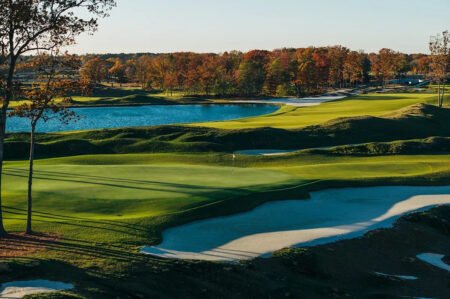
TPC Sawgrass, which every year hosts The Players Championship, boasts one of the most iconic holes in golf — the island green at 17. (Photo by Jared C. Tilton/Getty Images)
(Jared C. Tilton via Getty Images)
Fine, so The Players isn’t a major right now. But could it replace one of the four existing ones?
Ah, now we’re talking. Given that the majors came into existence by the machinations of a player and a journalist, shouldn’t the players and the journalists have a say in their future makeup, as well? And if that’s the case … well, the PGA Championship ought to be more than a little concerned.
Advertisement
The other three majors have aesthetic and narrative footholds that go into golf’s bedrock. The PGA Championship is the one that most lacks a consistent identity, the one that most bedevils itself with controversial venue choices. If we’re going to stick with four majors, maybe each one ought to justify themselves every so often. (Why not bring back the hyper-tense match play format that the PGA Championship used its first 40-plus years of existence?)
Players seem fairly cool to the idea of making The Players a major. “Look, I’d love to have seven majors instead of five, that sounds great,” McIlroy joked in February before noting that he’s a traditionalist and that The Players “stands on its own without the label.” Earlier this week, Justin Thomas and Brooks Koepka sidestepped the question. Mickelson had a five-word answer for whether he thought The Players is a major:
Surely it’s not a response at all influenced by his ongoing blood feud with the PGA Tour.
Advertisement
The Players might one day become a major. But it won’t happen overnight, and it definitely won’t happen just because the PGA Tour wants it so. Like all the best Sunday rounds, regardless of tournament, it’s a long way from the first tee to the trophy, and there are a whole lot of obstacles in the way.
Read the full article here