


The Los Angeles Rams enter the 2026 NFL Draft in one of the most advantageous positions of any team seeking wide receiver help—and that’s a dangerous combination for the rest of the league. With a strong roster foundation, premium draft capital, and a historically deep receiver class, the Rams are perfectly positioned to land an impact pass-catcher within the first three rounds this April.
Start with the draft capital. Los Angeles holds the No. 13 overall pick, along with selections at No. 61 and No. 93. That alone gives them three legitimate shots at finding a difference-maker. More importantly, they aren’t drafting out of desperation. The Rams have already addressed several roster needs, which allows them to focus on value and upside rather than reaching for a positional need.
Advertisement
That flexibility is key—because wide receiver isn’t just a need, it’s an opportunity to make the Rams offense even better than the 2025 version.
Even with a strong core led by Puka Nacua, the Rams are clearly searching for another dynamic weapon to round out their offense. This is where roster construction and scheme fit come into play. Under head coach Sean McVay, the Rams’ offense thrives on versatility, route discipline, and the ability to stretch defenses horizontally and vertically. While slot receivers are valuable in this system, Los Angeles already has Nacua who can operate effectively inside. What they’re more likely to prioritize in this draft is an “X” or “Z” receiver—players who can win on the outside, beat press coverage, and create explosive plays downfield.
In the 2025 Draft, the Rams attempted to trade up to select Tetairoa McMillan but they were unsuccessful in doing so. After failing to grab a wide receiver, expect them to show urgency in adding one in this year’s draft.
An “X” receiver typically lines up on the line of scrimmage and is tasked with handling physical cornerbacks, while a “Z” receiver plays slightly off the line and is often used in motion to create favorable matchups. Both roles are critical in McVay’s offense, especially as the Rams look to expand their vertical passing game and take pressure off their existing playmakers. Adding an outside receiver with size, speed, or elite route-running ability would give this offense a new dimension—and this draft class is loaded with those exact traits.
Advertisement
And that brings us to the most important factor: the 2026 wide receiver class is deep—exceptionally deep.
This isn’t a top-heavy group with only a few elite names—it’s stacked from the first round through Day 3. That depth dramatically increases the Rams’ margin for error. Even if they pass on a receiver at No. 13, they’re still highly likely to find a starting-caliber player in the second or third round.
At the top of the class, prospects like Carnell Tate, Jordyn Tyson, and Makai Lemon headline a diverse group of pass-catchers. Tate, in particular, fits the mold of a prototypical “X” receiver with his size, physicality, and polished route tree. Tyson offers similar outside versatility, while Lemon—though more of a slot-leaning option—still brings technical refinement and separation ability. For the Rams, however, the emphasis will likely remain on those boundary receivers who can consistently win one-on-one matchups.
What truly makes this class ideal for Los Angeles is the strength of the second and third tiers. After the consensus top three, there are still starting-caliber “X” or “Z” receivers at the end of Day 1, and throughout Day 2. These are the kinds of prospects who may not go in the top 15 but could quickly outperform their draft position—exactly the type of value the Rams have built their recent success on.
Advertisement
Because the class is so deep, there’s also a strong chance that quality receivers will slide into Day 2. That’s where the Rams’ additional picks at No. 61 and No. 93 become incredibly valuable. They can afford to be patient, let the board fall to them, and still walk away with a player who fits their system perfectly.
Another underrated advantage for Los Angeles is organizational clarity. They know exactly what kind of receiver they want. This isn’t a front office guessing on traits—it’s a team with a well-defined offensive identity targeting specific roles. That clarity will likely steer them away from purely slot-focused receivers and toward outside threats who can complement their existing weapons.
And if they identify a true difference-maker early, they have the flexibility to be aggressive. The Rams have never been shy about making bold draft-day moves, and this year could be no different if the right “X” or “Z” receiver starts to slide within striking distance. Here are a three wide receivers the Rams will consider if they don’t target/land one of the top pass catchers in Round 1.
Elijah Sarratt, Indiana
A 6’2” “X” receiver that is projected to go in Round 2, Sarratt and Mendoza mastered the back shoulder throw at the college level in 2025. Here are Sarratt’s measurables that make a physical threat.
Sarratt’s biggest weakness is his speed but there have been plenty of wide receivers that have not performed well in their 40 times that have gone on to be successful. See Davante Adams.
Advertisement
NFL Draft Buzz’s scouting report summarized the following on him…
When you watch Sarratt work, you see a receiver who understands exactly what he is and maximizes every tool in his arsenal. He is never going to be the guy who takes a slant 70 yards to the house or runs past coverage down the boundary. What he will do is catch everything thrown his way, find the soft spot in zone coverage on third-and-7, and come down with contested balls in the red zone when the quarterback needs a bailout option. That last part matters more than people realize. Forty-four career receiving touchdowns leading all active FBS receivers tells you he knows how to finish drives. His 15 scores in 2025 alone, despite missing two games, shows a player who becomes even more dangerous inside the 20.
The scheme fit matters here. Sarratt belongs in an offense that emphasizes timing and precision, one that features back-shoulder throws, dig routes, and concepts designed to attack the middle of the field. His value spikes in the red zone where his body control, strong hands, and ability to box out defenders at the catch point make him a go-to target when real estate shrinks. He can work as a traditional X receiver in systems that value contested-catch ability over speed separation, though some teams may view him as a big slot option depending on how he tests this spring. The lack of explosiveness will limit his role in offenses built around vertical shots and after-catch production, but coordinators who want a reliable chain-mover and touchdown scorer with size and toughness will find plenty to like.
Ja’Kobi Lane, USC
Makai Lemon is getting the majority of the attention out of USC but Ja’Kobi Lane offers a lot of intrigue for a team looking for a lengthy and explosive “X” receiver. His showing at the Senior Bowl, Combine, and Pro Day have continued to elevate his stock going into April.
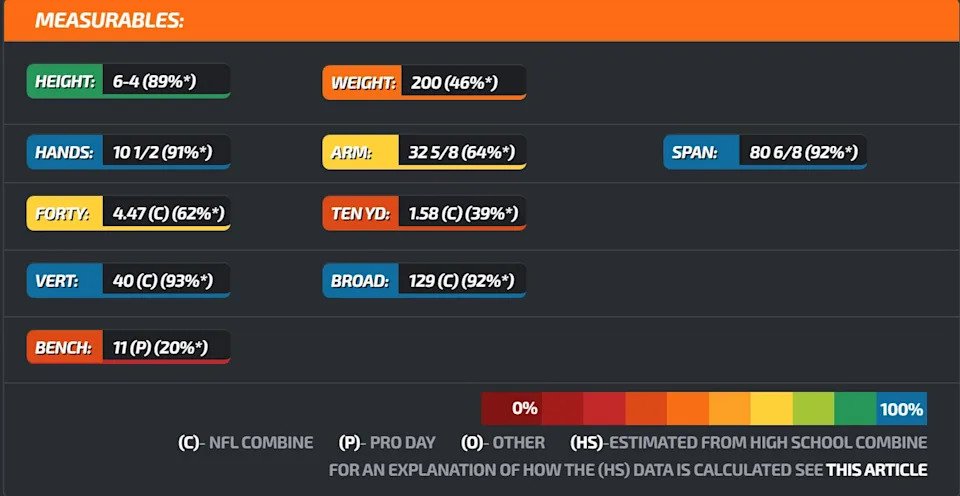
Lane’s game is built around the catch point, and that skill translates. He wins above the rim, owns contested situations, and understands how to use his frame to create advantages in tight coverage. His best role at the next level is as a boundary X receiver in a scheme that values isolation routes, play-action shots, and designed red-zone targets. The combine helped his stock. His vertical and broad jump numbers confirmed the explosive athleticism you see on film when he goes up for the ball, and his 40 time came in faster than expected, which should quiet some of the speed concerns.
The developmental questions remain. His route tree needs real work before he can handle a full-time starter’s responsibilities, and NFL coordinators will test whether he can win with precision rather than just length. Adding weight without losing that athleticism is critical, because press coverage at the next level will be more physical than what he saw in the Big Ten. The drop issues need cleaning up too. Four drops in each of his last two seasons is a pattern, and the inconsistent hand placement on tape backs that up.
Lane could see his name go as soon as late 2nd Round and will likely be gone before Day 3 arrives.
Ted Hurst, Georgia State
The Rams value players that “level up” or transfer and Ted Hurst went from Division II Valdosta State to Georgia State after two seasons. Hurst offers intrigue as a “Z” receiver and could be what Sean McVay looks to add since he heavily employs motion in his offense.
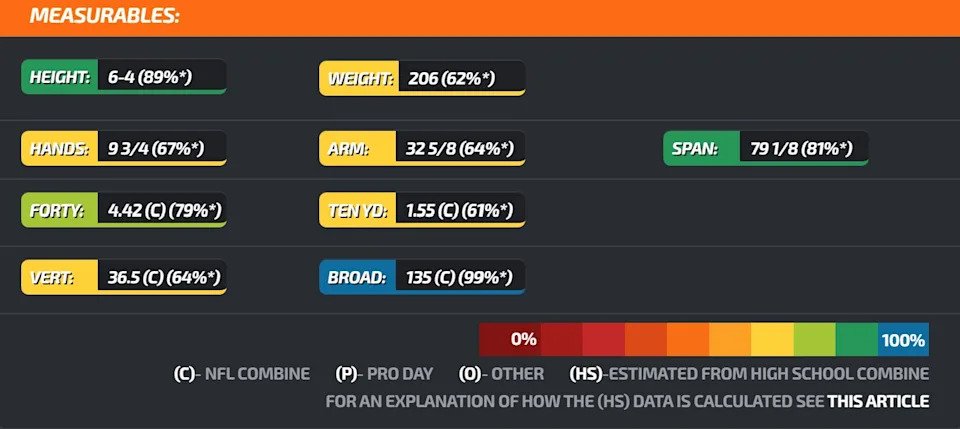
NFL Draft buzz said this about Ted Hurst…
Hurst fits best as a “Z” receiver in an offense that uses motion and formation variety to manufacture free releases. That matters early in his career because press coverage remains a real problem, and NFL corners will be stronger and more disciplined than anything he saw in the Sun Belt. But the important thing is what happens after the release. He changes speeds through his stems, sinks his hips on breaks with fluidity rare for his frame, and finds zone windows with a feel that his average depth of target shift from 17.2 to 12.6 yards between 2024 and 2025 confirms was already developing. His receiving grade climbed meaningfully in that same window. The route tree is further along than his college offense required.
At 206 on a 6-4 frame with a 99th-percentile broad jump, the physical projection is encouraging. There is room for 10 to 15 pounds of added weight without losing the movement skills, and that kind of development directly addresses his two biggest limitations: surviving press and finishing contested catches, where his numbers were only average despite the length. His speed is good enough to threaten vertically, but he separates with acceleration and timing rather than blowing past coverage. That style translates if the body catches up.
Whether they grab a Round 1 wide receiver or a Day 2 player, the Rams will likely be adding a starter to their offense; giving Matthew Stafford yet another option.
Advertisement
Ultimately, everything is aligning for Los Angeles.
Read the full article here