


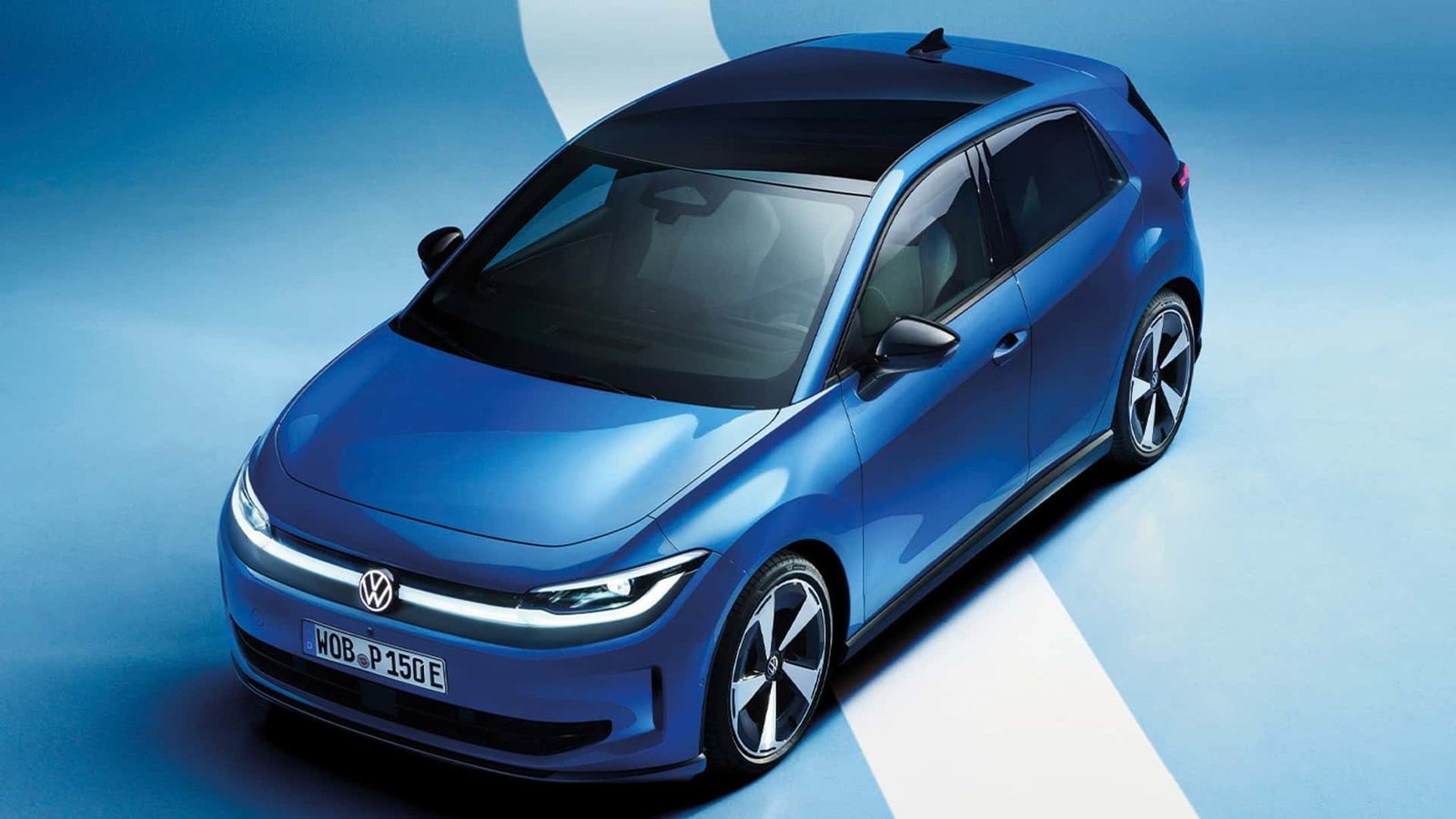
- The Volkswagen ID. Polo is a completely new development, unrelated to the combustion-engine Polo.
- It’s available exclusively with front-wheel drive and two battery capacities: 37 kWh and 52 kWh.
- VW estimates the electric Polo can cover up to 283 miles (455 kilometers) on a single charge.
Volkswagen has been selling the Polo for 51 years, but never before has there been a fully electric version. That changes today with the arrival of the ID. Polo, a showroom-ready version of the ID. 2all concept introduced three years ago. The name change for the production car aligns with VW’s new strategy of using familiar monikers for electric vehicles. At the same time, the “ID” prefix remains to differentiate EVs from combustion-engine cars.
Yes, the gasoline-powered Polo will continue and peacefully coexist with the electric ID. Polo for years to come. For those ready to switch to electric, the supermini is an entirely new development unrelated to the long-running model. It also adopts a fresh design language penned by VW Chief Designer Andreas Mindt and stays true to the 2023 concept car.
The Electric Polo Has An Entirely New Design
Photo by: Volkswagen
Even without knowing whether it has a combustion engine or not, the ID. Polo is clearly distinct from the conventionally powered Polo. Every single body panel is new and aims to deliver a clean look without the unnecessary details that have become so common in today’s busy designs. VW calls it a “Pure Positive” design language, and while not as daring as the retro-flavored Renault 5, the car has a sophisticated appearance and looks bigger than it actually is.
Speaking of which, it slots neatly into Europe’s crowded B-segment, measuring 159.5 inches (4053 millimeters) long, 71.5 inches (1816 millimeters) wide, and 60.2 inches (1530 millimeters) tall. It’s slightly shorter but wider than the gas-powered Polo, and predictably taller to make room for the battery underneath. At 102.3 inches (2600 millimeters), the wheelbase is marginally longer than the traditional model VW has been selling since 1975.
Technically a seventh-generation Polo, the small electric hatchback has an attractive profile with nicely flared wheel arches and Alfa Romeo-style hidden rear door handles. We’re told the C-pillar design draws inspiration from the original Golf, while wheel sizes can reach 19 inches on more expensive versions.
The rear end remains faithful to the concept, featuring a horizontal bar housed within a glass panel. On higher-end trim levels, it lights up together with the VW logo. These press shots show the optional taillights with a 3D-like depth effect. Similarly, pricier versions of the ID. Polo also get a front light bar bisected by an illuminated badge.

Photo by: Volkswagen
With the ID. Polo, VW doubles down on its promise to improve user interface design by reverting to good old buttons. Gone is the frustrating touch slider for the climate settings, replaced by dedicated controls mounted below the central air vents. The steering wheel thankfully ditches touch-sensitive keys in favor of plain, clear buttons everyone will likely appreciate. Another welcome improvement appears on the driver’s door, where there are dedicated switches for all four windows, as all cars should have.
The rotary switch for mirror adjustments and the lock/unlock button further contribute to the intuitive switchgear. Oh, and we almost forgot to mention a volume knob between the seats that the driver and front passenger can also use to change radio stations and songs. In the back, the electric Polo can accommodate 15.5 cubic feet (441 liters) of cargo without folding the seats.
Photos by: Volkswagen
It’s 2026, so there are bound to be some screens. As standard, the ID. Polo has a 10-inch digital instrument cluster paired with a 13-inch touchscreen featuring a tablet-style layout, as it’s not integrated into the dashboard as it was in the old days of VW interior design. While passenger screens are gaining traction, we’re glad there isn’t one here.
At an additional cost, buyers can splurge on a panoramic glass roof, which is quite rare in this segment. The same holds true for the 12-way electrically adjustable front seats with a massaging function, plus memory settings for the driver. Other goodies include a wireless charging pad, rear USB ports, and a 425-watt Harman Kardon sound system with 10 speakers and a trunk-mounted subwoofer. Ambient lighting for the dashboard and door panels further elevates the cabin.
VW ID. Polo: Technical Specifications
Photo by: Volkswagen
Unlike Volkswagen’s larger electric vehicles, the ID. Polo uses a front-wheel-drive platform. The MEB+ architecture brings a single-motor FWD setup with three power outputs: 114 hp, 133 hp, and 208 hp. A more potent ID. Polo GTI hot hatch with 223 hp will follow later this year.
As for batteries, there are two packs available, with net capacities of 37 kWh and 52 kWh. The former is of the LFP (lithium iron phosphate) variety and has enough juice for an estimated 204 miles (329 kilometers). The latter is a nickel-manganese-cobalt (NMC) battery with a range of up to 283 miles (455 kilometers). Contributing to these range figures is a relatively low drag coefficient of 0.26, aided by air curtains consisting of vertical inlets in the front bumper.
Photos by: Volkswagen
Stick with the smaller battery, and DC charging is limited to 90 kW, in which case it’ll take about 27 minutes to go from 10 to 80 percent. The bigger pack supports 105 kW and cuts the charge time to 24 minutes. Energy can flow both ways, as the ID. Polo benefits from Vehicle-to-Load (V2L) as standard, effectively becoming a mobile power bank with output of up to 3.6 kW.
While the Renault 5 we mentioned earlier has a more sophisticated multi-link rear independent suspension, the ID. Polo makes do with a torsion beam setup. However, VW claims it’s a new development specifically engineered for the electric hatch to improve comfort and reduce noise. Up front, the MacPherson suspension has also been fine-tuned for the electric Polo.
Weight is always a concern with EVs, but the ID. Polo isn’t too bad. Stick with the smaller battery, and the car weighs from 3,457 pounds (1,568 kilograms) before optional equipment. With the bigger battery, it’s only slightly heavier, at 3,474 pounds (1,576 kilograms).
VW ID. Polo Price And Launch
VW will begin taking orders in Europe this week, with pricing in Germany starting at €24,995. An even cheaper electric hatchback is scheduled to launch in 2027 as the production version of the ID. Every1, priced from approximately €20,000. It too will change its name, and here’s hoping the company dusts off up! or Lupo.
53
Source: Volkswagen
Motor1’s Take: With the ID. Polo, VW seemingly has a winner on its hands. It’s been a long time coming, and its lower entry price compared to the German-market €33,995 ID. 3 Neo should further accelerate the rise of EVs in Europe. In the first three months of the year, purely electric cars already accounted for 20.6 percent across the EU, the UK, Iceland, Norway, Switzerland, and Liechtenstein.
Read the full article here