



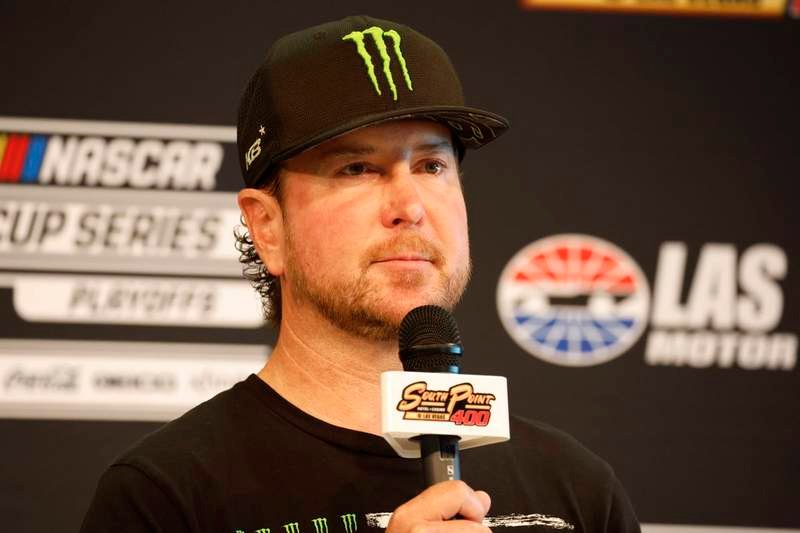
When Roush Racing moved the veteran crew chief Jimmy Fennig to the No. 97 in 2002, Kurt Busch already had speed and very little hesitation about using it. What he didn’t have, by his own admission that came later, was a clear sense of where the line was in traffic, in retaliation, or in race management. Kurt Busch would win races while still figuring out what he could get away with lap to lap. And Jimmy Fennig’s job was to make sure those decisions no longer cost the team.
Now, Fennig recently opened up about what it was really like working with that version of Kurt on Dale Earnhardt Jr.’s Dirty Mo Media podcast.
Advertisement
How Fennig Tried to Keep Kurt Busch From Derailing Himself
“He would blow up on everything,” Fennig recalled. “And then I would have to say, you got to calm down. You know, it’s gonna get better. This ain’t a bad day. Let’s keep working on it.”
In retrospect, Kurt Busch’s season took a dramatic turn following his August victory at Bristol in 2003. The win, emotional and volatile in equal measures, did not translate into consistency. In the next few races, he finished 38th or worse three times and fell from sixth to 10th in the standings, with just a slim 62-point lead over 11th. It was a far cry from 2002, when Busch had stormed from 12th to third late in the year, creating early championship anticipation for 2003.
He carried that form early on, winning twice in the first 11 races and running as high as third in points. But the rest of the season was inconsistent. While he added more wins, Busch also recorded six DNFs and seven finishes outside the top 30. The team oscillated between sharp execution and costly mistakes, with the weaker performances becoming more frequent as the season progressed.
Advertisement
Many suggested that Busch’s struggles could be owed to the distraction away from the track – specifically his public, physical feud with Jimmy Spencer. However, as Fenning said back then, “there are a lot of things that are out of your control that I had to adjust to,” and the crew chief moved quickly to set things straight.
The most striking part of Fennig’s approach was that he didn’t just hand Kurt off to someone else to fix. The two of them went to see a sports psychologist together. Back then, that wasn’t a common move in NASCAR’s garage, where the culture leaned heavily on toughness.
Then there was the Daytona 500. At some point during the race, Kurt’s frustration spilled over into the radio, and the language got so bad that Fennig had to act quickly. His solution was simple: he held down his own radio transmit button. With the crew chief’s channel open, Kurt’s voice couldn’t reach race officials or the broadcast. At the time, NASCAR was actively cracking down on conduct it deemed detrimental to the sport, and a penalty mid-race was a real possibility.
“I had to key him off the radio because he was swearing too much,” Fennig said. “I know he got mad at me for that, but hey, this is reality.”
Advertisement
Dale Earnhardt Jr., sitting across from Fennig, put it plainly: “The Kurt we know today is not the same guy you were working with in 2002.”
It’s because of such interventions that Fennig made that Busch called him a “father figure”. And so he did whatever his crew chief asked him to do.
“It was a surprise; I was just told out of the blue that Jimmy Fennig was going to be my crew chief. The way Jimmy came in was like a father figure to me. … Jimmy gave me that father-figure Bill Belichick (NFL’s New England Patriots former GM) type of feel and I just did whatever he said. If he told me to turn right at the end of Turn 1, I was going to do it. And that allowed my skills to develop as a racer because I got to focus solely on myself and to be able to develop under his mentorship,” Busch said in 2024.
Advertisement
Thanks to that, the pairing reached its pinnacle in 2004, as the #97 Ford driver clinched three wins with ten top-5 and 21 top-10 finishes, before holding the Cup Series Championship for the first time.
When the Feud With Jimmy Spencer Made Everything Worse
While Fennig was managing Kurt from the inside, there was an external problem making everything harder. Kurt’s rivalry with veteran driver Jimmy Spencer had been building through the 2002 and 2003 seasons, and it came to a head on August 17, 2003, at Michigan International Speedway.
After an on-track incident during the GFS Marketplace 400, Spencer confronted Kurt in the garage while he was still strapped into his car and punched him. Busch came away with a bloody nose, a chipped tooth, and facial swelling doctors said would take three months to fully heal.
Advertisement
NASCAR punished Spencer with a one-week suspension, a $25,000 fine, and probation through the end of the year. But Kurt was also fined $10,000 and placed on probation, with officials citing his role in provoking the situation on the track. The Lenawee County Sheriff’s Department opened a criminal investigation before Kurt eventually dropped the assault complaint in September.
What made it harder for Fennig was the garage’s reaction. Rival drivers and crew members began showing up to races wearing “Free Jimmy” T-shirts, a public show of support for Spencer. The #97 team was effectively isolated, operating in a garage that had turned against them. Later that season, NASCAR revoked Kurt’s hard card at Martinsville, meaning he had to sign in for paper credentials each week.
Read the full article here