

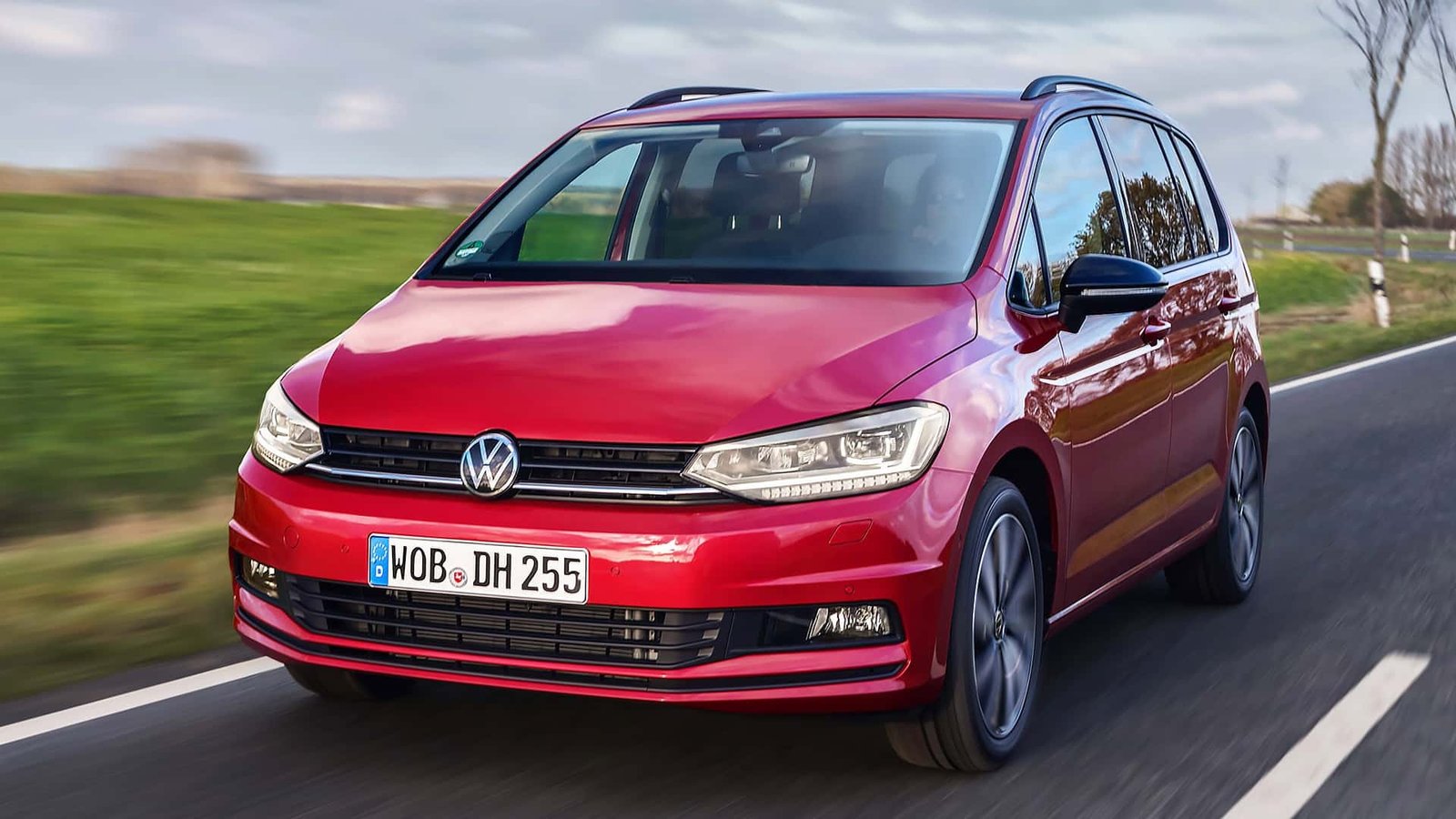
- The Volkswagen Touran has been retired, without a replacement in sight.
- The aging minivan fails to meet an upcoming EU regulation.
- The Touran was one of the oldest VW models in production.
Almost no one noticed it, but as of April 29, 2026, it’s official: the Volkswagen Touran is dead. On that day, the model’s last example rolled off the line in Wolfsburg. It’s not a huge surprise—at a little over 11 years old, the second-generation compact minivan was by far the oldest model in Volkswagen’s local lineup.
Between December 2002 and December 2025, a total of 1,070,558 Tourans were newly registered in Germany. With 95,408 units, 2004 was the model’s strongest sales year. In total, around 2.3 million Tourans were built, most recently at roughly 20,000 units per year. Last year in Germany, more than 14,000 Tourans were newly registered; at its peak, it was over 52,000. That means VW now has no minivan left in its lineup.
26
Source: Motor1.com
As the reason for the production stop, Volkswagen says the Touran does not comply with the UN “General Safety Regulation II, Stage C” that takes effect on July 6, 2026, meaning it can no longer be newly registered without an exemption.
Auto 5000 GmbH marked a distinctive chapter in Volkswagen history that’s closely tied to the Touran’s success. At the start of the millennium, VW faced the challenge of building its new compact minivan cost-effectively in Germany rather than moving production to lower-wage countries.
Under the slogan “5000 times 5000,” a program was created that was tailored specifically to producing this vehicle. The first Touran wasn’t just a new model—it was the centerpiece of an industrial experiment meant to prove that flatter hierarchies, team-based work, and more flexible labor agreements could make competitive production in Wolfsburg possible. VW’s labor chief at the time: Peter Hartz, later the namesake of the “Hartz IV” welfare reforms.

Starting in late 2002, the Touran rolled off the line exclusively in Auto 5000’s halls. Employees—often recruited from the unemployed—were trained specifically for assembling this model. Because the Touran was based on the Golf V platform yet featured significantly greater interior complexity and a wider range of configurations, Auto 5000 served as a real-world testbed for modern manufacturing methods.
The minivan’s success initially validated the concept; the Touran quickly became a segment leader. The portfolio expanded only with the Tiguan’s 2007 launch, but the Touran remained the defining face of the “5000” initiative.
In late May 2015, production of the second-generation Touran began in Wolfsburg. The 178.3-inch Touran II was about 5.1 inches longer and 1.2 inches wider than the previous Touran, benefiting interior space in particular. The second row featured three individual seats, and a third row was optional.
Cargo volume in the five-seat model was 26.2 cu ft, or 29.4 cu ft with the second row fully slid forward, and 69.9 cu ft with the rear seats folded. In the seven-seat version, there was 4.8 cu ft of space behind the raised third row. With the third row folded into the floor, cargo capacity was 22.4 cu ft. Folding the second row as well increased this to 65.6 cu ft.
Since 2024, the engine lineup has been limited to the 1.5 TSI with 150 hp and the 2.0 TDI with 122 hp or 150 hp. There is no direct successor to the Touran; in terms of size, the Tiguan is comparable. But seven seats are only offered as an option in the significantly larger Tayron. It’s a familiar pattern: as with other brands, SUVs are inheriting the role minivans once played. Too bad, really.
Source:
Wolfsburger Allgemeine
Read the full article here