


- The Miata gets quieter tires and a larger silencer in Japan.
- Without these changes, Mazda’s sports car would’ve failed upcoming external noise regulations.
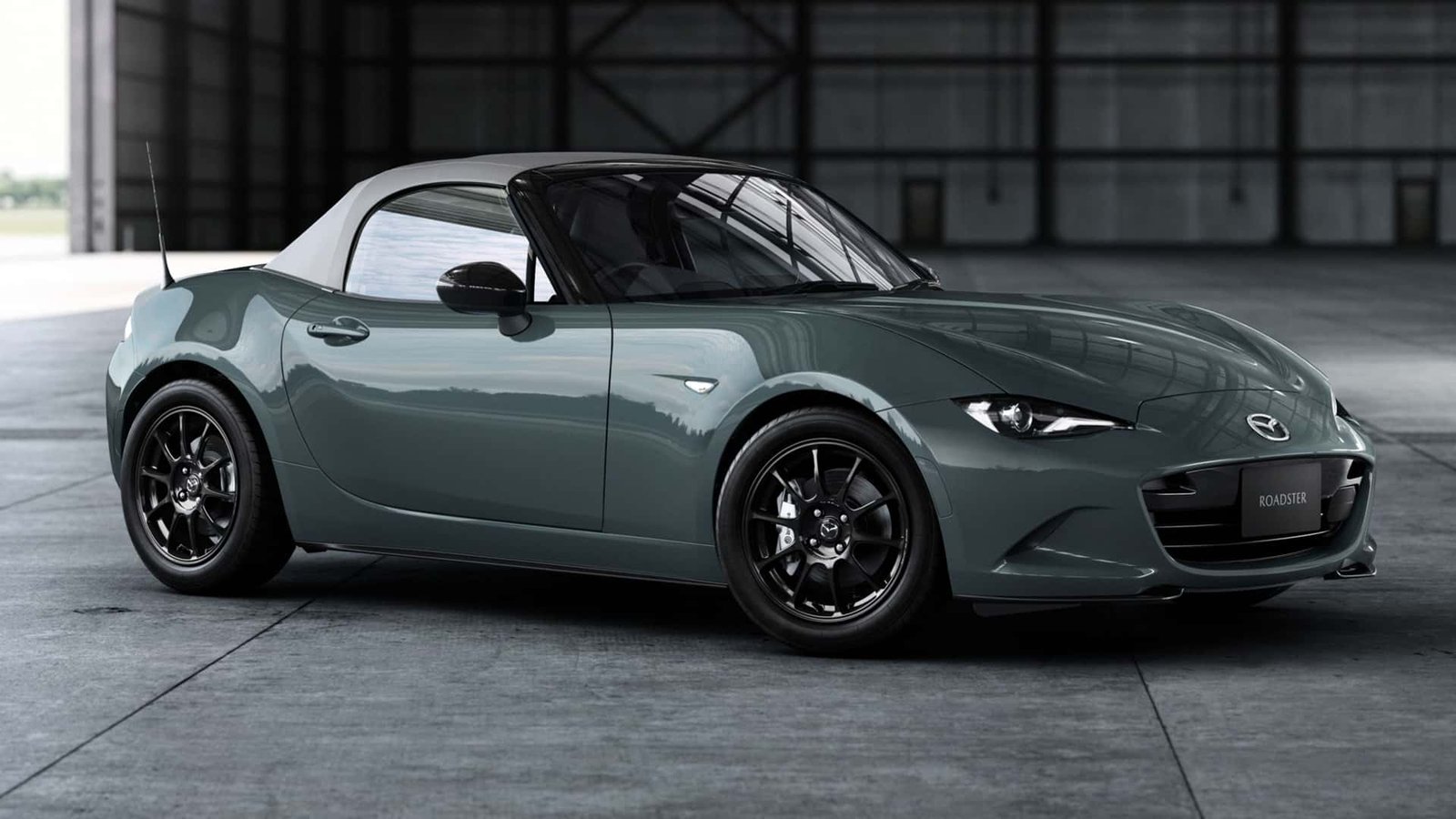
- Japan’s MX-5 has a new Pure Sport special edition with changes inside and out.
Mazda has made it crystal clear that work is well underway on a new Miata. That’s hardly a surprise given the continuous success of the popular roadster, even though the ND is getting up there in years. The fourth-generation model has been around for nearly 12 years, spawning multiple technical revisions and special editions throughout its lengthy life cycle.
But in 2026, the company still isn’t done tweaking the convertible sports car before its replacement (hopefully) arrives later this decade. The latest changes are happening not necessarily because Mazda wants to further update the Miata, but mostly because it has to ensure the car can continue to be sold in its domestic market. Japan’s latest external noise regulations are forcing engineers to revisit the ND yet again, fitting it with quieter tires and a larger silencer.
In the case of the Miata with a retractable hardtop, the larger silencer creates packaging constraints that have forced Mazda to reduce the depth of the car’s already tiny trunk. Additional changes to the intake enable the two-door sports car to comply with the external noise requirements. The legislation came into effect for newly approved models back in October 2024, and the requirement will expand to existing models from next month.
Photo by: Mazda
Without these changes, Mazda would’ve been unable to sell the car in Japan from July onward. That’s when the Phase 3 vehicle noise regulations, aligned with the international UN Regulation No. 51 (R51-03), extend to all vehicles. The rules lower the accepted dB levels to 68-72, with the limit depending on the vehicle’s power-to-mass ratio. For reference, the more relaxed Phase 2 allowed 70-74 dB, while Phase 1 permitted 72-75 dB.
The 2027 Mazda Miata Pure Sport
On a related note, Japan’s Miata also gets a Pure Sport (PS) special edition with the smaller 1.5-liter engine. It combines a gray fabric roof with the new Zinc Green Metallic color you’ve likely already seen, along with black 16-inch Rays wheels. Stopping power comes from Brembo brakes with silver calipers, while Bilstein dampers are fitted as standard.
Inside, not much has changed. The PS gets suede-like fabric seats and black rings for the engine start/stop button and the climate control dials. Elsewhere, the outer rings of the air vents also come in glossy black.
Even after all these years, the Miata’s cabin borders on perfection, as long as you can fit inside. Whatever comes after the ND, let’s hope it won’t follow recent Mazdas in supersizing the screen at the expense of physical controls.

6
Source: Mazda
Motor1’s Take: Mazda has sold more than 1.26 million Miatas since the NA debuted in 1989, and the small, rear-wheel-drive sports car remains literally in a class of its own. Nevertheless, Japan’s new noise standards remind us that even niche models must comply with ever-stricter regulations.
While most hurdles automakers face involve meeting tighter emissions standards, complying with lower noise limits adds another layer of complexity to engineering a new car or updating an existing model. Thankfully, the MX-5 soldiers on.
Read the full article here