
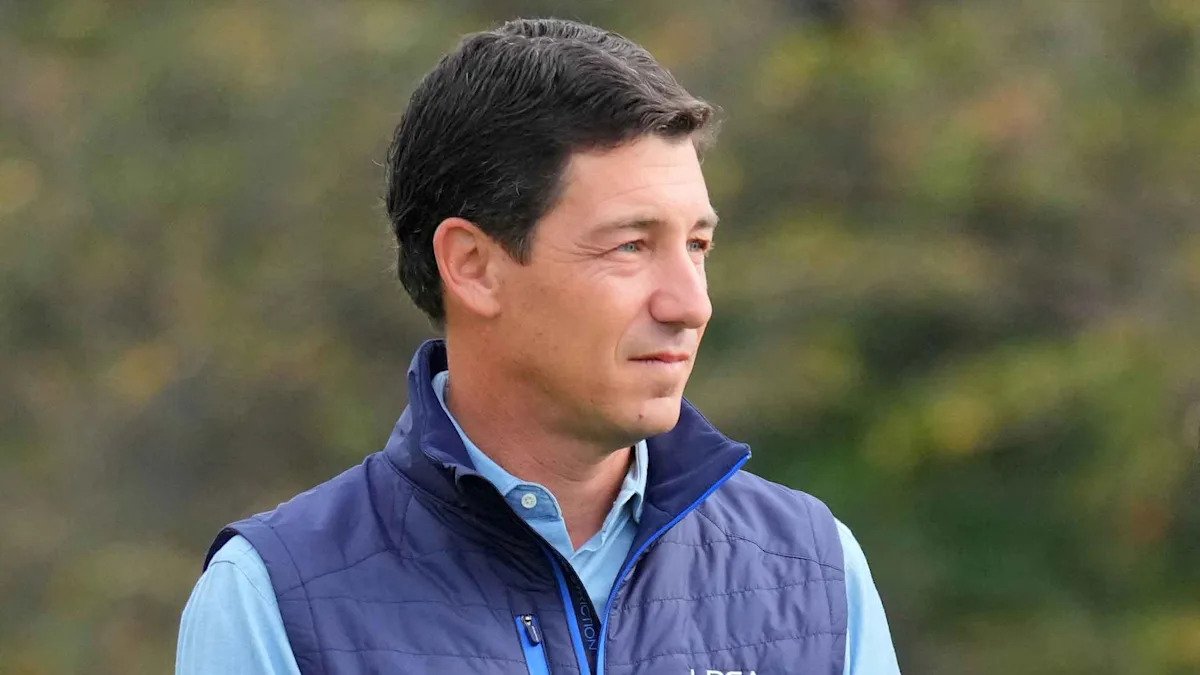
Craig Kessler was named LPGA commissioner last year.getty images
Craig Kessler, in his still newish role as LPGA commissioner, already has steered some big and impactful decisions for his tour: brokering a new broadcast deal; forging partnerships that will put more money in his players’ pockets; affixing the LPGA adjacent to Tiger Woods and Rory McIlroy’s indoor golf league, TGL.
Advertisement
But last Sunday presented Kessler, who is 40, with a different kind of business challenge: how best to determine the outcome of the LPGA season’s opener, in real time and with the eyes of the golf world (and fingers of golf Twitter) squarely on him. Complicating matters further: Kessler wasn’t on site at the Hilton Grand Vacations Tournament of Champions at Lake Nona in Orlando — he was 1,000 miles away, at home in Dallas, frantically trying to keep up with reports from the ground. “On the phone, reading materials from sunup until sundown,” Kessler told GOLF.com in an interview Tuesday. “Constantly trying to source as much information as possible in order to make an informed decision.”
That information — about the evolving course conditions, unseasonably cold weather and logistical concerns around pushing the event to a Monday finish — was coming from a variety of sources: Kessler’s deputies, tournament and rules officials, players and caddies, the grounds crew, even marketing partners. But ultimately the decision about whether to shorten the event to 54 holes and declare world No. 2 Nelly Korda the winner without her striking a single shot Sunday sat in Kessler’s lap.
“One of the tougher calls I’ve had to make in my six months with the LPGA,” he said. “No matter what we decided, there would be some who understood it and respected it, and others who didn’t. The questioning was there from the beginning.”
***
Advertisement
That second-guessing centered around whether the Tom Fazio-designed course, which awoke to below-freezing temperatures Sunday morning was playable for such a high-level tournament — or, more to the point, whether it would become playable as the day progressed and the mercury crept out of the 20s and into the 40s. When Amy Yang, one of eight players who didn’t complete their third rounds Saturday, arrived on property Sunday to prepare for the 10 a.m. resumption of Round 3 she said the greens were “frozen” and “unplayable.”
Ricki Lasky, who is the LPGA’s chief tour business and operations office, added: “What we found was when we got on site and talked to several of the players when they were warming up was that the grounds was really hard and it was changing the trajectory of their shots as they were practicing. The balls were releasing when they weren’t supposed to be so, so we pushed back [starting times].”
Reasonable minds might counter that contending with the elements — assuming water isn’t pooling or wind isn’t blowing balls off greens — is central to the game, but Laski and her team didn’t like what they were seeing and hearing.
The start was pushed from 10 a.m. local time to 11 a.m. . . . then noon . . . then 1 p.m. . . . before the LPGA finally settled on 2:15 p.m., by which point there was not enough daylight remaining to complete both Rounds 3 and 4.
Advertisement
Many observers noted the decision to postpone play so deep into the afternoon was a curious one given the temperatures (and golf course) were at least playable enough for the contingent of celebrities also competing in the event; they’d been dispatched to the course hours earlier, at 10 a.m. Among the participants in the celeb division was LPGA legend and Lake Nona resident Annika Sorenstam, who after bundling up and playing nine holes Sunday told Beth Ann Nichols of Golfweek: “I don’t know why they’re not playing. There’s pitch marks. I mean, I hit some crispy shots today and the ball even stopped. I am surprised. It’s difficult, it’s cold but it’s as fair as anything.”
Yang, after signing for a third-round 69 that secured her runner-up honors, also described the course as “playable.” “It got much better,” she said. “It is still very cold but compared to this morning 9 a.m. when I was warming up, much better condition.”
News
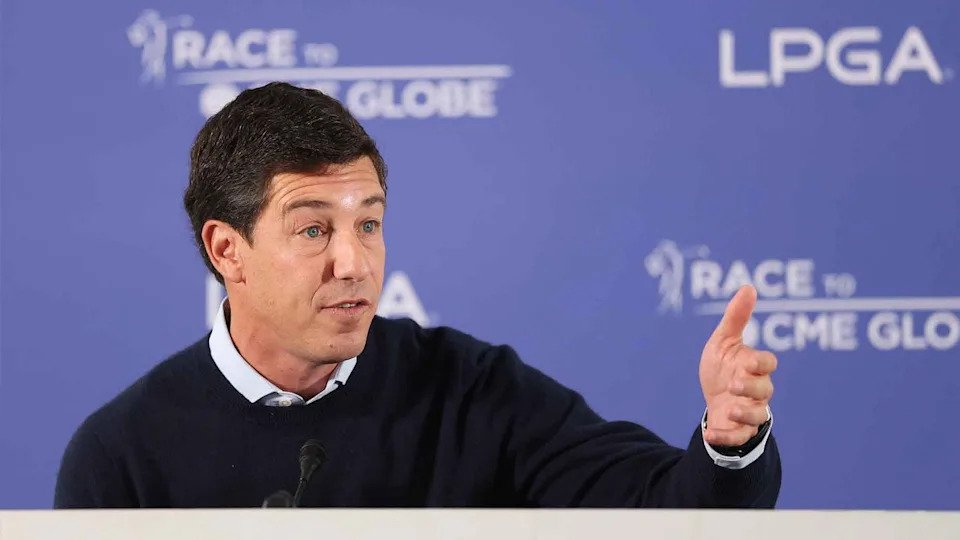
LPGA commissioner Craig Kessler addresses the media at the CME Group Tour Championship
Still, Kessler said he had other concerns beyond just the competitive integrity of the setup — namely the risk the frigid turf posed to his players. This worry was not communicated to either players or the public Sunday, but in a memo — a mea culpa, really — that Kessler emailed to players Tuesday, he revealed that he was “worried that our athletes might be injured given the way record overnight low temperatures hardened the course.” Kessler acknowledged in that note that “while the decision was a tough one and ran counter to prior statements we shared, I made a judgement call.”
Advertisement
There is precedent, of course, for calling tournaments after 54 (or even 36) holes, but nearly always it happens only in instances when it’s clear that severe weather (the wet and/or windy variety) will prevent play from being completed not only on Sunday but also Monday. There is little, if any, precedent for a professional golf tournament being called on account of concerns of players jamming a wrist or a catching a stinger.
But Kessler said the circumstances in Orlando, from what he deduced, were highly unusual. “Hand on heart, based on the information I had available when the call needed to be made, I had real concern about the potential for player injury,” he told GOLF. “Particularly in week one of the season, I think that’s something that has to be taken very seriously, and we took it very seriously.”
So seriously that Kessler made the decision to declare a champion after the third round. When the dust (frost?) had settled, Nelly Korda, who’d shot a stunning eight-under 63 in windy and chilly conditions Saturday, was named the winner by three.
After picking up her first win since November 2024 and her 16th LPGA title overall, Korda sounded largely supportive of the LPGA’s decision to shorten the event, saying, “At the end of the day, what we have on the line versus what the celebrities have on the line is a little bit different. I think the LPGA made the decision to look after their players, and at the end of the day we can’t do anything about that.”
Advertisement
***
Another question still loomed, though: Why not finish the tournament on Monday, as is customary on the PGA Tour when an event cannot be completed on Sunday?
“We weren’t fully prepared,” Kessler said.
Pressed on what that meant exactly — i.e., not prepared in terms of onsite logistics? Necessary support teams? Broadcasting needs? — the commissioner said: “It’s the whole nine yards. Think about the complexity of running a golf tournament. You’ve got sponsored considerations, player considerations, fan considerations, volunteer considerations, folks who actually show up to bring the tournament to life.”
Advertisement
The last Monday finish on the LPGA Tour coincidentally came at the Tournament of Champions, in 2020, but that round included only two players — Gaby Lopez and Nasa Hataoka — who after five playoff holes Sunday were still deadlocked, forcing the players to return to the course Monday morning. Logistically, there is, of course, a big difference catering to two players playing a couple of extra holes vs. 39 players returning to the host site to play a full round. Whatever the reason for the LPGA’s inability to extend to Monday, the tour was not equipped for a fifth day of competition.
News

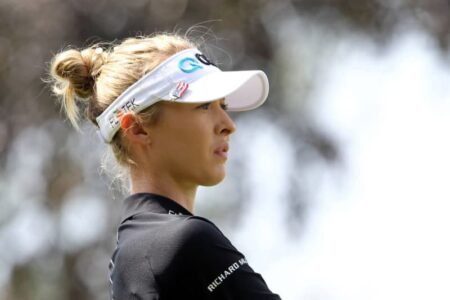
Nelly Korda looks on during the Hilton Grand Vacations Tournament of Champions
“In hindsight, I wish we had spent a little bit more time thinking about solutions that would have allowed us to get all 72 holes in,” Kessler continued. “I’m not sure it makes sense to go back and sort of relitigate all of the details, but what I do know is that going forward, we’re gonna work like hell to make sure, if we’re ever in a position like this again, we’re ready to go with those creative solutions.”
Advertisement
Kessler declined to say what those solutions might be, but beyond being better prepared to push to Monday, presumably that could mean, in the case of an ominous Sunday forecast, squeezing in more golf on Saturday. Kessler said he has no regrets about shortening the tournament, but in his memo to players he did acknowledge that “this decision, and others we made in real time, were confusing and disappointing to our fans. And our communication around the decision wasn’t clear or timely enough. Your frustration is valid — I own that, and I’m sorry.”
Asked what, in retrospect, he would have done differently, Kessler said, “I think there are two major themes. The first is around preparation — making sure we’re ready for plan A, B and C, and we’ve thought through all the logistics from start to finish, so that if we’re met with exceptional circumstances, we’re ready to go. The second is communications and making sure that when we communicate with the people who matter most, our fans, our players, the media, our partners, we’re communicating in plain English so that people read our statements and understand exactly what we decided and why we made the decision.”
Kessler will have a minute to process his learnings. The next LPGA event, in Thailand, doesn’t begin until Feb. 18. That tournament kicks off a three-week swing in Asia before the tour returns to the U.S. in mid-March.
“I know I made a tough call from a very good place,” Kessler said. “I realized that there’s been fallout, and there are some people who are upset with the decision that I made. At the same time, I’m just deeply proud of what we’ve done, and the momentum we’ve created, and the culture we’re starting to create with our team here. I really hope as quickly as possible we can get back to that.”
The post The LPGA made a mistake. Its boss owned it. But questions persist appeared first on Golf.
Read the full article here