



Comparison may be the thief of joy, but if you were lucky enough to wind up in the gallery on each of the last two Masters Sundays, it was only natural to spend a little while exploring the parallels.
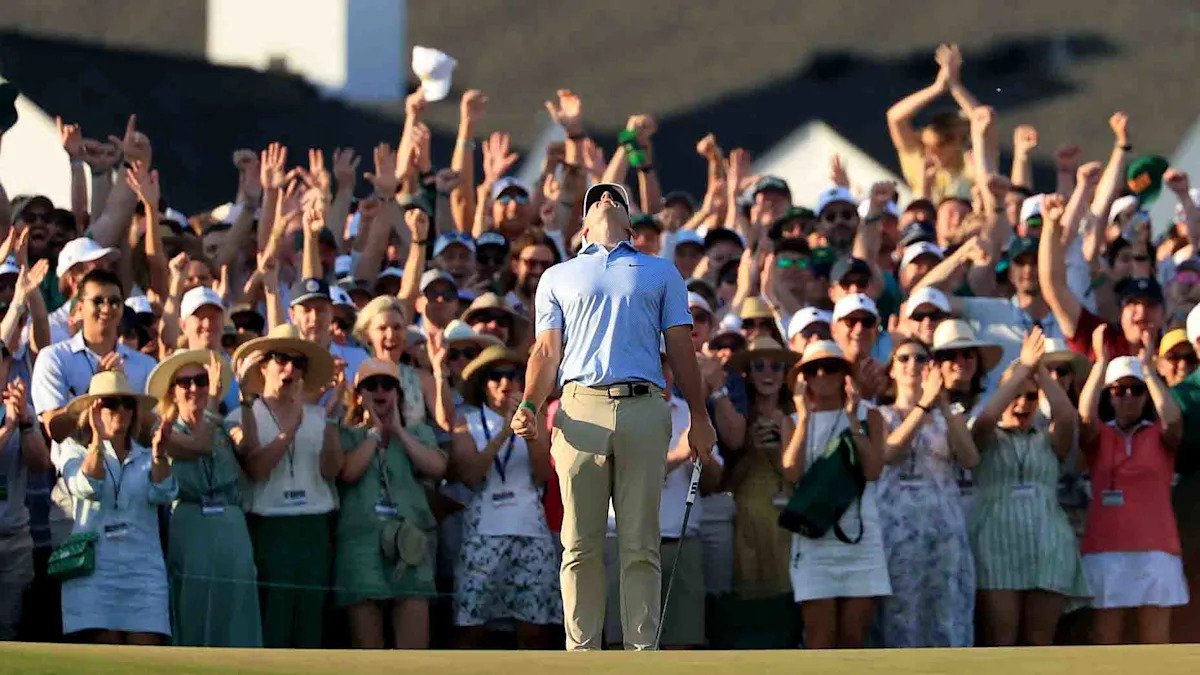
On each of the last two Masters Sundays, Rory McIlroy stepped to the first tee cast at the center of the gravitational pull of golf’s largest event. On each of the last two Masters Sundays, he endured a final round that featured incredible highs and impressive disaster in equal parts. And, on each of the last two Masters Sundays, McIlroy emerged on the 18th green at the top of the pack, enjoyed an emotional walk to the scorer’s tent, cruised to Butler Cabin, and slipped his shoulders into a green jacket.
Advertisement
And yet, for all of their spine-tingling similarities, the differences between the two McIlroy wins were even more striking. The crowd on this Masters Sunday seemed excited but not totally euphoric. The winner on this Masters Sunday seemed emotional but not completely overcome. And the larger impact of the victory on this Masters Sunday seemed respectful but not quite earth-shattering.
In nearly all ways, this was perfectly understandable. Rory McIlroy can only end a decade-long epoch in pursuit of major glory once. He can only complete the career Grand Slam with a victory at one of the sport’s holiest sites, Augusta National, once. And he can only deliver a reaction of instant-iconography once.
But then, early last week, the TV ratings came out suggesting something entirely different. According to Nielsen, McIlroy’s 2026 Masters win outrated McIlroy’s 2025 Masters win by a significant margin, delivering 13.995 million average viewers, up eight percent from McIlroy’s win last year.
If you’re like me, you saw those numbers and paused. Nothing about McIlroy’s win this time around suggested the numbers would have outperformed his win from last April, and nothing about the reaction to the victory in the days that followed suggested that TV audiences were salivating for more than they’d gotten last April (when late-night TV spots, morning show hits, a crazed degree of social media fame were fairly standard fare).
Advertisement
So, does that mean CBS has the wrong numbers? Or Nielsen screwed up the ratings? Not exactly.
This year’s Masters numbers come to us courtesy of the new Nielsen Big Data + Panel, a new audience capturing methodology that’s quickly becoming all the rage among sports TV networks and executives. The reason for this is evident in McIlroy’s Masters ratings: Big Data + Panel numbers generally tend to be higher for golf broadcasts than their previous Nielsen counterparts, and higher numbers are good for those who sell advertisements based upon their number of viewers.
That might sound sketchy, but the reason for it is actually fairly reasonable: By Nielsen’s estimation, Big Data + Panel is a vastly more accurate tool for measuring audiences in the age of modern media, accounting for trends like smart TV watching and streaming. If you are a company like CBS, you rely upon Nielsen ratings to set the profitability of your business, which means you also have a fiduciary responsibility to track the best numbers you can, especially if they just so happen to give your broadcasts an added boost.
Advertisement
For CBS, the decision to report Big Data + Panel numbers might not have drawn any attention at all, had the numbers from McIlroy’s win at the Masters not felt slightly strange relative to the cultural impact of his win a year ago. The Big Data panel is seen among many in the industry as the latest metric in the continued evolution of sports TV ratings in the age of cord-cutting — an effort meant to better understand and capture sports audiences who no longer watch on old-school cable, but still tune in religiously.
In the interest of transparency, many networks have opted to produce both Nielsen’s old numbers and its new Big Data + Panel numbers, but as CBS showed with its Masters release, not every network has fallen in line with that approach.
In the end, it might not matter much at all. For those whose livelihoods depend upon interpreting Nielsen data, the “Big Data bump” is well-trodden terrain by this juncture. And for those whose don’t? A few percentage points in the TV ratings will do very little to change the story of this year’s Masters as you saw it, anyway.
The post The latest Masters TV ratings came with a twist. Here’s why appeared first on Golf.
Read the full article here