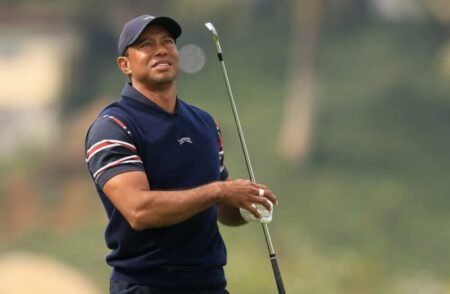



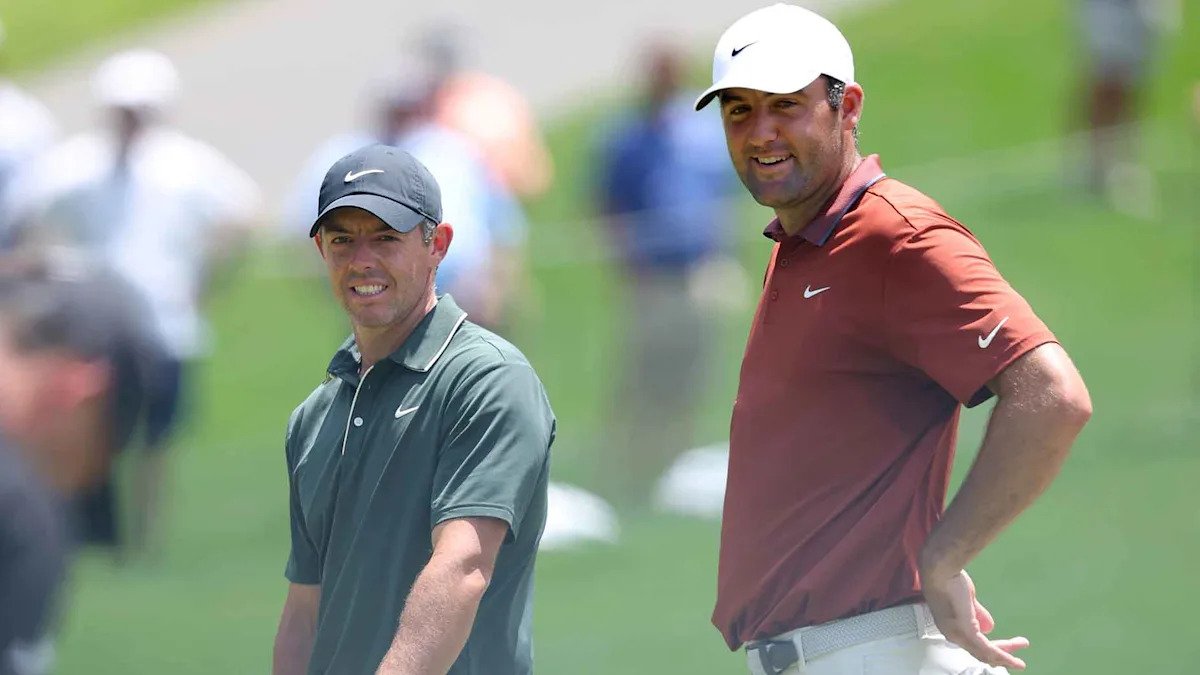
Rory McIlroy and Scottie Scheffler at the 2025 PGA Championship.Getty Images
Every year, the PGA Tour shares an annual report with its membership. It is often a 50-plus-page document, fronted by a photo of the previous year’s FedEx Cup champion and a lengthy, optimistic letter from the commissioner.
Advertisement
It looks like a magazine, with big, glossy images and infographics and a table of contents. But buried within that “Annual Report to Membership,” as it is titled, is financial information about the Tour’s core business, its revenues and losses, as compiled by Grant Thornton, the Tour’s accounting firm.
GOLF.com obtained copies of these annual reports from recent years, which are filled with important details on the state of the Tour. Together, the documents provide a holistic look at the Tour’s business as of year-end 2024, covering every corner from TV revenue and outside investment to the health of player retirement accounts. Here are nine key takeaways.
1. PGA Tour’s official valuation
On Jan. 30, 2024, the PGA Tour finalized a deal to sell a piece of equity to Strategic Sports Group, a collection of prolific sports investors led by the owners of the Boston Red Sox. At the time, headlines pegged the deal as a $3 billion investment and a $12 billion valuation, which isn’t necessarily inaccurate. The figure just wasn’t fine-tuned.
Advertisement
According to the annual report, SSG’s initial investment of $1.5 billion was for 11.62% of PGA Tour Enterprises, valuing the Tour at just over $12.9 billion, more than originally reported.
Why do the closing adjustments of the Tour’s agreement with SSG matter? Because a $900 million change in valuation is, at least on the surface, a 7% sweetener on the Tour’s value, which matters even more when Tour equity now belongs to the players, and because the Tour has flirted with additional outside investment (like from a sovereign wealth fund), which could be affected by price fluctuations. According to a source with knowledge of the Tour’s financials, the Tour was profitable in 2025, a positive sign that its new equity partners would certainly care about.
2. But what about SSG’s *other* $1.5 billion?
Times were different when the SSG agreement was consummated in early 2024 — just as they were different in 2023 and 2022 and 2021, which is quite obvious in the annual reports. At that time, the Tour was just months removed from a framework agreement with Saudi Arabia’s Public Investment Fund, and all indications were that both parties would eventually finalize an agreement granting the Saudis a similar piece of PGA Tour equity.
Advertisement
How close did they get? Close enough to meet about it in the White House. But golf fans know that plan fizzled.
What they can wonder now is if SSG’s first $1.5 billion investment in the PGA Tour will be its last. PGA Tour Enterprises — the for-profit arm of the Tour — has three years from the date of the initial 2024 investment to officially draw on the remaining $1.5 billion, in which it would offer up more equity as a result. That deadline is Jan. 30, 2027, less than a year away. That decision will ultimately be made by the PGA Tour Enterprises board, which consists of seven player directors (Tiger Woods, Camilo Villegas, Patrick Cantlay, Keith Mitchell, Maverick McNealy, Adam Scott, Joe Ogilvie), commissioner Jay Monahan, chairman Joe Gorder and, importantly, four investor directors from SSG (John Henry, Sam Kennedy, Arthur Blank and Andrew Cohen).
3. The Tour could (should?) own more events
The Tour maintains a considerable grip on the structures of pro golf and its worldwide audience, but for years managed only a conservative approach toward owning its own events. A significant part of the Tour’s business is dependent on sharing tournament ownership with local organizations.
Advertisement
As spelled out in the annual report, the Tour owned eight events outright as of year-end 2024. It has boosted than number to 10 with the formation of two more tournaments (bolded below) in the last 12 months:
— Players Championship (March)
— Tour Championship (August)
— Presidents Cup (September)
— FedEx St. Jude Championship (August)
— The Sentry (January … for now)
— Truist Championship (May)
— Baycurrent Classic (October)
— Cognizant Classic in the Palm Beaches (February)
— Cadillac Championship (April)
— Biltmore Championship (September)
It will be interesting to keep these specific tournaments top of mind as the Tour looks to announce a new schedule structure in the coming months, just as it was interesting when the Tour kick-started a discussion earlier this month about the Players Championship being worthy of “major” distinction.
Elsewhere, the Tour’s uncertain future in Hawaii might not necessarily spell demise for its premier Hawaiian event, The Sentry. It seems far more likely that the tournament will simply shift locations and dates, as has been reported by Golf Digest and Sports Business Journal. Considering The Sentry’s status as one of the few wholly owned and operated events, it would make little sense for the Tour to do anything else.
Advertisement
4. TV business increasingly massive
It goes without saying that pro sports’ billion-dollar days are made possible only by television viewership and the rights to broadcast events (TV and media acumen is a major reason why Brian Rolapp was hired as PGA Tour CEO.) But the Tour’s recent annual reports underscore that trend.
Year after year, the Tour’s broadcast arm — aka its “core business” responsible for driving the largest amount of revenue — has continued to see growth via media rights.
In 2019, the Tour’s net TV revenues accounted for roughly 48% of its core business. Just three years later, in 2022, once the Tour’s newest TV rights deal began (with ESPN+ joining as a streaming partner), the Tour’s TV money suddenly became 67% of its core business. It has settled in to a roughly 65% share of that metric in recent years.
Advertisement
News
Brooks Koepka
That may mimic the trend of other pro sports over the last decade, but it serves as a perfect reminder that the next few years figure to be the most important years in PGA Tour television history. The Tour itself is in the midst of restructuring its entire schedule and competitive format, which will lead to restructuring deals with TV networks. The hope, as it exists within the Future Competition Committee, is that the new schedule will be so valuable that it dwarfs the current TV deal, which is worth roughly $1 billion annually.
This, of course, presents a slight apples-and-oranges scenario for the Tour and its TV partners. Under a revised competitive format, decades-long TV partners may be expected to pay the same or more for a different product, different inventory, different stakes, etc. Golf fans will have to put their faith in the brains behind it all: SSG’s savvy sports leaders and the player-led faction of PGA Tour Enterprises’ board.
Advertisement
5. Tour’s TGL ownership
According to the report, the PGA Tour — which has long called itself a “partner” of TGL — owns 20% of the simulator golf league, which is considered a joint venture between the Tour and TMRW Sports. The Tour acquired that 20% stake via a “non-cash $50 million investment” — which, by year-end 2024, had depreciated to $38.3 million. That value-loss might be exactly what you’d expect from a startup league that saw its inflatable dome collapse and, at the time of accounting, had not yet hosted any matches. The 2026 report will be far more telling as it likely will include an indication of TGL’s financial performance in its first full season, during which it established eight founding partnerships that would help its bottom line.
Also detailed in the report are the origins of TGL, which was established by TMRW Sports on March 4, 2022, just three months before LIV Golf launched its first season (and five months before Rory McIlroy and Mike McCarley announced it to the world). As Phil Mickelson and Greg Norman were putting the final touches on LIV Golf, Tiger Woods and Rory McIlroy — co-founders of TMRW Sports — were not sitting idly. The non-cash $50 million investment was finalized roughly a year later, on March 9, 2023, just as TGL was locking in player commitments.
6. Tour’s Pro Shop ownership
Similar to TGL, the PGA Tour owns a considerable stake (~27%) in Pro Shop Holdings, the media company founded by “Full Swing” executive producer Chad Mumm and three others. That said, the annual report lists this deal as a “contribution agreement, intellectual property license and stock purchase agreement.”
Advertisement
Pro Shop is the choice production house of the Tour, and for obvious reason. Why go elsewhere when you can retain a predictable storytelling result from a company that influences your bottom line? That partnership helps explain how, say, Scottie Scheffler ends up starring in “Happy Gilmore 2,” which was produced in part by Pro Shop.
Pro Shop is an exploratory media venture for the PGA Tour, wherein the Tour can benefit from Pro Shop producing The Skins Game, which re-debuted on Amazon on Black Friday, or from Netflix’s “Full Swing” and “Happy Gilmore 2.” All it cost the Tour was a non-cash, asset and IP licensing deal worth $17 million. Pro Shop’s licensing deal with the Tour runs through 2030, similar to the Tour’s deals with other broadcast partners.
7. Strategic Alliance remains complex as ever
It’s February 2026, which means we just passed the five-year anniversary of the Tour’s original investment in the DP World Tour, based in Europe. While the deal was announced in November 2020, the PGA Tour officially acquired a 15% equity interest in European Tour Productions on Jan. 29, 2021, in an agreement priced at $85 million, with $30 million coming up front. About 17 months later, in the wake of LIV Golf launching, the PGA Tour bolstered its partnership with the DPWT, expanding the alliance to 2035, increasing its ownership to 40% by 2027.
Advertisement
Over the years, the financial relationship between the PGA Tour and DPWT has changed shape, as detailed in the report. At times, the PGA Tour has loaned money to the DPWT and been repaid. More commonly, as DPWT CEO Guy Kinnings has noted, the PGA Tour has “underpinned” the DPWT’s tournament staging efforts, i.e., paid for shortfalls in funding DPWT purses. That underpinning number increased from 2023 (~$24.9 million) to 2024 (~$28.2 million), aligning with an increase in the DPWT season-long purse total.
While it is largely difficult for the public to assess the health of the PGA Tour’s investment in its European cousin, the internal report notes impairment losses of $25.1 million on the PGA Tour’s DPWT equity shares, which suggests something worse-off than the day the expanded alliance was signed. There was also the leaked legal documents (from the summer of 2022, when LIV launched), which included the PGA Tour’s assessors suggesting a 100% takeover of the European Tour Group, calling it a “distressed asset.”
Rest assured, not everyone feels that way. The DPWT has played a quiet but massive role in the ongoing saga between the PGA Tour and LIV Golf and will continue to in the coming years. The DPWT and PGA Tour have agreed to defer the payments the PGA Tour was scheduled to make in 2023, ’24 and ’25 to 2028, ’29 and ’30, only elongating the tail of their arrangement.
As it stands, the PGA Tour has acquired a 30% equity stake in European Tour Productions, but the partnership includes a clause where, as of Dec. 31, 2027, the PGA Tour could “put back” the shares or the DPWT could buy back the shares. The original 15% would be at a fixed cost, while the remaining 25% would be at a variable rate, based on market value. As every profit and loss of the PGA Tour is being analyzed in great depth these days, the alliance could look a whole lot different in the years to come (particularly given the continued existence of LIV Golf and the deep pockets of the Saudi PIF).
Advertisement
8. Tour’s golf courses and (future with?) TPC Boston
The report also revealed the Tour’s involvement with its TPC courses. In total, there are 30 TPC courses, a handful of which host PGA Tour events. But only about 35% of those courses are owned and operated by the Tour. The majority of those courses are part of the “TPC” network via licensing deals. Understanding the ownership of these courses could inform a bit about their fates when it comes to the Tour’s future.
For instance, the Tour owns 81% of TPC Deere Run in Western Illinois, which annually hosts the John Deere Classic. Out east, the Tour maintains a 62.5% ownership in TPC Boston, a course at which the Tour hosted 17 events since 2000. While the Tour’s ownership stake in TPC Boston hasn’t changed over the years, the Tour’s visits to Boston have been eliminated … for now. Numerous reports have suggested that a reduced Tour schedule would like mean a return to some of the major American markets, including Boston, New York and Chicago. If that’s true, TPC Boston would make obvious sense as a landlord where the rent is extremely cheap, if not free.
9. The road to retirement
One of the points the Tour clearly wants to stress to its members — as evidenced by its high placement in the report — is how much money is piling up in their retirement accounts. Through various plans, the Tour has contributed $47 million to eligible players’ retirement accounts in each of the last four years. Similar to your 401(k), that money largely stays put until players can draw upon it after their core playing years are over, most often around age 50. Step 1 is finishing high in the FedEx Cup.
Advertisement
In August 2024, when Scottie Scheffler earned $25 million for winning the FedEx Cup, $1 million of it was deferred to his retirement account, just as a portion of the year-end bonuses were deferred for all 30 players at the Tour Championship. Any players who didn’t advance, but still finished in the top 150 that year, also earned a piece of the deferred pie.
The Tour also contributes a certain amount — around $5,000 in 2024 — for every cut made by players who play a minimum of 15 times. For each of those those first 15 made cuts, players receive one “point” ($5,000) of Tour contribution. For all cuts made after the first 15, they receive two points ($10,000). Play a bunch of events and make a bunch of cuts and you won’t be returning to the normal workforce when your playing career is over.
Surprisingly, the 2024 leader in the Cuts Plan clubhouse was not Scheffler and his 19 cuts made in 19 starts. Rather, it was Mark Hubbard’s 26 cuts made in 30 starts that garnered 37 “contribution” points, sending $187,881 into his retirement account. Make 20 cuts a season for a bunch of seasons and the money piles up quickly. As of year-end 2024, 372 players had retirement balances north of $1 million. Of that group, 179 had amassed balances of $3 million or more — and all in addition to on-course and endorsement earnings, again, at year-end 2024. Rest assured, the players’ nest eggs have only increased since then.
The author welcomes your comments at sean.zak@golf.com.
The post PGA Tour financial reports reveal much about Tour’s present, future | EXCLUSIVE appeared first on Golf.
Read the full article here