

We’ve officially made it through the opening game of each NBA playoff series. It’s important not to overreact to these things, but there’s always information to glean. We’re going to take a look at a key number that emerged from each game, one that could serve as a solve-or-sink point as we get deeper into the series.
Let’s dig in, shall we?
Cavaliers-Raptors
Key number to watch: 28
I was excited about the unknown of this series: all three of the regular-season matchups, all won by the Raptors, happened before Thanksgiving. There were key figures missing in each matchup, and because of the early nature of the meetings, we had no film of James Harden as a Cavalier to gather clues from.
Advertisement
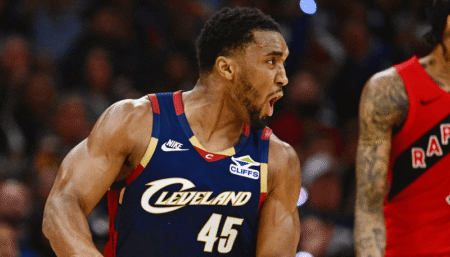
Harden promptly ripped the Raptors, and virtually every defensive coverage they deployed, to shreds in the Cavs’ 126-113 victory on Saturday. A 22-point, 10-assist performance is relatively straightforward; the pick-and-roll dominance — 36 on-ball picks received, an absurd 1.28 points per possession on those trips — was the real story.
What stood out to me, aside from Harden having answers to the schematic test, was how high up the floor a lot of those ball screens happened. It’s one thing to have to deal with talented ball-screen partnerships — it’s another when you have to do so while being stretched thin from a spacing perspective.
More broadly, it felt like the Cavs were consistently intentional about maximizing their space — Spacemaxxing? Can we say that? — with their ball screens in real time. In addition to running them high on the floor, they often paired those actions with their weakside spacer lifting from the corner to the wing to put a help defender in peril.
Advertisement
Help on the roll, and a shooter’s open; stay attached to the shooter, and you have Jarrett Allen or Evan Mobley rolling free to the basket.
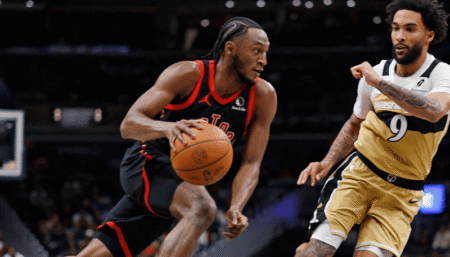
To that end: per Second Spectrum, the Cavs ran 28 ball screens 30+ feet from the basket, their fifth-highest total in a game this season.
(If you extend it to 35 feet or more, the number is still 10 — their highest clip in a game, only trailing the Phoenix Suns, who had 12 on Feb. 3 against the Trail Blazers, for the most by anyone in a game this season.)
When operating 30+ feet from the basket, they were just as lethal: 1.21 points per possession on those trips, with the Raptors getting progressively more frustrated as the game went on. Toronto’s screen navigation, drive containment, and help discipline must all be better moving forward, or this series won’t last very long.
Nuggets-Timberwolves
Key number to watch: 1.64
You can’t talk about the Denver Nuggets without talking about the dominant pairing of Nikola Jokić and Jamal Murray. In Jokić, you have an all-time great who can knock down shots from anywhere and make every pass in the book. In Murray, you have a true three-level scorer who can exhaust you with his on-and-off-ball blend of usage and his overall aggression.
Advertisement
Together, you have a two-man game that nobody really has an answer for.
The Nuggets often exacerbate the problem by mixing in different spacing looks for the two to operate within. My favorite is the “flat spacing” alignment: it’s when there’s a player spaced in each corner, and a third player stashed in the dunker spot (low block area).
Here’s an example of what it looks like. Cam Johnson and Tim Hardaway Jr. are in the corners, while Spencer Jones is in the dunker spot. This gives Murray and Jokić a ton of space to work with since both the left and right wing are empty.
There’s already little you can do to contain these two; the inherent nature of this spacing alignment makes it tough to send help without potentially giving up something even more fruitful. In Denver’s Game 1 victory, the Wolves found that out the hard way — over, and over, and over again.
Going back through Denver’s offensive possessions, there were 11 instances — 10 if you don’t count the Chicago action rep at the very end of the video above — where those two were in action together with a flat spacing alignment. The Nuggets scored 18 points on those trips — 1.64 (or 1.8) points per possession.
Advertisement
There isn’t an easy answer to this particular problem, but the Wolves have to find something that’ll bring that number down.
Knicks-Hawks
Key number to watch: 1.15
One of my pressing questions heading into this series was how the Hawks would go about defending Karl-Anthony Towns. Would they defend him straight-up positionally with Onyeka Okongwu, or would they pull the increasingly popular gambit of stashing a wing or forward on Towns while allowing Okongwu to “guard” Josh Hart, ultimately acting as a roamer?
On April 6, their final regular-season matchup but their first with the current iteration of these teams, the Hawks opted for the former. The two-man game between Jalen Brunson and Towns largely destroyed them from the opening tip.
Advertisement
In Game 1, the Hawks stuck with the same plan. The Brunson-Towns pairing once again got busy in ball screens (15 picks, 1.46 PPP) while sprinkling in some pass-and-cut actions. Zooming out, I was more enamored by the touches that Towns received above the break — with some of those approaching the logo.
Between pick-and-pops and genuine passing hub work, Towns is able to stress defenses twofold. He’s obviously good enough to make shots and reads; but because he’s being defended by the best rim protector on the floor, the Hawks’ backline is extremely exposed with Towns being that high on the floor.
The play below is a transition scramble, but you can see the amount of strain a Towns pop can have:
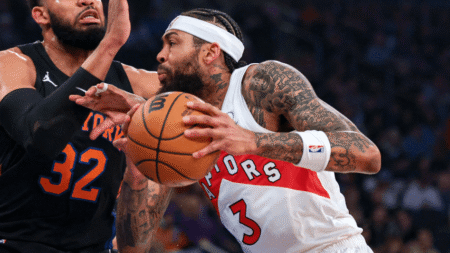
Towns logged 29 above-the-break touches in the Knicks’ Game 1 victory, his sixth highest total in a game this season. The Knicks generated 1.15 points per possession on those trips, an elite figure that represents an increase from the regular season (1.12 PPP).
Advertisement
In fact, among 117 players to log at least 1,000 above-the-break touches during the regular season, Towns ranked fifth in the NBA — behind four guards at that. He narrowly edged out Nikola Jokić (1.11 PPP, 6th) for the best mark among bigs within that same pool.
The Hawks did experiment with some cross-matching in the fourth quarter of Game 1, but the game was firmly in the Knicks’ control at that point. We’ll see if the Hawks want to “blink” and cross-match at the start of Game 2.
Lakers-Rockets
Key number to watch: 111.6
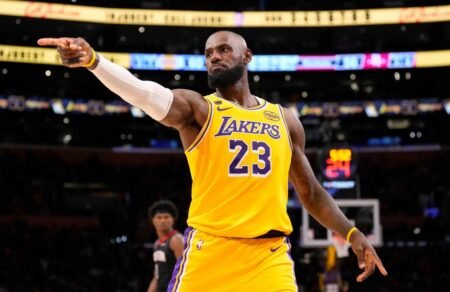
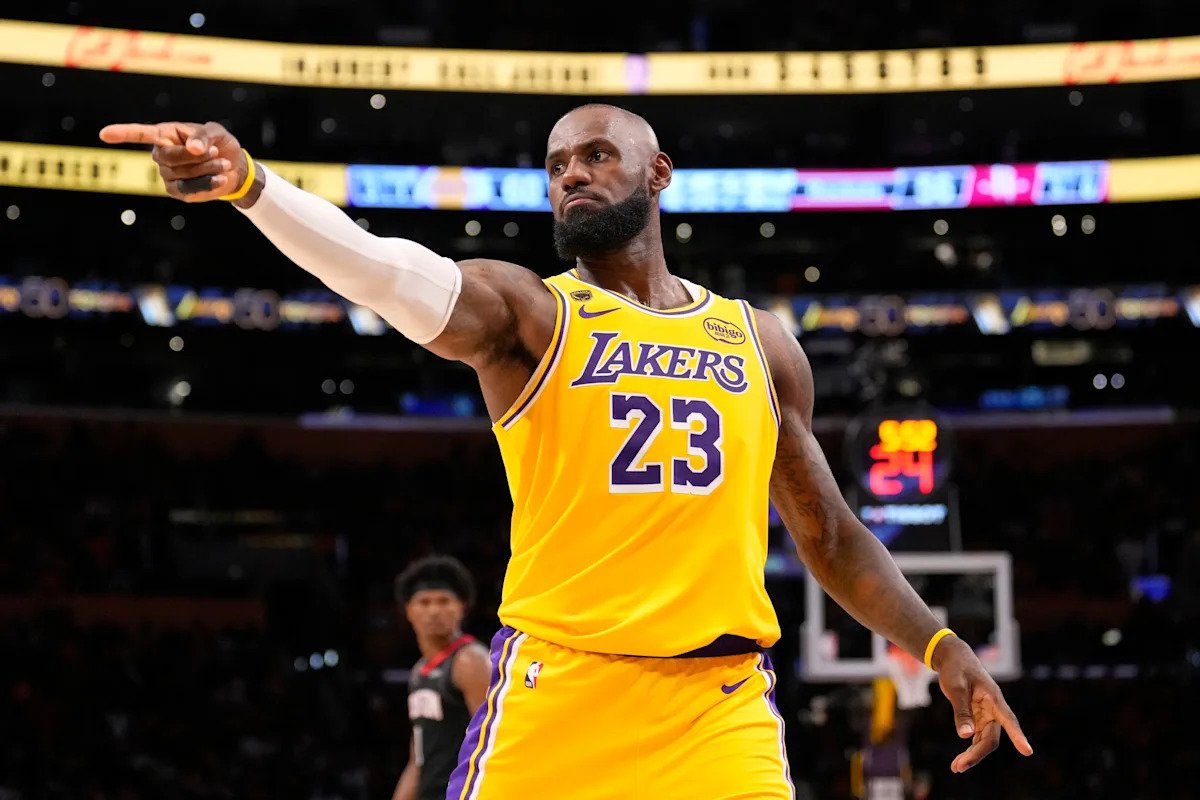
If I told you the Lakers, down Luka Dončić and Austin Reaves, were going to have a solid offensive performance against the Houston Rockets in a convincing win, your mind probably would’ve went to LeBron James having some sort of turn-the-clock-back scoring binge with timely shotmaking from others.
Advertisement
What we got was a high dosage of LePlaymaker, logging a career-high eight assists in the first quarter before ultimately finishing with 19-8-13 and three stocks.
Now, if I told you the Lakers were not only going to light up the Rockets in the half-court, that you’d have to go back at least three years to find a comparable outing — and even longer to find a winning one — your brow might’ve raised smooth off your forehead. I know mine nearly did.
Sure enough, the Lakers logged a 111.6 offensive rating in the half-court on Saturday, their highest half-court offensive rating in a playoff game since Game 1 of the Western Conference finals against the Denver Nuggets (115.3) in 2023.
Advertisement
It’s their highest in a playoff win since their Game 5 Western Conference finals matchup with the Nuggets (114.5) … in the 2020 Bubble.
There were plenty of goodies in this one. They moved LeBron around the board as an initiator, screener, and post (or elbow) threat. The back-’em-down touches (8 total, 1.33 PPP) were insanely fruitful, with some fun shotmaking (a lefty hook, anyone?) in his film.
Luke Kennard lost his mind from deep (5-of-5), but the off-ball work to get him curling inside the arc for midrange bucket-getting was a pleasant surprise. As with any LeBron-led playoff offense, there was also a healthy dose of matchup-hunting.
They went after Reed Sheppard, getting him involved to navigate screens, goading him into unfavorable switches, forcing him to defend Marcus Smart post-ups, and even a transition seal from Smart for good measure.
Obviously, the health of Kevin Durant looms large over this series. But Houston’s defense can’t break down the way it did in Game 1. The Lakers deserve a ton of credit for their offensive purpose, variety, and incredible shotmaking. The Rockets simply have to tighten the screws — some of their breakdowns were incredibly loud — regardless of if Durant returns or not.
Celtics-76ers
Key number to watch: 43.8%
With Joel Embiid out for Game 1, and potentially the first round entirely, attention rightfully shifted to Tyrese Maxey. He’s played at an All-NBA level all season, and they’d need that version of him (if not more) to hang with this Celtics team.
Advertisement
They didn’t get that from Maxey in Game 1’s loss — or anyone, really.
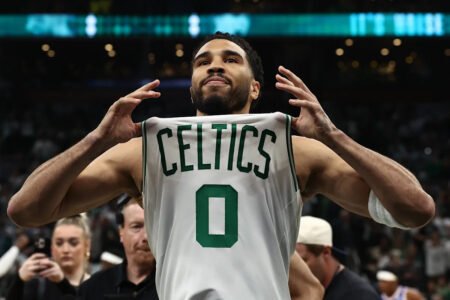
Maxey led the team with 21 points, but went 7-of-16 (43.8%) on shots inside the arc, continuing his season-wide struggles against them despite his career-season (52.5%) overall. He also went 1-of-4 from deep; considering how far back the Celtics’ bigs were dropping in pick-and-roll, I don’t know if I’m more bothered by the singular make or the four attempts.
The inside the arc bit is really what I want to focus on, because I think it represents a clear-but-attainable growth-area for Maxey. He’s an absolute speed demon with awkward-foot gathers and growing foul-drawing craft. He’s growing more comfortable as a floater artist and pull-up middy threat.
But he’s not completely there yet, and the Celtics know it.
Advertisement
Maxey saw at least one help defender on 90% of his drives, leading to inconsistent process from him. On the high end, he was able to get into the teeth of the defense for fouls or finishes, or beat some of the funky rotations the Celtics were sprinkling in by advancing the ball to the wing and letting that person make a play against tilted defenses.
On the low end, his pacing felt a smidge too fast. That, combined with early pickups for foul-drawing attempts, were understandable from a process standpoint, but also put him (and the Sixers’ transition defense) in trouble at times.
I ultimately think he’s going to be fine, and surely the Sixers will make more open shots than they did on Sunday. But it is worth noting they need Maxey to hit all the notes to compensate for the overall talent edge.
Thunder-Suns
Key number to watch: 0.61
I’m running out of things to say about the Thunder defense.
Advertisement
They were the league’s stingiest unit this year; with Cleaning The Glass’ garbage time-removed tracking, they were one of the best defenses in modern history relative to league average. They have dawgs everywhere; when they’re humming, they can choke the life out of offenses in a way that’s mildly uncomfortable.
(THIS IS NOT THE SPACE TO FILE YOUR REF COMPLAINTS. DO THAT ELSEWHERE.)
It’s safe to say they were humming on Sunday, holding the Phoenix Suns to 84 points in a dominant Game 1 victory. The Suns could only muster an 89.7 offensive rating before garbage time kicked in; their 62.0 offensive rating in the half-court reads like a typo.
You should be familiar with the Thunder ethos by now; insane ball pressure that can extend, never-ending physicality off the ball, coverage versatility with their bigs, and a willingness to switch (and scram switch) whenever they feel the need to. We gotta talk about the way they swarm and recover, though.
Advertisement
Like, what is this?
It felt like any time a Suns player — Devin Booker, Jalen Green, and Dillon Brooks logged double digit attacks — attempted to get downhill, they were thwarted by pristine screen navigation, slowed by a Thunder big creeping up to give their navigator time to recover, or a third Thunder player was nearby to make them think twice (or thrice) about what they were doing.
Overall, the Suns logged 40 drives with at least one Thunder help defender present, just the 16th time they’ve seen help that often this season. This was easily their worst performance among those games, generating [checks notes] 0.61 points per possession on those trips.
Advertisement
Their pathway to finding more success involves finding more room to breathe; a daunting task against this unit, but, as the regular-season matchups showed, not an impossible one.
Pistons-Magic
Key number to watch: 0
Whew, buddy, what a game from the Orlando Magic.
Their offense was likely the story for a lot of people, and rightfully so. It would appear #PlayoffPaolo is a real thing after putting Detroit in the blender with the kind of driving oomph, jumper efficiency, and overall processing speed that makes you wonder, aloud, “Why the heck can he not do this all the time?!”
Attached to that was the decisiveness and timely contributions of the others. Jalen Suggs’ hot start; the second half exploits of Franz Wagner and Desmond Bane; the consistently good decision-making in the short-roll from Wendell Carter Jr. It was there, and it was impressive.
Advertisement
I’d like to shift to the defense, in which the Magic were also excellent. One of the things that popped early was their willingness to mix coverages against Cade Cunningham in ball screens — sometimes it’s a switch, sometimes it’s a drop, sometimes it’s ICE coverage and you don’t know how high (or not) the big will be.
It’s easy to see what kind of impact that can have on Cade, though he wound up having a phenomenal game as he got increasingly more comfortable. The real story is what that mixture did to take away Jalen Duren.
The Magic’s help defense — and the timeliness of that help — shined throughout the game. The switching naturally took away some of the easy pockets on Duren’s rolls to the basket. When dealing with more traditional coverages, the Magic were dutiful in their tags — and occasionally audacious with their rotations.
The example below isn’t a ball screen, but the same principle applies. Duren gets a favorable matchup to seal, but he’s getting nothing easy.
That brings me to this: Sunday’s Game 1 was the second time all season that the Cade-Duren pairing ran at least 20 pick-and-rolls with Duren logging zero shot attempts or drawing a shooting foul. You’d have to go back to Nov. 10 — the 45-shot, “I’m not bleepin’ losing” effort from Cade in the shorthanded Pistons’ overtime win over the Wizards — to find the other one.
Advertisement
Place this in the “duh” box, but that simply can’t happen moving forward. Duren has to be more involved in ball screens — maybe we see an uptick in empty side actions in Game 2. Outside of the ball screen context, he just needs to be more assertive, period. We know he has it in him.
Spurs-Trail Blazers
Key number to watch: 107.1
Similar to the Cavs-Raptors matchup, I was excited to see this one largely because we didn’t have a reliable regular-season sample to take info from. Multiple key Blazers were missing during the meetings and, most notably, Victor Wembanyama didn’t appear in any of the matchups.
Advertisement
Question No. 1 for me was a simple one: Who were they going to give the Wemby assignment to?
To my cross-matching delight, the Blazers gave the keys to Toumani Camara (and Jerami Grant when he subbed in), with Donovan Clingan (and Robert Williams when he subbed in) roaming off Stephon Castle or whichever wing the Blazers dubbed as the least threatening shooter.
The opening possession of the game highlighted the theory behind the matchups. You can, ideally, mute some of the impact of the perimeter-based actions with Wemby. You can turn ball screens featuring him and De’Aaron Fox into switches. With Clingan staying near the paint, you can maintain a rim protecting and rebounding presence.
You can see it here, too:
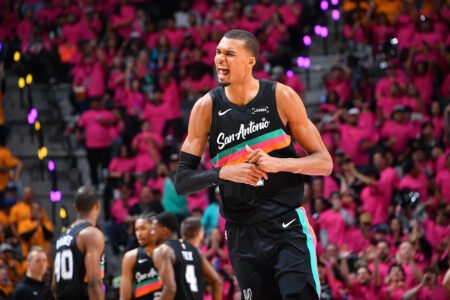
The box score will say it didn’t work — Wemby dropped 35 in his playoff debut, and the Spurs ultimately snagged a 111-98 victory — but I’d push back a bit. I’d argue it didn’t ultimately matter because of the game result, but the gambit largely did what it was supposed to.
Advertisement
Second Spectrum tracks who’s guarding who in half-court settings, and the who’s-guarding-Wemby split, positionally, was probably louder than it felt in real time.
-
Guarded by Clingan or Williams: 15 points on 14 matchups (107.1 points per 100 half-court matchups)
-
Guarded by Camara or Grant: 9 points on 28 matchups (32.1 points per 100 half-court matchups)
To be clear, that wing-based number is still good, but the Blazers obviously felt (and likely still feel) that this sort of cross-matching is more tenable for their defense.
Zoom out, and the Spurs only had a 90.5 offensive rating in the half-court — that’s well below their regular-season average (102.4, 4th). You could argue the Blazers did their job on that front; they just can’t afford to have an even lower offensive rating in the half-court (87.5) like they did in Game 1.
Read the full article here