



Morocco have been declared the winners of the 2025 Africa Cup of Nations after the Confederation of African Football (Caf) overturned the result of the final following Senegal’s controversial walk-off.
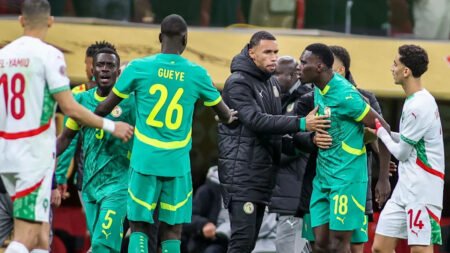
Senegal beat Morocco 1-0 in the final on 18 January in a match which was overshadowed when the Senegalese players refused to play after the hosts were awarded a stoppage-time penalty with the match goalless.
Advertisement
Following a delay of around 17 minutes, the players did eventually return and Brahim Diaz’s penalty was saved before Senegal’s Pape Gueye scored an extra-time winner.
However, that result has now been overturned after a decision by an appeal board at African football’s governing body.
A statement from Caf said that Senegal are “declared to have forfeited the final match” with the “result of the match being recorded as 3-0 in favour” of Morocco.
The Senegalese Football Federation said it would appeal Caf’s decision at the Court of Arbitration for Sport, calling it “unfair, unprecedented and unacceptable”.
Advertisement
The decision follows an appeal by Moroccan FA (FRMF) which Caf said is “declared admissible in form” and was upheld.
Caf added that “through the conduct of its team” Senegal infringed on Article 82 of regulations of the Africa Cup of Nations and as a result Article 84 became applicable.
Article 82 states that if a team refuses to play or leaves the ground before the end of regulation time without the referee’s authorisation, it will be considered the loser and eliminated from the competition.
Article 84 complements this provision, stating that any team that violates Articles 82 will be permanently eliminated and will lose the match 3-0.
Advertisement
A statement from FRMF said that their decision to appeal the final result was “never intended to challenge the sporting performance of the teams” but was a request for the “application of the competition’s regulations”.
“The federation reaffirms its commitment to respecting the rules, ensuring clarity in the competitive framework, and maintaining stability within African competitions,” the FRMF statement added.
“It also wishes to commend all the nations that took part in this edition of the Afcon, which has been a major moment for African football.”
Earlier, a video was posted on the X account of the Senegal men’s national team of their players celebrating on a bus parade with the Afcon trophy and an ‘OK’ emoji.
Advertisement
Maher Mezahi, a North African football journalist, told BBC Radio 5 Live that the decision to overturn the result will not change the emotional impact of what unfolded on the pitch for those who witnessed it.
“We cannot erase the final 16 minutes of that match and what we saw,” he said.
“We cannot erase the feelings of seeing Senegal lift the trophy and the players going home with the medal and them having a parade.”
What happened in the Afcon final?
With the scoreline 0-0, referee Jean Jacques Ndala gave a spot-kick in the eighth minute of added on time.
Ndala was advised by the video assistant referee (VAR) to consult the pitchside monitor and review defender El Hadji Malick Diouf’s challenge on Diaz.
Advertisement
Senegal head coach Pape Thiaw, still incensed by Ndala’s decision a few moments earlier to disallow a Senegal goal from Ismaila Sarr, ushered his team off the field.
Former Liverpool striker Sadio Mane stayed on the pitch and tried to encourage his Senegal team-mates to finish the game.
After a 17-minute delay, Senegal’s players did eventually return.
Real Madrid forward Diaz was trusted with the penalty, but his tame ‘Panenka’ effort was caught by Senegal keeper Edouard Mendy who barely had to move, and Ndala immediately blew his whistle for full-time.
Villarreal midfielder Gueye then scored the winning goal in the fourth minute of extra time to seal a second triumph in five years for Senegal.
Advertisement
In his post-match news conference, Morocco coach Walid Regragui said Senegal’s actions were “shameful” and do not “honour Africa”.
Fifa president Gianni Infantino strongly condemned the “ugly scenes” in a post on Instagram.
Thiaw, meanwhile, had his media briefing cancelled after a ruckus broke out in the press room.
But in a later post-match interview he accepted that he should not have ordered his team off the field and he had reacted “in the heat of the moment”.
Morocco subsequently parted company with head coach Walid Regragui on 5 March – four months before the World Cup finals.
Read the full article here