

As you know, the collective-bargaining agreement between MLB owners and the MLB Players Association ends on Dec. 1, 2026. The last time such an expiration happened, five years ago, owners began a lockout on Dec. 1, 2021 that ran well into March and threatened the entire 2022 season.
That didn’t happen, though Spring Training 2022 was truncated and after games had been “cancelled,” owners and players agreed to squish a 162-game season into a time frame shorter than normal, largely through playing doubleheaders (the Cubs played six of them, five at Wrigley Field, not much fun for anyone).
Advertisement
So we stand just about seven months from that CBA expiration and Evan Drellich of The Athletic has written an article that covers many of the main points that will need to be addressed in the negotiations. I’m going to hit some of those points here and give a bit of commentary, and later on, I’ll note something that Drellich left out.
First, a bit of the time frame we’re looking at:
In the next couple weeks, MLB and the Players Association are expected to formally start negotiations.
First, the talks will open with a months-long prelude of proposal exchanges. The parties will, naturally, both start out asking for more than they expect to receive.
Last go-around, the sides made opening presentations on April 20, 2021. The players made their first economic proposals in May, and the owners their first in August. A deal wasn’t finalized until March 10, just in time to preserve a full 162-game schedule for 2022.
COMMENT: So, as you see, the time frame of “formal negotiations” will be about the same as it was five years ago. As you can also see, these things move slowly. They are expected to move even more slowly this time because of all the talk, that you have surely heard, about owners wanting a salary cap.
MLB has not confirmed it will make a cap proposal, but Manfred has made many overtures in that direction, and people briefed on ownership thinking who were not authorized to speak publicly say the owners have settled on that approach.
Much will depend, however, on whether owners actually stick by their opening salvo. It’s one thing for MLB to propose a cap at the outset and another to still be fighting for it next spring.
If owners are committed to landing a cap no matter what it takes, the lockout could well cost a season. In that scenario, both sides would try to outlast the other, and historically, little has galvanized players more than attempts to limit their pay.
If the owners eventually back off a cap proposal, preserving some form of the current market system, the 2027 season probably has a better chance to be played in full. The devil would then be in the details of the alternative proposals — and, as always, which side is motivated to outlast the other.
COMMENT: And there we have it, with many owners supposedly being adamant about wanting a cap this time, as opposed to the current “luxury tax” system, a system that some owners (Dodgers, Mets in particular) have shown no interest in limiting themselves to the existing tax levels. The difference, for example, of the Dodgers’ 2026 player tax payroll of $416 million is $337 million more than the bottom-ranking Marlins ($79 million). The difference is more than the entire payrolls of all but two teams (Mets, Yankees).
Advertisement
This is the sort of disparity that concerns many team owners, some of whom feel the only way to stop it is to have a cap. Other payroll-related things, notably the deferred contracts some teams, including the Cubs, have begun to issue, are bound to come up in the negotiations.
So who caves first on this issue, and will we lose games in 2027?
Anything is possible. The damage done to the sport would be to some extent proportional to the number of games missed. Fans would likely more easily forget a missed month than a missed season.
In recent years, some owners have been curious whether players might cave on a cap quickly, or at least, more quickly than expected. This is not a group of players that has been heavily battle-tested, in a labor sense.
Players, too, have differing interests. Some are close to free agency, some are far away, others might never get there. Maybe more of them find a cap appealing today than they did 30 years ago, although there’s no indication of that so far. Stars such as Bryce Harper, Manny Machado and Brent Rooker have spoken out against the change.
“It remains to be seen whether the union can do better by the rank-and-file players than they have in recent years,” Harry Marino, a former MLBPA lawyer who challenged union leadership during a 2024 mutiny, recently told The Athletic. “Do I think that that can be achieved without a salary cap? I do, but the priority of the union has to be the well-being of every single member.”
COMMENT: Drellich is right about a missed month as opposed to losing an entire season. A missed month could mean some games made up; in 1995, for example, coming off that tremendously damaging labor dispute, a 144-game schedule was agreed to. Thirty-one years later, no one really blinks an eye at the 18 games that were missed that year, though it’s possible the missed games cost Albert Belle, who hit 50 home runs that year, a chance at 60.
More important than just missed games is the perception of missed games. Baseball seems to be riding a high right now in popularity. Attendance was up last year. TV ratings are good, and the recent World Baseball Classic got huge audiences compared to previous such events. MLB, per the Drellich article, had about $12 billion of revenue in 2025 and could touch $13 billion in 2026. Do owners really want to risk that, especially because of this?
The league office also has to soon negotiate new national TV deals for 2029 and beyond, and missed games will not help the haul.
If regular-season games wind up canceled, the outcry would be immense. Pressure to end the lockout would fly in from all angles, including TV networks and cable companies and sponsors. Fans would vilify all involved, from the owners who bought teams with hope of being beloved public figures, to the superstar players who are otherwise adored.
COMMENT: No question, Drellich is right about this. MLB hasn’t had a labor dispute that cost games in more than 30 years (the 1994-95 strike). Even in 2022, as noted above, all the “cancelled” games were eventually played, every MLB team played a full 162-game schedule that year.
Advertisement
You can bet that team owners are concerned about those TV deals. As of last year, 49 percent of MLB revenue came from TV deals, about 26 percent from national TV and 23 percent from local. That’s especially important because of this desire of Commissioner Rob Manfred:
Manfred wants to revise the sport’s media-rights structure and the way teams share TV money between themselves — revenue sharing, as it’s called. Manfred believes the answer to the local-media problems is to divide local TV revenues more evenly and to ultimately sell more games nationally.
A cap makes it easier for the commissioner to get all his owners on board with such changes. Large-market teams probably won’t be willing to share significantly more TV money with small-market teams unless a cap arrives.
Indeed, what revisions Manfred could build owner support for in the media-rights and revenue-sharing buckets without a cap is one of the most fascinating questions entering bargaining.
COMMENT: There’s the crux of things right there. With potentially $6 billion (or more) of revenue at stake, Manfred and team owners don’t want to anger TV partners to the point where they don’t want to make deals offering more money.
Would a cap do what Manfred wants? Would it persuade owners of teams like the Cubs, Dodgers, Mets and Yankees, all of whom own their own local RSNs, to go in with MLB Local Media, which now controls the rights for 14 of the 30 teams (and also handles streaming for six others)?
This is not the only reason owners want a cap, but it is one of the most important. Manfred thinks the league could make more in TV revenue if he could offer the entire package — national and local rights — as one thing. He could be right, although the cautionary tale is the very public divorce between MLB and ESPN last spring, which cancelled the last three years of that deal, about $550 million a year. Eventually, the two kissed and made up and signed a deal for about the same money — but MLB had to sell off MLB.TV as a result. That’s all fine and good for the league, maybe not so much for fans, who by next year are likely going to have to spend more money to get MLB.TV.
Advertisement
Same as it ever was, I suppose.
That leads to the bottom line here:
March 2027 is the month to circle, because if a deal isn’t reached then, it’s impossible to hold even a truncated spring training ahead of a full 162-game schedule. Not without drastically altering the schedule, anyway.
Could the sides reach a deal a bit later, maybe in April 2027, and push back the regular season and the playoffs while still playing 162? Maybe, but it’d be a logistical nightmare. For example: Fox, a league broadcast partner, would have to be open to moving the World Series.
If the lockout ultimately extends beyond March, the end date becomes anyone’s guess.
COMMENT: Unless something truly unusual happens, there will be a lockout Dec. 1. Manfred has all but said that will be the case. That means the sport completely shuts down — no Winter Meetings, no free agent signings, no trades, likely no Cubs Convention.
So things would be quiet, as they were in the 2021-22 offseason, until March. Last time, it almost appeared we were going to lose the entire season, with games being “cancelled,” until suddenly, there was a deal. Let’s hope it’s not as messy this time.
I said there was one thing left out of Drellich’s article, and that’s the idea of a salary floor to go along with a cap. I don’t think a cap works without a floor. If MLB had a system like that — and a guaranteed percentage of league revenue going to players — players might be willing to do that, if the percentage was high enough. This article says it’s probably not:
MLB players received 47% of total league revenues in 2024 (figure does not include the estimated ~$800mm in annual expenses that go toward minor league players represented by the MLBPA). By contrast, NFL, NBA, and NHL players all share ~50% of their respective leagues’ pie.
It is estimated that baseball’s players association has left ~$2.5bn on the table over the last three years by failing to tie compensation to revenues (assumes 50/50 split).
As the old saying goes: “A billion here, a billion there, soon you’re talking about real money.” Players are the game. No one goes to a MLB game, or watches one on TV, to watch owners own teams. In a $13 billion industry, the people who produce the value — in this case the players — should get at least half of league revenue. Do that with a cap and floor and now you might have the basis for a deal. In practice, what that would mean is that teams that don’t spend now (Marlins, Guardians, White Sox, Rays are the bottom four in payroll this year) would have to. Some mid-range free agents (Lucas Giolito, maybe?) would be signed for more money than they’re making now.
Advertisement
If a cap/floor system happens, one thing that would have to go along with it is grandfathering existing contracts until they end. This is one reason, I believe, that teams signed players to long-term extensions this spring (including the Cubs, with Nico Hoerner and Pete Crow-Armstrong). They did so to get cost certainty in a possible cap system.
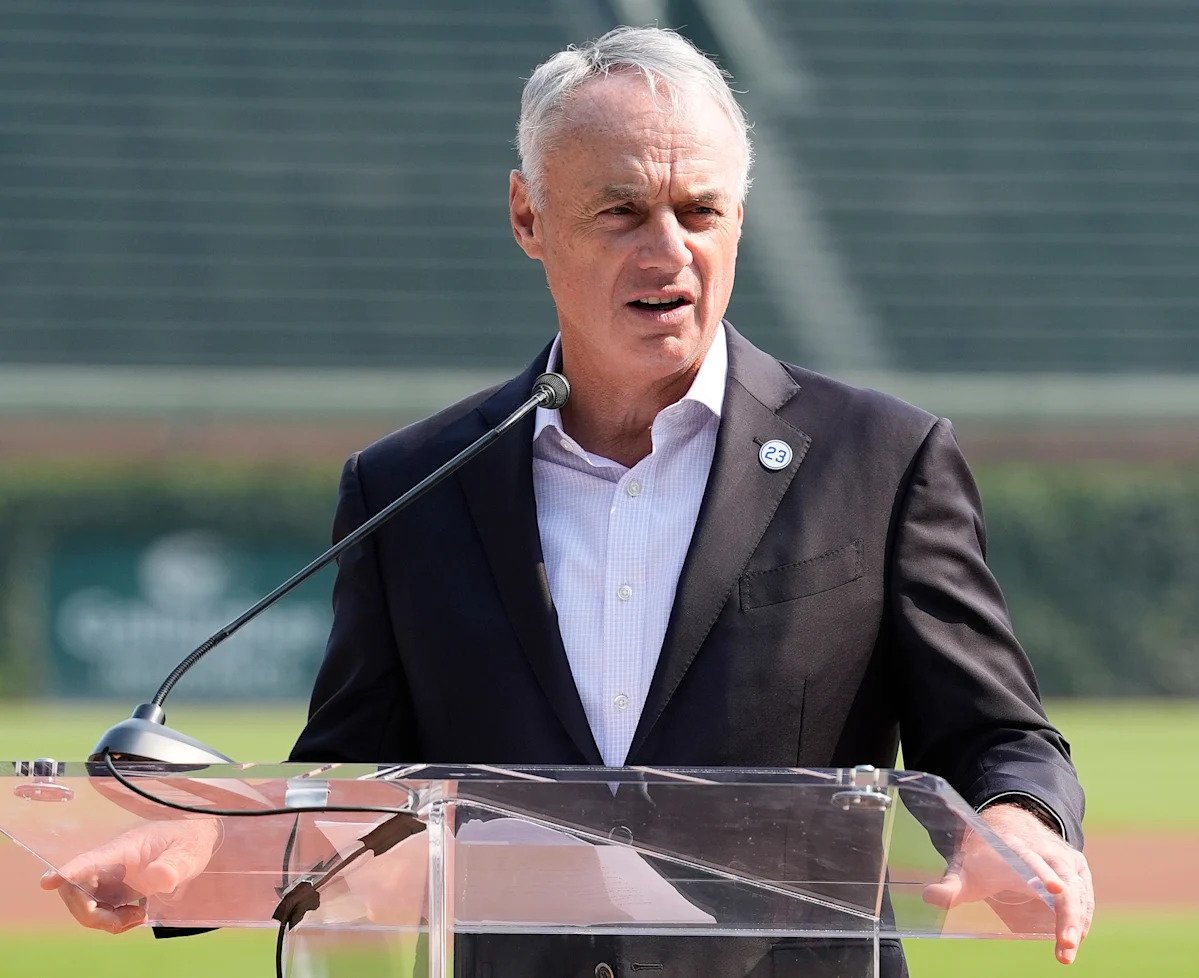
Lastly, for the Cubs the 2027 All-Star Game is at stake — the photo above is of Manfred at Wrigley announcing the ‘27 ASG awarded to the Cubs last August. The Cubs have reportedly been told that if a labor dispute wipes out the ‘27 ASG, they’d get it in ‘28 or ‘29. Clearly, though, with planning already in progress, the Cubs would like for the All-Star Game to be played as scheduled at Wrigley Field in July 2027.
Much has to be done, obviously, before there’s a deal. Both owners and players have an interest in not losing any 2027 games to a labor dispute. Let’s hope they can put together a deal that’s good for everyone — including fans.
Read the full article here