




There was a lot of talk about running it back this offseason. After a frustratingly brief trip to the Elysian Fields of the playoffs, the fans, writ broadly, wanted change. Few, if any, would’ve wanted a change in Jesús Luzardo, though. His first season in red pinstripes (and blue/black gradient thing; not to fear, City Connect skeptics, the Phillies are scheduled to get a new one next season) was excellent, with the bespectacled baseballer bedeviling batters with his new sweeper. His ERA of 3.92 was solid, and the underlying numbers suggested his performance was better than that. When the Phaithful insisted that there be no running it back, they didn’t mean Luzardo. They would’ve been fine with him keeping his approach the same.
He didn’t, though.
Advertisement
His approach in the still-young 2026 campaign might look like running it back at first. He’s presenting the same pitch mix as last year: sweeper, 4-seamer, changeup, sinker, slider. For the moment, the sweeper has swapped places with the 4-seamer as the most used pitch, but that doesn’t seem to represent a sea change. Certainly nothing like the change Luzardo made at the start of last season, when he introduced said sweeper. Names, though, can be deceiving (as someone who has a surname that sounds like a first name, I know this very well). Just because he’s throwing five pitches with the same names as last season doesn’t mean he’s throwing the same five pitches.
That’s a chart showing the vertical movement of Luzardo’s pitches vs. the average for pitches of the same type, by season. What’s that green line, rising up from the dirt like the first shoots of spring? It’s Luzardo’s changeup. In 2025, it dropped 3.2 inches less than the average cambio. In 2026, it’s dropping 3.2 inches more than other pitches of its type. Year over year, it’s a change of 8.3 inches. That’s a changeup in a changeup, alright.
Why make that change, though? Luzardo’s changeup was a good pitch last season. It induced whiffs 36.2% of the time, placing in the top ten among changeups league-wide for that measure, and just behind Devin Williams’ feared Airbender. Luzardo accrued a run value of 6 with it; only nine hurlers got more value from their changeups. Pitchers may change their approach even when things are going well, in an attempt to keep ahead of batters (Zack Wheeler, in particular, is constantly tinkering and tweaking, even when he’s producing some of the best results in baseball). But it’s worth asking why it was the changeup, in particular, that changed.
Advertisement
Luzardo’s changeup was a good pitch last season, but his 4-seamer wasn’t. It wasn’t a bad pitch, exactly. Just not great, either. His 19.8% whiff rate with it ranked 128th. Batters slugged .421 against it. He accrued a run value of 0 with it. His so-so heater didn’t stop him from producing very good results last season, but it wasn’t a huge boon to his arsenal. The same is true of his sinker, which accrued a run value of -1. Overall, his fastballs just weren’t very good: he ranked in the 35th percentile for fastball run value. If there was some sort of tweak that Luzardo could make to his fastballs to turn them into plus pitches, it would be a major benefit. And while he doesn’t necessarily need a great fastballs to be a great pitcher when he’s got that sweeper, there’s no such thing as gilding the lily with a pitch arsenal: every advantage you can get in the endless arms race between hurler and hitter is worth pursuing.
There doesn’t seem to be too much change in Luzardo’s 4-seamer from last season. The vertical and horizontal movement are just about the same. He’s throwing it a half-tick harder (97 MPH vs. 96.5), but that doesn’t seem too meaningful. The sinker looks a bit different, dropping more and getting more arm-side movement, but the difference is much slighter than the changes in his changeup. He hasn’t really changed his fastballs much. That being said, you can change the results of a pitch without necessarily changing the pitch itself. Pitches do not exist in a vacuum; a change you make to one may impact the rest of your arsenal, too. Or rather, impact the way batters react to it. Luzardo may not have changed his fastballs, but the change to his changeup may be benefitting them anyway.
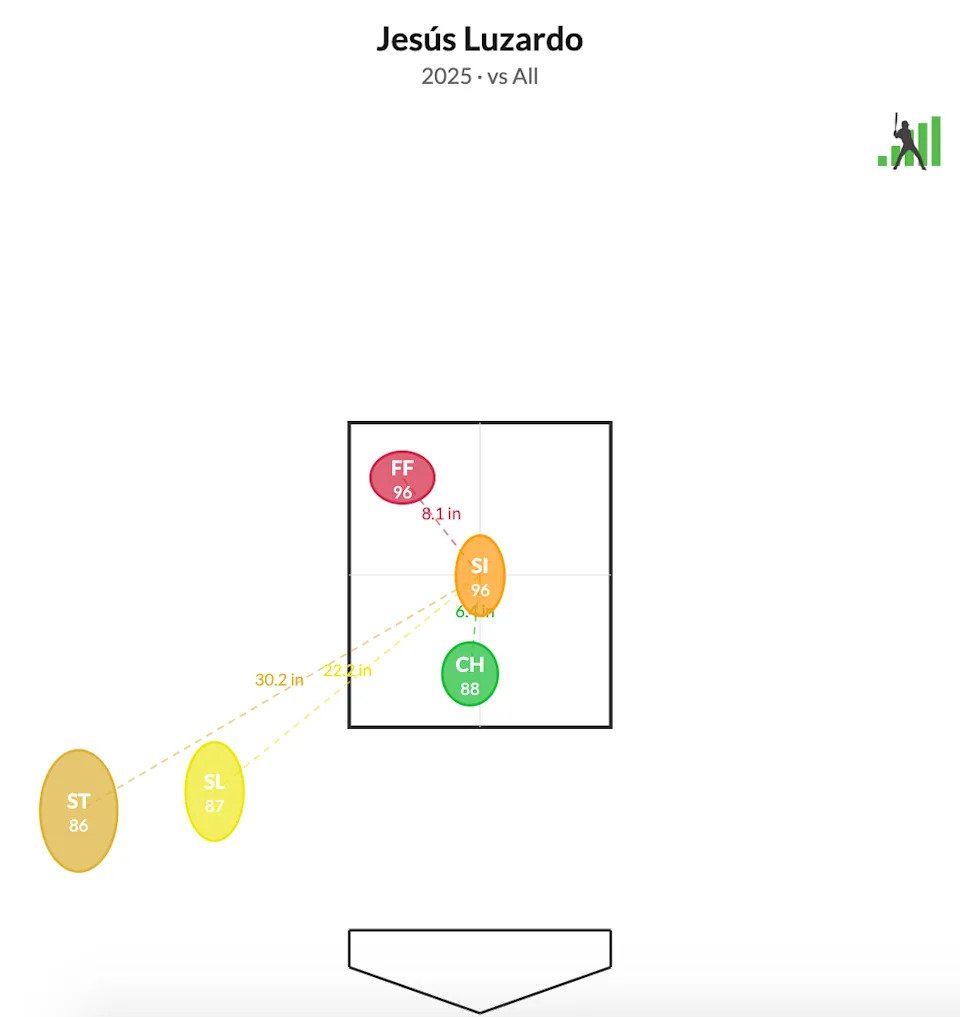
The whole point of a changeup is to baffle a batter who was expecting the fastball. The more distinct his changeup is from his 4-seamer and sinker, the more batters will be punished for guessing wrong. The slower the changeup is compared to the fastballs, the more the batter’s timing suffers for thinking he was getting the other pitch. The more the changeup moves compared to the fastballs, the more likely it is that the hitter will just flat-out whiff. So changes to the changeup ought to benefit not just that pitch, but the other fastballs as well. This is something that’s easier to understand visually. Fortunately, FanGraphs has introduced a new Paired Pitches tool that presents just that.
Here’s Luzardo’s pitches in 2025, using the sinker as the reference pitch:
And here’s his pitches in 2026:
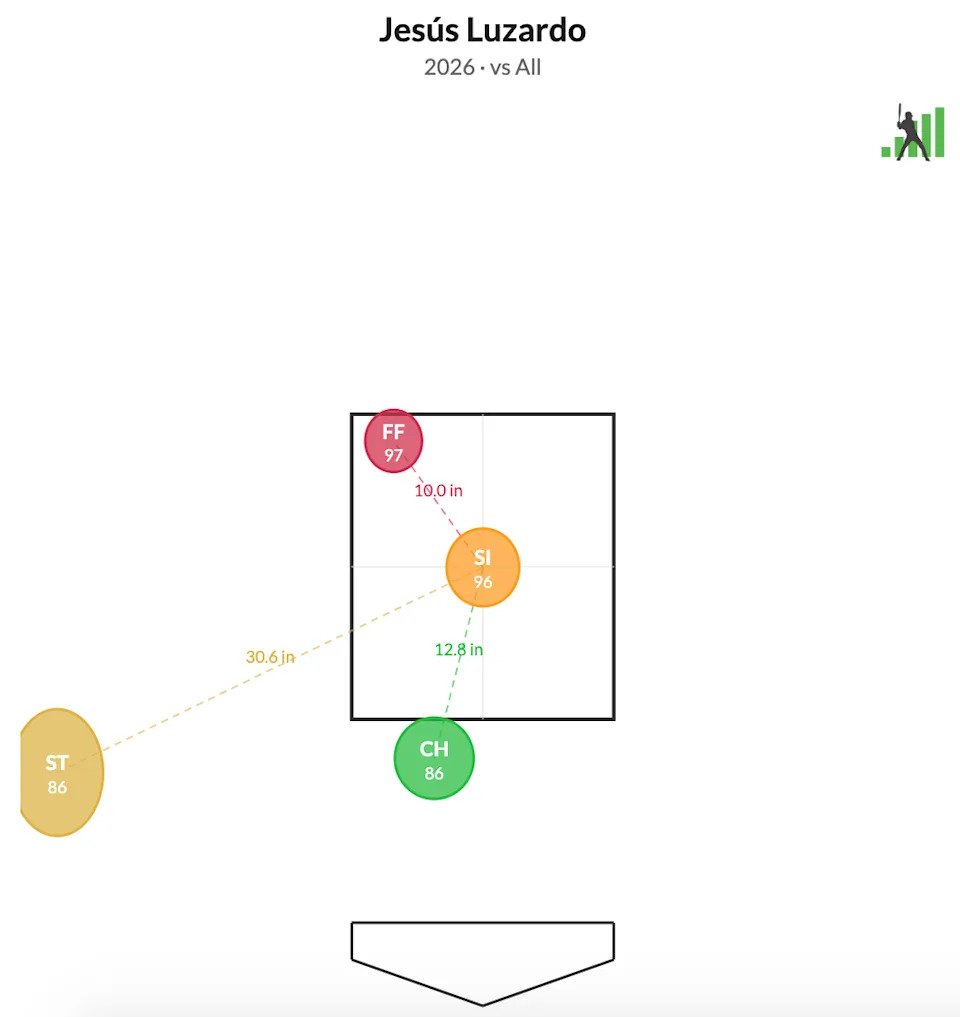
Luzardo’s changeup was always pretty distinct from the 4-seamer by location, though now it’s even more distinct from it in terms of speed. But the real difference comes in the comparison with the sinker. The location his sinkers end up in is now much different than the location his changeups end up in. Lower, and slightly less to the arm side. In particular, that difference in vertical location ought to induce more whiffs. In 2025, guessing wrong in everyone’s favorite game show of Is It A Sinker or a Changeup meant you were still swinging in roughly the right area. In 2026, guessing wrong means swinging way above or below the pitch, and just missing entirely. Cue Price is Right Sad Horns.
Advertisement
So, is that what we’re seeing with Luzardo’s results this year?
|
Pitch |
Whiff %, 2025 |
Whiff %, 2026 |
|---|---|---|
|
4-Seamer |
19.80% |
28.20% |
|
Sinker |
18.20% |
16% |
|
Changeup |
36.20% |
50% |
We can get a little bit more precise here: Luzardo almost exclusively deploys the changeup against right-handed hitters (which is what you’d expect; the typical use case for a changeup is against opposite-handed batters). How do those numbers look when we take only righty batters into account?
|
Pitch |
Whiff %, 2025 |
Whiff, 2026% |
|---|---|---|
|
4-Seamer |
18.40% |
27.80% |
|
Sinker |
11.60% |
7.70% |
|
Changeup |
35.10% |
48.40% |
Firstly, the standard caveat about early-season small sample size applies. We’ll need to see a lot more of these pitches before we can really draw any conclusions about what’s changed. But for the moment, let’s tread through the treacherous territory of saying things about small samples: for batters who really do have to worry about all three pitches, Luzardo’s 4-seamer and changeup are now more of a struggle. The sinker, though, appears to be less of one, at least by Whiff rate. Then again, Whiff rate may not be the right metric to look at for a sinker: the pitch is meant to generate weak contact, rather than misses. So improvement in that pitch would probably be better measured by how batters perform when they do make contact with it. And so far, the sinker has been more of a success this season: year-over-year, Luzardo’s sinker now has a lower hard hit rate, a lower barrel rate, a lower wOBA.
This is all early stuff. But for the moment, it looks like Luzardo may have improved two of his lesser pitches by tweaking one of his better ones.
Read the full article here