



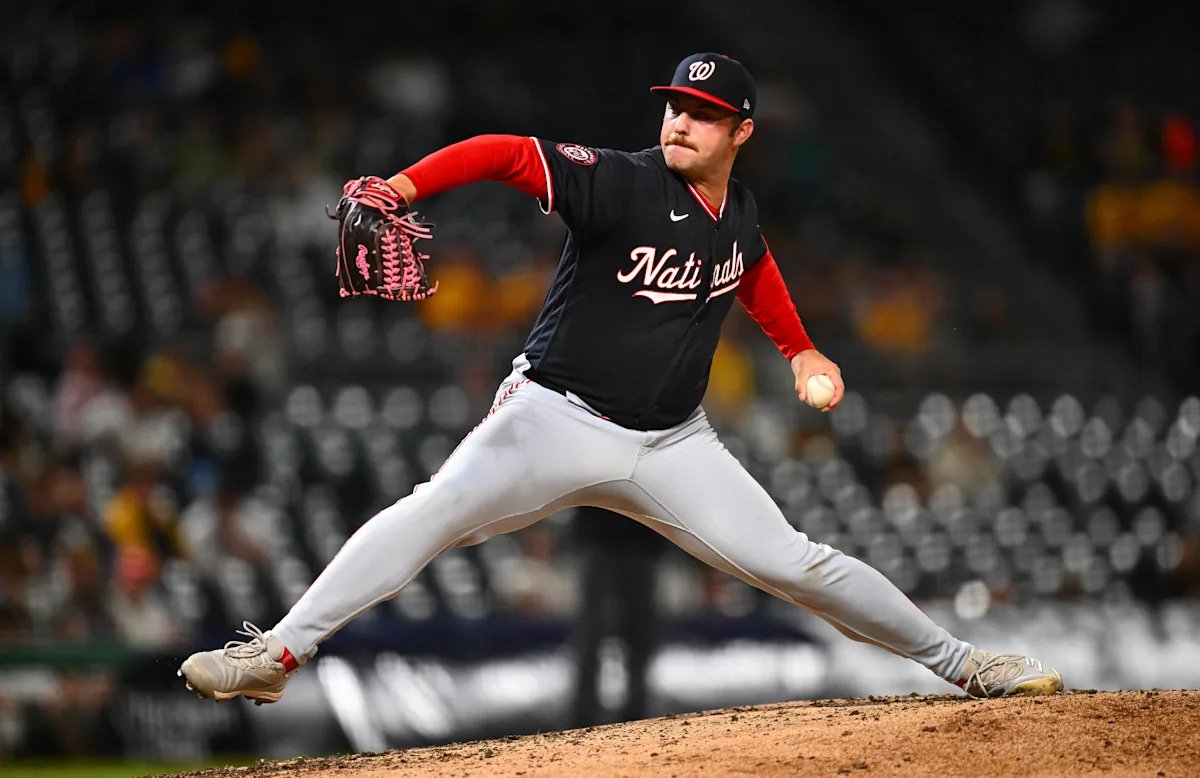
After a disastrous 2025 season, Mitchell Parker knew he had to change a lot. That point was driven home even further when the former rotation mainstay was sent to the minors on March 13th. Coming off a season where he posted a 5.68 ERA, Parker had to become a new pitcher to stick around in the big leagues.
Parker has done just that in 2026, totally changing up his arsenal. Last season, Parker threw his 4-seam fastball 55% of the time and his slider at a 12% clip. This year, he is throwing the slider at a crazy 58% rate and throwing the heater just 31% of the time. Who knows if this will work long term, but Mitchell Parker is a very different pitcher these days.
Advertisement
It is not just the usage that has changed though. The shape of Parker’s slider is also quite different. It is almost 2 mph slower than last year, but has much more break. When you look at the pitch plot, you can see how much Parker subtly manipulates the shape as well.
Despite heavy usage, the slider is really fooling hitters. Parker is generating whiffs almost 40% of the time on the slider, despite using it as his primary pitch. Batters are hitting a decent .259 off the pitch, but their expected batting average is .233.
The heavy slider usage is also helping Parker’s fastball be more effective. Batters are hitting .167 off his heater and whiffing almost twice as often this year. Parker’s whiff and chase rates this year have been elite, both ranking in the 93rd percentile. While this has only led to a 4.05 ERA so far, his underlying numbers suggest more improvement is in store.
Parker’s FIP and xFIP are 3.43 and 3.44 respectively. Last season both of those numbers were around 5. It is clear that Parker’s changes have made him a better pitcher. However, it is not just those changes that are allowing him to thrive. He is also in a new role as a multi-inning relief arm.
Advertisement
He is only going 2 or 3 innings per appearance. That allows him to spam those sliders without hitters catching on to it. If he used this approach as a starter who is meant to see hitters two or three times, he could be in trouble. However, this new mix and Parker’s experience as a starter makes him perfect as a multi-inning reliever.
Before the season, we talked a lot about the Nats cutting back on fastball usage. After being at the top of the charts for fastball usage last year, the Nats are now bottom 10 in that category. Parker is one of the guys who has benefited the most from that philosophy change. He was throwing a ton of heaters, but his fastball is not an elite pitch.
When Parker got recalled from AAA, you could immediately see his massive changes. In his first outing, Parker threw his slider over 60% of the time and was racking up the whiffs. It was pretty wild to see a pitcher you thought you knew transform that quickly.
Now, these changes are not going to make Parker an ace, or even part of the Nats long term pitching plans. However, it is clear that this slider heavy approach has made him a better pitcher. He now has a clear plus weapon that he can lean on to get big league hitters out. Parker’s slider has good movement and he is commanding it very well. When he does not command it, he is in trouble, but he is doing a great job putting it just underneath the zone.
Advertisement
Before the season, I would not say I was that interested in Mitchell Parker. He was a pretty generic arm with no real out pitch. I figured he would get a couple spot starts here and there, but that he would just be an ordinary arm. With his mix changes, that has changed.
Again, these tweaks have not made him a star, but they could make him a viable big league arm. Last season, Parker was in the big leagues, but was not a big league caliber arm. Now, he is a guy who has a chance to be a nice multi-inning relief weapon for this team.
Read the full article here