



The closer you are to the green, the better your chances of sticking it close. Yet for most amateur golfers, that’s usually where things start to unravel.
Inside 100 yards, nerves creep in and these short wedge shots feel anything but simple. You second-guess your setup, forget fundamentals and lose confidence in yourself at the worst possible moment.
Advertisement
Instead of letting tension take over, causing you to blade it over the green — or worse, chunk it a few yards in front of you — David Armitage, a GOLF Top 100 Teacher, offers a simple solution.
“It’s all about leaning left, and staying left,” Armitage says.
With this simple phrase and the three keys below, you’ll learn how to build a solid setup every time and turn these delicate wedge shots into scoring opportunities.
Load your lead side for better low-point control
In order to execute these shots successfully, Armitage says you need to have low-point control — and it starts before you even take the club back.
Advertisement
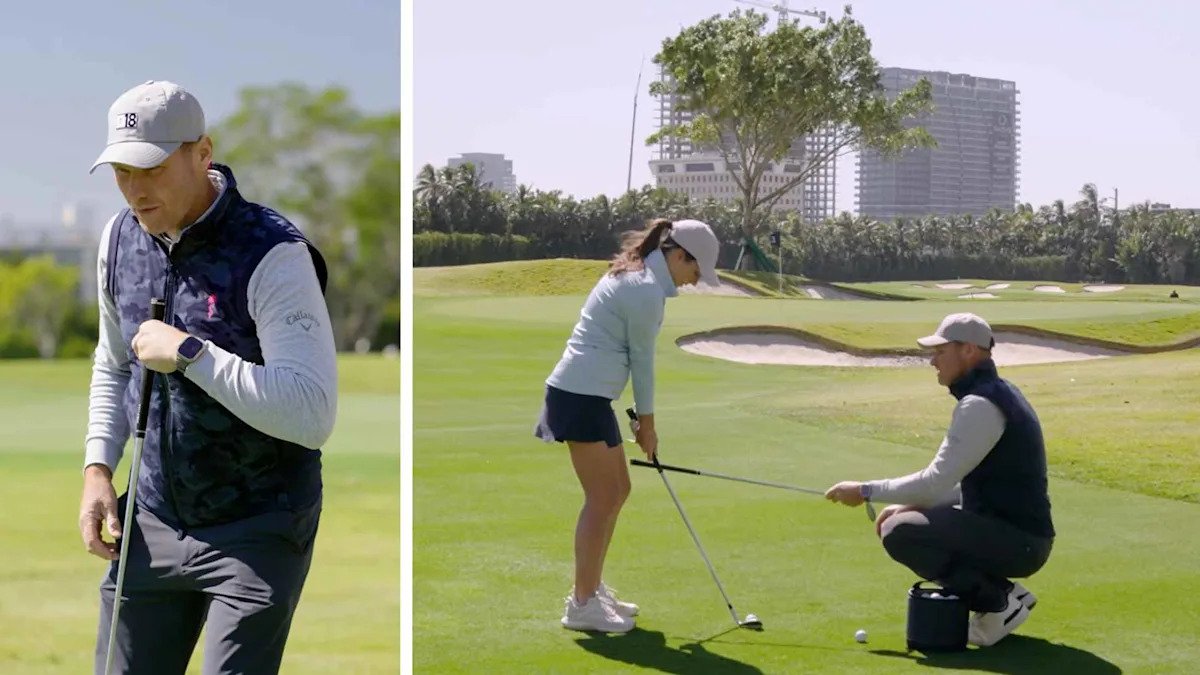
“For me, low-point control is all about the setup,” he says. “What I want you to do is I want you to get about 65% of your weight on that front, lead leg. Once you’ve got that there, I want it to also feel like it’s leaning there with your sternum.”
They key here is loading your lead side completely — not just your lower body. Armitage says amateurs often let their weight drift backwards during their backswing on these short wedge shots. When that happens, it becomes almost impossible to return to a forward position by the time your club passes through impact. As a result, players hang back or lean away from the target as they hit the ball, followed by a slew of contact issues.
By remembering to pre-set your entire lead side, you set yourself up to make ball-first contact and stay forward through the shot, helping you improve the quality of your strike and avoid a common error that can quickly break down your contact and confidence.
Keep your nose over lead toes as you swing
After you’ve loaded your lead side and established a good setup, it’s time to practice your swing. Armitage says the key here is maintaining the foundation you’ve already built at address.
Advertisement
“As you make a backswing, I want you to feel like your nose and your weight stays there [just in front of the ball],” he says.
To build this feel, take a few practice swings without a ball, keeping your sternum and nose positioned over your lead leg throughout the motion. You’ll know you’re doing it right if your divot is happening in front of your ball position.
When you bring a ball back into the equation, you should notice that your shots have a lower trajectory and more spin — hallmarks of a great wedge player.
Develop stock swings for better distance control
There are several ways to dial in different yardages with your wedges. You can open the face or grip down, but Armitage says the most reliable method for controlling distance is to adjust the length of your swing.
Advertisement
To do that, you need a set of defined stock swings. You can build them by creating clear, repeatable boundaries — or “triggers,” as Armitage calls them. His checkpoints are:
Much like the clock system many players use, these checkpoints give you a clear, repeatable reference for how far the club travels back and through. That structure allows you to make a repeatable swing with the same tempo every time, which is ultimately what builds dependable distance control and feel.
Callaway Opus SP+ Custom Wedge
Callaway Opus SP+ Custom Wedge
Introducing the all-new Opus SP+ with Spin Pocket™ Construction + Tungsten, a new extension of our Opus SP family. Tour-preferred shaping with an even higher center of gravity for more spin and precision.
$229.99 from Fairway Jockey
View Product
The post How to turn crucial 50-yard shots into scoring opportunities appeared first on Golf.
Read the full article here