

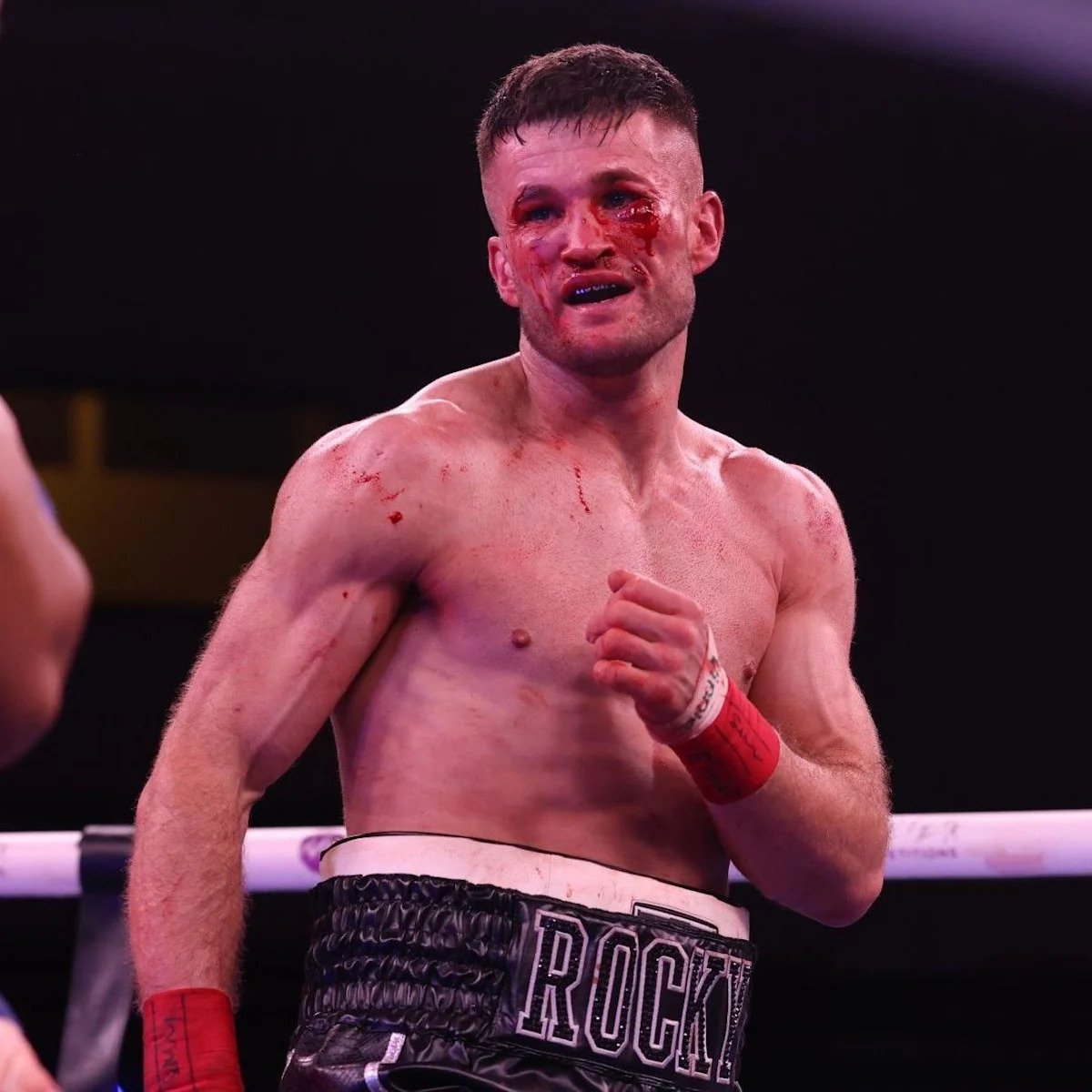
“One punch could change your life. But I love the sport.”
Bare-knuckle boxer Liam Rees is aware of the dangers when he steps onto the canvas.
The Welshman juggles his day job as a carpenter with the demands of a sport so visibly brutal it has stayed in the shadows of combat sports for much of its existence.
Advertisement
Slumped in a chair moments after losing his light-middleweight world title at the Vale Sport Arena, Cardiff, the Swansea native’s wife Emma gently implores her bloodied partner to give up the sport.
“No more now babe,” she says.
But nothing can replace the buzz for him.
“You’ve got so much adrenaline pumping through your body in that ring,” he tells BBC Sport.
“Some people think I’m crazy.”
At licensed bare-knuckle events, fighters go toe-to-toe on surfaces half the size of a professional gloved boxing ring – which means there is nowhere to hide.
There are more cuts, bruises and knockouts – which is exactly the appeal for some fans.
Advertisement
After overcoming substance-abuse issues, the 31-year-old was introduced to the emerging combat sport by a trainer in his boxing gym.
He made his bare-knuckle boxing debut in 2023, going on to become a two-time light-middleweight world champion in BKB.
During camp, Rees trains three times a day, five days a week, forgoing seeing his two children on weekdays.
He does not earn enough from the sport to quit his carpentry business. His goal is to leave a “legacy, just to prove to the city I’ve done something for them”.
Bare-knuckle is the oldest form of boxing but became associated with unlicensed fights on wastelands after The Marquess of Queensberry rules were introduced in 1867, which insisted on gloves.
Advertisement
However, in the past decade, licensed events have grown. As per data from BoxRec, there were only 21 licensed bare-knuckle bouts in 2015. Last year, the figure was more than 1,000 across 21 countries.
Rees fights under the banner of Bare Knuckle Boxing (BKB) promotions – one of two major international promotions who host licensed bouts, alongside US-based Bare Knuckle Fighting Championship (BKFC).
Attendances at BKB venues are capped at 2,000 and the organisation’s president David Tetreault says they generally sell out.
Broadcast in more than 60 countries, BKB has partnerships with the likes of VICE TV and TalkSport.
Advertisement
Retired boxing world champions Lee Selby, Paulie Malignaggi and James DeGale have all crossed into bare-knuckle boxing as the popularity grows.
However, Luke Griggs, chief executive of brain injury charity Headway, said he is “hugely concerned” about its rise and the “glamourisation of a sport that’s going to be taken out into the streets”.
In a new film, BBC Sport investigates the realities of a sport that is slowly becoming more popular, and the people at the heart of it.
Growing among young audiences
It was only in 2018 that the first sanctioned bare-knuckle bout for 130 years took place in the US state of Wyoming.
Advertisement
The US has seen the biggest growth in the sport. There were at least 65 events in the States in 2025. The UK is second, with 31 events last year.
Tetreault told BBC Sport that 90% of BKB bouts end in knockout or technical knockout and claimed that the fast nature of the sport appeals particularly to Gen Z and millennial fans.
Some 50% of their audience on social media fall into those younger demographics.
When Malignaggi defeated Tyler Goodjohn by split decision at the John Charles Centre for Sport in Leeds last October, the crowd was studded with boxing luminaries, including former multiple super-middleweight world champion Carl Froch, former two-time featherweight world champion Josh Warrington and former two-weight world champion Natasha Jonas.
Advertisement
“It’s a blood sport, people do have a blood thirst to watch this sport,” Malignaggi says.
“It’s more action packed and I think the misconceptions are going to slowly go away once people watch it more and more.”
Jonas says she was “impressed by the set-up”, but doubts she will ever compete in it.
Boxing promoter Eddie Hearn says while there is clearly an audience for the sport, “it’s a little bit barbaric for me, I am a boxing purist”.
Is it safer than gloved boxing?
Although bare-knuckle boxing seems more brutal than its gloved counterpart, Tetreault claims that there are misconceptions.
Advertisement
“The fighters have to be taking care of their hands. They can’t hit as hard,” he said.
Whereas professional gloved boxing events involve a maximum of 12, three-minute rounds, in BKB, bouts are capped at a maximum of six, three-minute rounds while BKFC bouts involve two-minute rounds.
Tetreault cites the shorter duration of bare-knuckle fights as another mitigating factor when answering safety concerns.
“The difference is it’s not the continual punching,” he said.
Dr. Louis Durkin, president of the Association of Ringside Physicians, who is also a stitch doctor for BKB, shared data from a study conducted by the ARP in 2025. It looked at 2,000 fighters across BKB and BKFC and compared the rates of injury with previously conducted studies from gloved boxing and MMA.
Advertisement
The study found that the percentage of concussions was lower in bare-knuckle boxing (5% in BKFC and 4.76% in BKB) than gloved boxing (12%) and MMA (14.7%).
Conversely, there was a much higher rate of laceration found in bare-knuckle boxing (34.3% in BKFC and 35.9% in BKB) than gloved boxing (8.7%) and MMA (13.5%).
However, consultant neurosurgeon Peter Hamlyn says there is a lack of data in general in bare-knuckle boxing.
“Hitting someone with equal power with an ungloved fist delivers more energy to the head, more brain injury,” he explained.
“However, you’ve then got all those confounding factors – it hurts your hands, so you tend to hold back a bit, and there is the number of blows that are landed, the number of rounds.
Advertisement
“When you add that all together, you end up actually with a conclusion that reads something like, ‘I don’t know’.”
Hamlyn also mentioned that it is difficult to make conclusive judgements on brain injury in the short term.
“The difficulty we’ve had in sport is that that data doesn’t emerge until they’re in their later life,” he said.
Headway are unequivocal.
“If you’re deliberately trying to cause a brain injury in order to win a bout, that can’t be right,” Griggs said.
Where will the sport go next?
The first BKB event of 2026 will take place at London’s Indigo on 21 February.
Advertisement
“Part of what we’re doing in 2026 is we’re going to be coming to the bigger cities,” Tetreault said.
He is convinced that bare-knuckle boxing can go mainstream.
“We’re seeing it with our ticket sales,” he reasoned. “We’re seeing it with our ratings. Part of our roadmap is building out bigger mega fights with some star power.”
Meanwhile, Rees’ future in the sport is uncertain. Since losing his title to Filipino former UFC fighter Rolando Dy, he says he is in “semi-retirement”.
“Bare-knuckle’s a full-time job,” he said.
“I’ve missed out on too much of my kids’ lives. I’d love to get involved again, but we’ll see.
Advertisement
“Let’s say I’m on a long vacation at the minute.”
More boxing from the BBC
Read the full article here