



Inspiration.
Last season, the Diamondbacks were the only NL West team with a losing record playing the Rockies at Coors Field. I’m confident the Diamondbacks can improve. How?
Runs at Coors When Playing the Rockies.
Focusing on the NL West, runs scored and runs allowed can explain why the Diamondbacks had a worse record when playing the Rockies at Coors. The Diamondbacks ranked lowest in runs scored per game, and they ranked highest in runs allowed per game. The following table provides details. Data from Baseball Reference.
Deciding on how to improve, let’s look at two questions:
Advertisement
-
Is batting or pitching more to blame?
-
What statistics provide insights that point towards how to improve?
Most of the Blame.
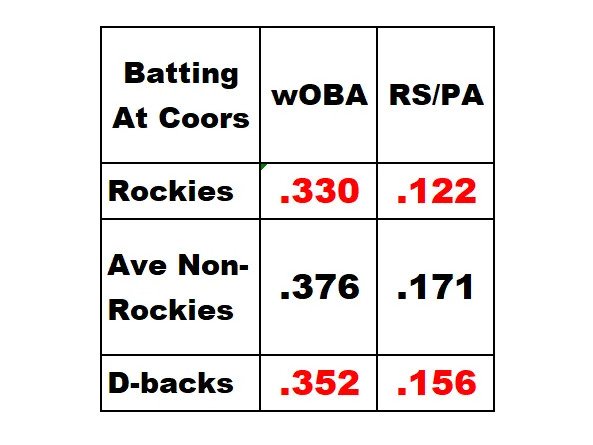
Batting at Coors. The following table shows two statistics. Although they batted better than the Rockies at Coors, the Diamondbacks batters were below the average of the other teams at Coors.
The following table has a broader focus; non-Rockies teams includes all teams in the Majors. Data from Baseball Savant.
Pitching at Coors. The following table shows two statistics. Although they pitched better than the Rockies at Coors, the Diamondbacks pitchers had better than average wOBA against, but average runs allowed per PA of the other teams at Coors. Data from Baseball Savant.
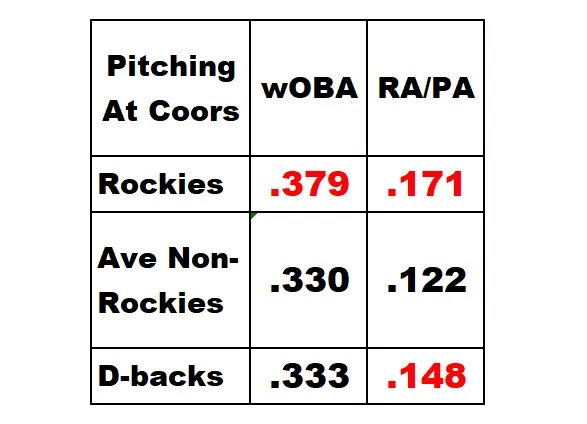
The Diamondback batting shouldered most of the blame for the poor win-loss record at Coors because the batting wOBA was much worse than non-Rockies teams (while pitching wOBA about the same).
Advertisement
Two reasons Diamondbacks’ batters need to make adjustments at Coors. One reason is last season’s poor batting at Coors. The other reason is that Rockies pitchers at Coors are expected to make adjustments to improve their results. “Every guy [pitcher] is one adjustment away from being one of the best in the game, and there’s a lot of low-hanging fruit [pitching at Coors Field] that can be changed.” — Michael Lorenzen, newly acquired Rockies pitcher
The Blue Jays Batters Had Success at Coors.
Of all the teams who played at Coors, the Blue Jays batters had the best wOBA and best runs scored per PA. How did they do it?
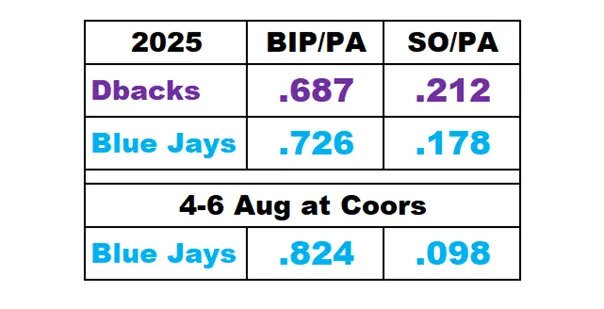
This article from The Athletic led me to think contributors to their success at Coors included their “…contact-dominant offense…” and in August had baseball’s “…lowest strikout rate….” To check that out, let’s look at Balls-In-Play (BIP) per Plate Appearance (PA) and strikeouts per PA.
Advertisement
Although the following table shows that for the whole season (and especially for the Rockies-Jay series on 4-6 August) the Blue Jays’ batters had a better Balls-In-Play (BIP) per PA and a lower strikeouts per PA than the Diamondbacks, my opinion is that does not tell the whole story. Also, I’m uncertain how batters could put more balls in play and strikeout less. One thought is for Diamondbacks batters to swing more often than they usually do.
Did the Diamondbacks swing more (or less) often at Coors? In 2025, the Diamopndbacks swung at more pitches at Coors (48.9% vs 46.9% of pitches) per Baseball Savant. That 2% increase seemed great until considering that the Blue Jay increased their swing percentage by 4.1% (increased from 48.6% to 52.7% of pitches). Asking Diamondbacks batters to further increase their swing percentage is not likely to be realistic.
Swing Characteristic. For the entire season, the Blue Jays qualified batters had a swing characteristic that was significantly different than the Diamondbacks. While it is a characteristic of Diamondbacks batters that they intercepted the baseball farther than the average distance in front of the plate (per this AZ Snake Pit article), most Blue Jay batters intercepted the ball nearer than average to the front of the plate. The following table shows the difference between the teams. Data from Baseball Savant.
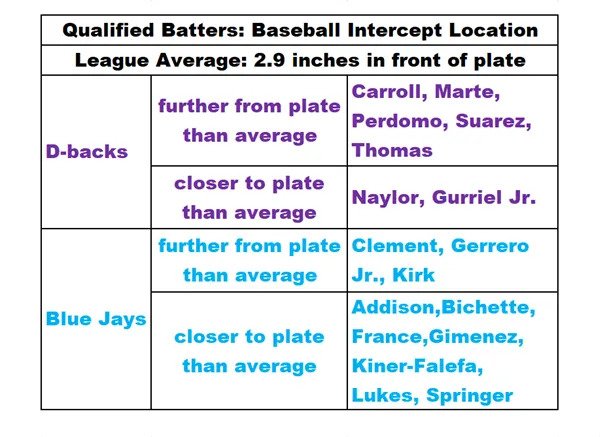
Because of Coors’ high altitude, the pitches move less. Therefore, the Blue Jay batters did not suffer a reduced contact rate that would typically occur in venues at a lower altitude. My opinion is that this was an important part of why the Blue Jays batted better than the Diamondbacks at Coors. Unfortunately, asking Diamondbacks batters to make such a large change in their swings is not realistic.
Advertisement
Summary.
Last season, the Diamondbacks were the only NL West team with a losing record playing the Rockies at Coors Field. The Diamondbacks ranked lowest in runs scored per game, and they ranked highest in runs allowed per game.
Based on wOBA and runs scored per PA, the Diamondback batting shouldered most the blame for the poor win-loss record at Coors.
Although the Blue Jays’ batters had better Balls-In-Play (BIP) per PA and lower strikeouts per PA than the Diamondbacks, my opinion is that does not tell the whole story.
Although the Blue Jays’ batters increased their swing percentage at Coors more than the Diamondbacks, my opinion is that does not tell the whole story.
Advertisement
Much of the difference between the teams is that the Blue Jays’ batters intercepted the baseball nearer than average to the front of the plate, while the Diamondbacks batters intercepted the baseball farther than average to the front of the plate. Because of Coors’ high altitude, pitches move less. Therefore, when the Blue Jay batters hit closer to the plate, they did NOT suffer a reduced contact rate that would normally occur in venues at a lower altitude.
Answering the question of how could batters improve at Chase remained elusive. My opinion is that it’s not realistic to ask for Diamondbacks batters to make significant changes to their swings to address the factors that I’ve mentioned. On the other hand as an optimist, I’m open to the possibility of batting improvement at Coors.
Read the full article here