



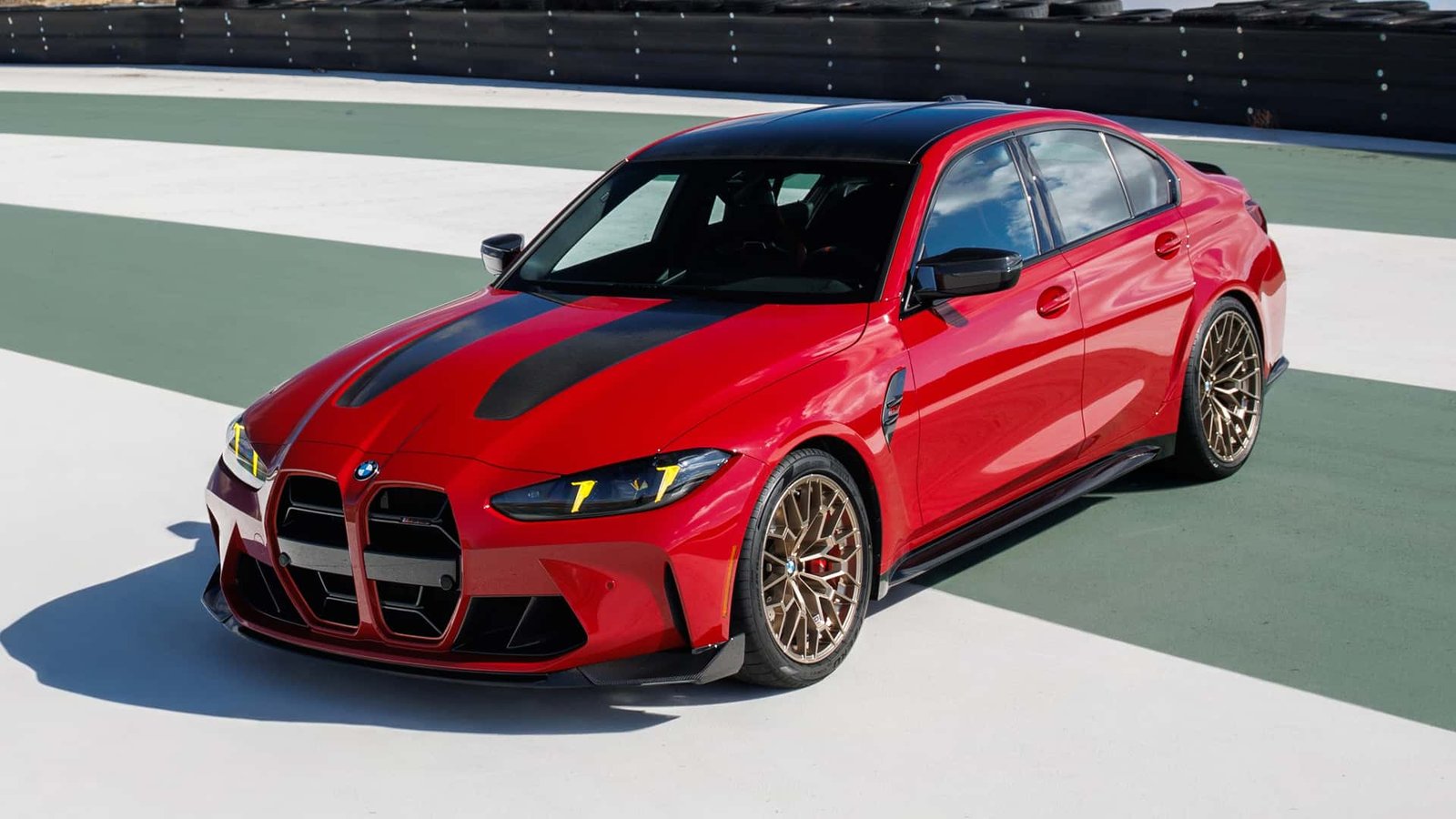
- The manual CS is the last hurrah for the sixth-generation M3.
- The next-generation M3 with an inline-six engine is likely coming in 2028.
- A fully electric M3 will arrive first, sometime next year.
Pour one out for the M3 because the “G80” isn’t long for this world. Of course, we saw this coming after BMW itself said the manual CS for North America would serve as this generation’s sendoff. The sixth-generation sports sedan has already entered the 2027 model year in the United States, and now we’re learning it’ll also be its last. That’s right; the M3 won’t return for the 2028 model year.
In an interview with BimmerLife, BMW Product Planning Specialist Scott Stirling confirmed 2027 will be the final model year for the sixth-generation M3. He was also the person who convinced BMW’s higher-ups in Munich to approve the M3 CS Handschalter for production as the car’s last hurrah. The lightest G80 joins a short list of North America-only special editions, including the E92 Lime Rock and E36 Lightweight.
While Stirling didn’t go into detail about when production will end, an insider on the Bimmer Post forums claims BMW will build the final M3 in February 2027. The gas-powered model’s direct successor isn’t expected to arrive until sometime in 2028, when it will begin rolling off the assembly line at a different factory. Codenamed G84, the seventh-generation M3 will become the first gasoline-powered M3 built outside Munich, with production moving to Dingolfing.
Photo by: BMW
BMW Will Make Gas And Electric M3 Models
We specify “gasoline-powered” because an electric M3 is scheduled to enter production in Munich next year. The ZA0 has already been teased multiple times as a quad-motor EV monster complete with fake V10 noises and simulated gear changes. It’s going to have an M-specific battery pack with a net capacity of more than 100 kWh and significantly more power than the 463 hp available in the i3 50 xDrive.
Looking ahead, the gasoline-fueled M3 will retain a twin-turbo 3.0-liter engine, although it’ll use a “new type of six-cylinder engine,” according to Neue Klasse boss Dr. Mike Reichelt. Reports suggest it’ll adopt mild-hybrid technology to comply with stricter European emissions regulations. If the rumor mill is accurate, the next M3 will be sold exclusively with an automatic transmission and all-wheel drive. That would make the M3 CS Handschalter the end of the line for the three-pedal, rear-wheel-drive formula.
The Manual Gearbox Is On Its Death Bed
However, BMW isn’t abandoning the traditional recipe just yet. The current-generation M2 and M4 are rumored to remain in production until closer to the end of the decade. That means you still have roughly three years to buy one of the two coupes available with a stick shift and rear-wheel drive. Even so, the writing is on the wall for manuals, with M boss Frank van Meel recently hinting that the six-speed manual is unlikely to survive into the next decade:
‘It’s going to be quite difficult in the future to develop completely new gearboxes because the segment in the market is quite small, and the suppliers are not so keen on doing something like that.
So we’re still happy with the manuals we have, and we plan to keep them for the next couple of years, but in the future, probably it’s going to be more difficult to keep the manuals alive, especially in the next decade.’


Photo by: BMW
There’s Still Time To Buy A Manual M3
Meanwhile, there’s still time to buy an M3 with the do-it-yourself transmission. If production really does end next February, order books are unlikely to close before the end of this year. The CS Handschalter enters production in July, albeit in “very limited numbers” for the United States and just 40 cars for Canada.
The manual CS costs $108,450 before options in the U.S., but you don’t have to spend that kind of money if you’re willing to settle for a standard M3, which starts at a far more reasonable $80,650.
30
Source: BMW
Motor1’s Take: It’s increasingly likely that the M3 CS Handschalter marks the beginning of the end for the manual transmission. Once the current-generation M3 dies, BMW will be left with just two manual-equipped models in its portfolio, and even the six-speed M2 and M4 are unlikely to survive beyond the end of the decade.
As BMW explains, manuals face torque limitations, and there isn’t enough demand to justify developing a new gearbox. Modern automatics also deliver better fuel efficiency and lower emissions. Enthusiasts might not necessarily care about those gains, but every extra gram matters for automakers selling cars in the EU and other regions with increasingly strict regulations.
There’s still hope for rear-wheel drive since BMW’s xDrive system already offers a pure RWD mode once traction control is switched off. It’s reasonable to expect that feature to carry over to the next M3, but there’s a strong chance you won’t be rowing your own gears anymore.
Read the full article here