



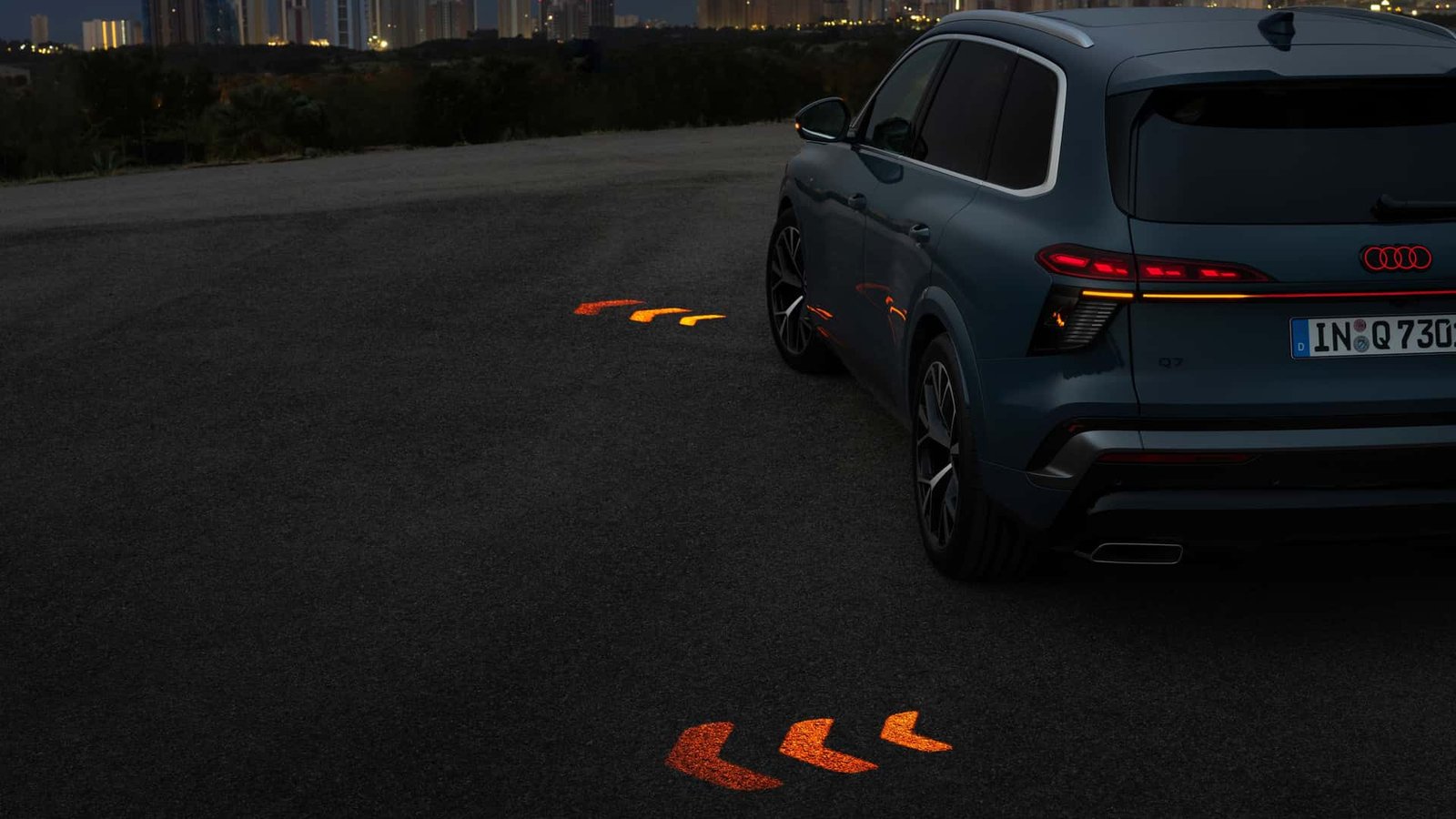
- The third-generation Q7 is Audi’s first model to feature advanced turn signals.
- The luxury SUV has projectors built into the headlight and taillight housings.
- At night, stylized arrows are projected onto the road, in sync with the regular turn signals.
I still remember when BMW and Audi raced to bring the first production car with laser headlights to market. Although the R8 LMX was announced before the i8s, Munich managed to one-up its adversary from Ingolstadt by becoming the first to deliver cars to customers. It happened 12 years ago, and as you can imagine, a lot has changed since 2014. Laser headlights have since given way to matrix LEDs, which offer better light distribution and comparable range.
In 2026, headlights are still evolving. Customizable light signatures are becoming increasingly common in high-end models, with some even featuring built-in projectors. The third-generation Q7 happens to be one of them, along with a feature dubbed a “world-first innovation.” At night, when the low beams are on, the advanced turn signal function uses projectors mounted within the headlights to display stylized arrows on the road.
It works in sync with the regular sequential turn signals and activates automatically the moment you use the stalk. While those customizable light signatures we mentioned earlier are ultimately a gimmick, this looks like it could actually be useful, especially in pitch darkness. The additional turn signals should improve safety by reducing the risk of a collision with another nearby car, bicyclist, or pedestrian.

The so-called advanced turn signal function has also been integrated into the taillights, making it easier for those behind the Q7 to tell that the driver is about to change lanes. Available with OLED technology, the rear lights are also customizable and can display certain warning symbols to alert other drivers to a potential hazard ahead.
There’s even more trickery in the Q7’s lighting system. Up front, the headlights feature a marking light that helps identify pedestrians by directly illuminating people on the side of the road. When the cameras detect an icy road, the projectors built into the headlights briefly display an ice crystal on the road as a visual warning for the driver. Audi says the headlights also automatically adapt to surrounding traffic when you’re changing lanes and provide lane guidance at construction sites or in other tricky driving situations.


2027 Audi Q7 with extra brake light
Photo by: Audi
At the back, an interrupted bar is reflected onto the tailgate glass, effectively serving as an additional brake light. We’ve already seen that on the smaller Q5 in Europe, while on the US-spec version, the bar is bisected by a “Quattro” script. Due to regulatory constraints, the latter is not legal in Europe, although we’re hoping that will change since it looks rather cool. It reminds me of the rear-window defroster featuring a Quattro logo from the 1980s and 1990s.
If it all seems rather complicated, that’s because it is. We certainly wouldn’t want to be in a position where we had to replace a headlight or taillight. The diagrams below reveal what goes into making a digital matrix LED headlight and an OLED taillight.
2027 Audi Q7 headlight assembly
Photos by: Audi
2027 Audi Q7 taillight assembly
Motor1’s Take: It’s a never-ending race to make cars more complicated, though some would call it progress. There’s a fine line between having a feature that’s genuinely useful and doing things purely for bragging rights. We’d put Audi’s advanced turn signals in the former category, but the customizable light signatures and illuminated grille definitely belong in the latter.
Read the full article here