


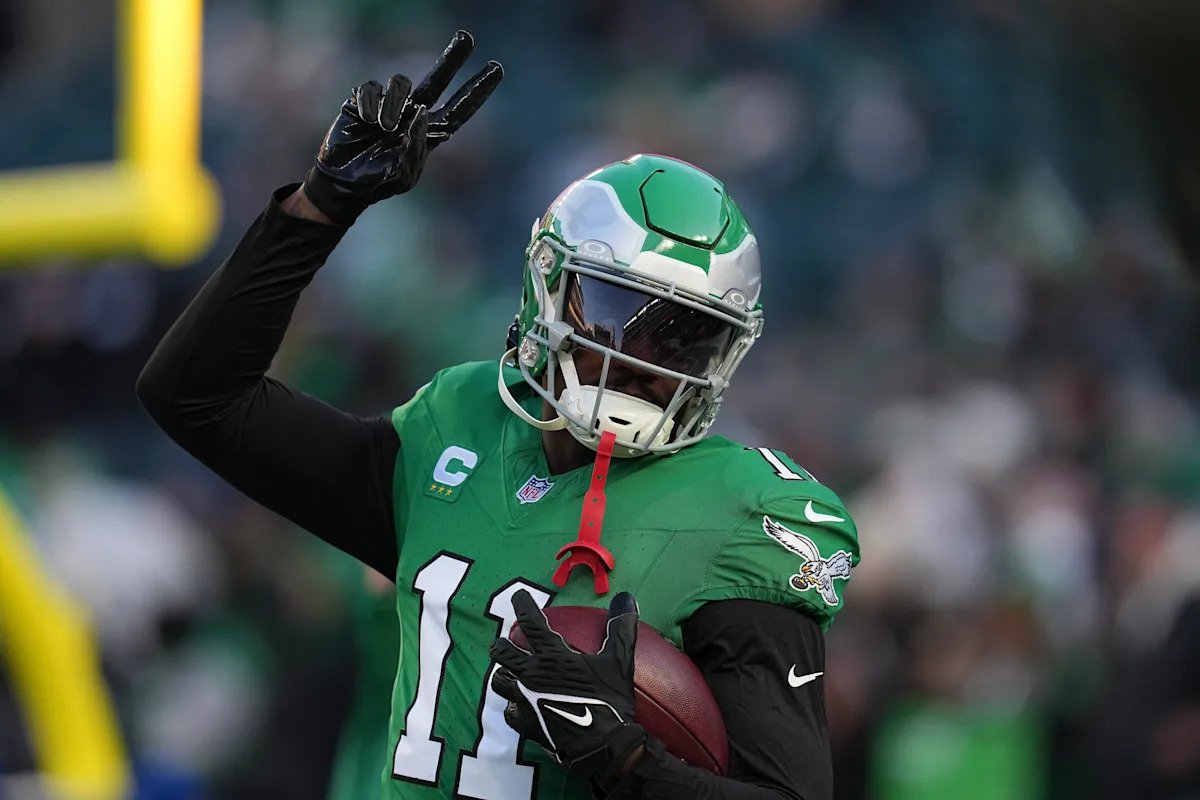
In a conversation last Thursday, a league executive considered the twists and turns of the A.J. Brown trade saga.
Few around the league doubt whether the (for now) Philadelphia Eagles wide receiver is a strong talent. Few doubt, either, his production. But as four days of legal tampering and then deal-making passed, and Brown remained on the team that seems intent on moving him, an executive considered reasons why.
Advertisement
Compensation between trade partners, salary cap implications and Brown’s physical health all are complicating trade scenarios. But the executive added, after breaking down those factors, a comment that would soon prove ironic.
“If he was 27,” the executive said of Brown, “maybe it’d be different.”
On Tuesday, the Denver Broncos and Miami Dolphins seemed to agree.
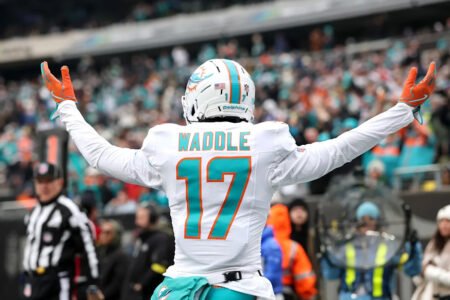
The Dolphins dealt 27-year-old speedy receiver Jaylen Waddle to the Broncos on Tuesday in a deal with compensation eerily similar to what many in the league believe the Eagles are targeting in a trade for Brown.
Denver sent its first-round draft pick and a third-round pick to Miami to acquire Waddle. The teams also swapped fourth-round picks.
Advertisement
[Yahoo Fantasy Bracket Mayhem: Make your picks for $50K in total prizes]
At first glance, Miami’s value seemed excellent. A first-round pick and more for a receiver who wasn’t top 10 in major metrics last season? And on second glance, the compensation is still strong.
But the first-round pick that Denver sent Miami was not a top-10, or even top-20, slot in the 2026 NFL Draft. The Broncos dealt the 30th overall pick — which comes with first-round benefits like a fifth-year option but also precedes the second round by just three picks. In a draft considered shallow at high-end talent and at premium positions, the Dolphins’ top pick may land them a talent more akin to historical second-round value.
And yet: They acquired a first-round pick.
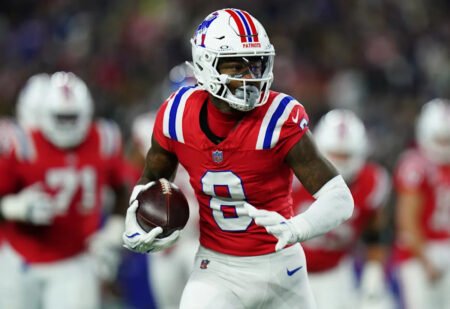
Could a trade of the Eagles’ A.J. Brown yield about the same returns that the Dolphins got for wideout Jaylen Waddle? (Photo by Mitchell Leff/Getty Images)
(Mitchell Leff via Getty Images)
Many around the NFL initially believed the Eagles could do something nearly identical. In conversations with league executives and deal-makers last week, the New England Patriots continued to surface as a logical destination for Brown. Sure, there is Brown’s history in Tennessee with now-Patriots head coach Mike Vrabel. And after the Patriots released veteran receiver Stefon Diggs, Brown’s talents seemed ever-more-needed. Even after the Patriots signed former Green Bay Packers receiver Romeo Doubs, Brown’s value to a contending team with a rookie-pay-scale quarterback continued to make sense.
Advertisement
And the icing on the cake? If Eagles general manager Howie Roseman was dead-set on including a first-round pick in the deal, as many in the league believe he is, the Patriots could offer a compromise: Philadelphia could land the 31st overall pick, which like the Broncos’ 30th includes some of the perks of Round 1 capital. At the same time, the Patriots could take solace in knowing that the marginal talent value between pick 31 and early second-round slots was not significant. That might ease the blow of not picking until the 63rd overall slot, especially while acquiring a player who will be 29 years old before the season starts.
Executives and talent evaluators still anticipate the Eagles will trade Brown before Week 1, six league sources told Yahoo Sports in conversations over the last week. And they still believe compensation will resemble that of the Waddle deal, with multiple picks including a spot as high as the late first-round.
But there’s a catch in the Eagles’ ability to move quickly. The catch might explain why Brown is still currently an Eagle — and could also explain why many in the league would not be surprised if he remains an Eagle at the conclusion of the 2026 NFL Draft.
Why the Eagles have June 1 circled on their calendar
So much of NFL salary cap math is fungible.
Advertisement
While the NFL sets a salary cap number each year, rules exist for teams to borrow from last year. Rules exist that help teams push the cap hit of salaries forward to future years, a popular mechanism as teams see the salary cap’s steady growth from year to year. And rules even exist for teams to semi-act as if a player was released after June 1 (and thus their cap charges can count toward a future cap year) even if a team makes the decision to release the player, and announces that decision publicly, beforehand.
Each team can designate two players per year as post-June 1 releases, allowing their cap charges to spread out after that date, per CBA rules.
And yet, amid all the cap gymnastic possibilities written into the collective bargaining agreement, and manipulated brilliantly by teams each year, no mechanism exists for post-June 1 designations on trades.
Put more simply: Teams who trade players before June 1 must take the full hit on their cap that year, rather than splitting it with future years.
Advertisement
Trade a player after June 1, and cap magic options increase.
For Brown, that cost may prove prohibitive in the short term.
Because while the Dolphins, who are paying far fewer stars than the Eagles, were willing to absorb $26.3 million in dead cap space this year to trade Waddle, the Eagles must be willing to (and have room for) $43.45 million in 2026 dead cap space if they trade Brown before June 1.
If they trade him after, they’ll need to designate only $16.35 million of their 2026 cap toward his owed charges.
Again, put more simply: The Eagles must stomach $27.1 million more in 2026 cap space to trade Brown before June 1 rather than after.
This could be a key reason why the Eagles did not trade Brown last week. And it could make a draft week trade less likely than it would otherwise be.
Advertisement
Without the heaping dead-cap consideration, a draft week trade for Brown would make plenty of sense. The Eagles, after all, initially acquired Brown via a draft-day trade. Philadelphia’s leverage, too, could increase during the draft if a team misses on a receiver it hoped to secure because another team selects that player first.
And yet, any trade involving a 2026 NFL Draft pick would require the Eagles to absorb Brown’s entire $43.45 million dead cap charge in 2026. So some executives believe a post-June 1 trade is more likely, with compensation including some combination of picks in the 2027 to 2029 drafts.
How similar would a Brown trade be to Broncos’ Waddle deal?
In seven pro seasons, Brown has surpassed 1,000 receiving yards six times. During the 2025 season, despite his vocal frustration with the Eagles’ offense, Brown’s 66.9 receiving yards per game slotted 12th. He posted 1,003 receiving yards (19th) and seven touchdowns (tied, 15th).
Advertisement
Those numbers all surpass the metrics of Waddle, who averaged 56.9 receiving yards per game (26th), posted 910 receiving yards (25th) and had 6 receiving touchdowns (T-26th).
Brown is two years older, and has two seasons’ more tread on his tires, than Waddle. He’s surpassed 1,000 receiving yards twice as many times as his Dolphins counterpart.
A conditional draft pick may also help a team feel more comfortable acquiring a player who will be 29 by Week 1 and has a history of knee injuries that have prompted surgeries on both of his knees.
Possible compensation options for Brown (in no order) could include the following, per executives:
Advertisement
-
A late 2026 first-round pick and a future third-round pick that could elevate to a second-round pick if Brown hits a threshold of participation or performance.
-
A 2026 second-round pick and 2027 first-round pick that drops to a second-round pick if Brown misses playing time or performance thresholds.
-
A 2027 second-round pick that could elevate to a first-round pick if Brown hits a threshold of participation or performance, paired with a second- or third-round pick.
-
A similar structure with picks that do not begin until 2027.
The Eagles could also be incentivized to wait until after June 1 by the perceived strength of the 2027 draft relative to that of 2026.
The considerations are endless. And it’s possible that the Eagles have already agreed to a post-June 1 trade in principle that would become official as soon as June 2 if Brown passes his physical (which, as Maxx Crosby and his knee showed last week, is not a given).
Some executives question whether Brown has more than one strong year of play left, given his age and injury history. But many coaches still view Brown as a strength.
Waddle is younger and fresher, but Brown’s demonstrated production is deeper.
Advertisement
“I don’t think that there’s been any real drop-off,” former NFL offensive coordinator Scott Turner said Monday on Yahoo Sports’ “Inside Coverage” podcast. “[The Eagles’] offense, they’ve prioritized running the football. I know he’s been frustrated with his lack of targets [and] their lack of the ability to get him the ball.
“A.J.’s just such a big, physical guy. The further he gets down the field, those DBs, they’re lost [and] he’s going to go make the play because of his physicality. Obviously, he can still run away from people with the ball in his hands.
“I think A.J. Brown is one of the top receivers in this league, and I think he still is.”
Read the full article here