



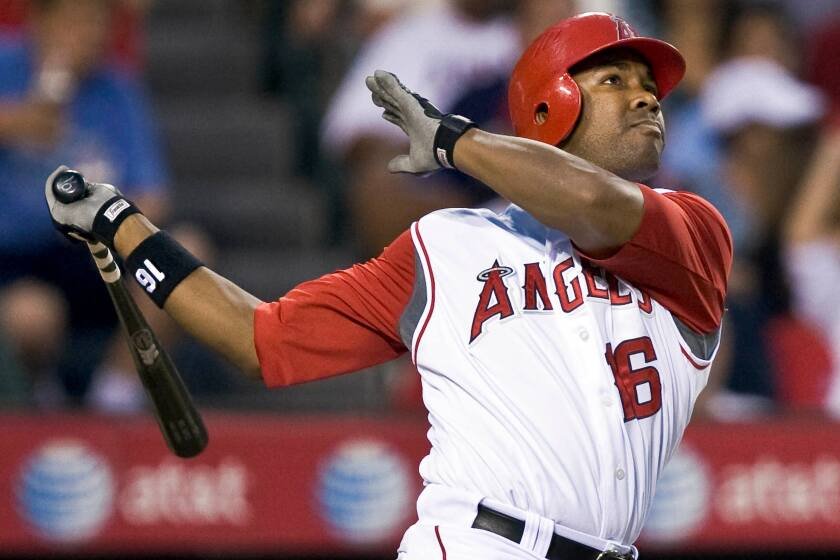
Garret Anderson was a Hall of Fame-caliber major league baseball player who never made the Hall of Fame. Baseball is a numbers game, and GA didn’t have enough of them.
When he finished his career and was eligible for the vote in 2016, he got just one vote. That represented 0.2% of the total. It also meant that he wasn’t even on the ballot the next year.
Advertisement
So, when he died Friday, way too soon at age 53, it presented an interesting twist. Had he lived into his 80s or 90s, there would have been few still around to remember anything about him but statistics. Now, the memory of his underrated greatness remains. What he did and how he did it is still in the frontal lobe of those who watched and those who wrote and broadcast about him.
He was the quiet man who played for various versions of the Angels for 15 seasons — the California Angels, the Anaheim Angels and the Los Angeles Angels. Right there, you have a Hall of Fame problem. A team struggling so hard to find its own identity does not attract the deep and passionate interest of the bulk of the writers/voters who live in time zones whose bed time is the same as game time in Anaheim.
It should have mattered that GA delivered the most important hit in Angels’ history, the game-winner in the 2002 World Series. It was Game 7, it was at Angel Stadium and the opponent was the San Francisco Giants, who had superstar slugger Barry Bonds and his line drives that created dents in outfield fences, except when they flew over them, which was often.
Anderson came to the plate in the third inning. The bases were loaded and Anderson took a shoulder-high fastball, slapped it down the right-field line and three runs came home. The Angels won 4-1 and haven’t come close to a World Series title, much less a World Series, since then. That at least got Anderson into the Angels Hall of Fame in 2016.
Advertisement
Read more: Angels’ World Series hero and even-keeled slugger Garret Anderson dies at 53
Mike Scioscia was the manager then and the most effective the team has had. He is the one who, Saturday, called Anderson’s Game 7 hit the greatest in team history.
“I remember looking out there when he went to the plate with the bases loaded,” Scioscia said, “and thinking he is exactly the guy I want there right now.”
Scioscia called Anderson’s death “a punch in the gut.” He said the player everybody called GA, didn’t have to be managed. “He was a resource for me,” Scioscia said. “He had an incredible inner drive. He was one of the most talented players I have been around. I’d call him a superstar.”
Advertisement
Scioscia, reminded that his “superstar” didn’t make baseball’s Hall of Fame, said, “Sometimes, great players slip through the cracks.”
Anderson’s not-quite-Hall-of-Fame performances included three All-Star game appearances. He was the game’s MVP in 2003 and also won the home run derby that year. He beat out Albert Pujols, then of the Cardinals. His career batting average was .293, he hit 287 home runs and had 1,365 runs batted in. He went to the plate to hit, not to watch. He never drew more than 38 walks in a season and never struck out more than 100 times.
Yet the statistic he felt gave him the best chance for the Hall of Fame was number of hits. Getting 3,000 hits would make him almost an automatic choice. He ended with 2,529, and near the end of his career with the Angels, he sat down with a reporter to discuss just that, plus one other thing.
Garret Anderson, left, talks with Jackie Autry, widow of Angels team owner Gene Autry, as he is inducted into the Angels Hall of Fame on Aug. 20, 2016. (Reed Saxon / Associated Press)
It was uncharacteristic for Anderson to have this sort of conversation with anybody outside of his teammates, or maybe his family. It was lunch at Zov’s in Tustin and the question was how this voting system works and could maybe 200 more hits get him in. Could 2,750 do it? He wasn’t a big ego guy by any stretch of the imagination, but the Hall of Fame seemed to be dangling there and any baseball player who could see that for himself in the distance had to be intrigued.
Advertisement
There was no discussion of the intangibles, no consideration of the Angels being the Angels and what effect that will always have. Do voters even look much at other stats, such as his 24 walks and 35 home runs in the same season? The reporter wasn’t a great help. He wasn’t even a voter. Anderson wasn’t really stressed out over the Hall of Fame premise, just kind of fascinated. The reporter was probably more encouraging than realistic. Zov’s food was good, the company great.
Eventually, Anderson got to the second issue that had prompted the lunch: How to deal with Times columnist TJ Simers. He asked because the reporter was once Simers’ boss. Simers tended to probe and kid and seek to stir up things, but Anderson also recognized that he could be highly accurate, perceptive and even fun. Anderson, as a team star, was bracing for frequent visits. How should he handle it?
The answer was simple: Don’t lie to him. Don’t hide from him. If he is being a jerk, tell him so. He will accept that. If he is wrong, tell him that and tell him how. If he insults you, insult him back. He loves that.
Tim Mead, former director of public relations, when asked for his thoughts on Anderson, said that his perspective or quotes would not be as telling or as meaningful as simply watching the tape of Anderson’s three-run double that won the 2002 World Series for the Angels.
Advertisement
“Just watch it, just watch his reaction when he gets to second base,” Mead said Saturday.
And so we did. Anderson slaps his hit down the right field line, just fair. Angel Stadium goes crazy. Anderson stops at second base, claps his hands four times, then stands there quietly. Little emotion. Little hoopla. No contortions for “SportsCenter.” He has done his job. He has done what was expected of him. There are six more innings left. Let’s celebrate when it is truly over.
That was Garret Anderson, GA to his friends, a Hall of Fame player in all the ways that numbers don’t show.
Get the best, most interesting and strangest stories of the day from the L.A. sports scene and beyond from our newsletter The Sports Report.
This story originally appeared in Los Angeles Times.
Read the full article here