


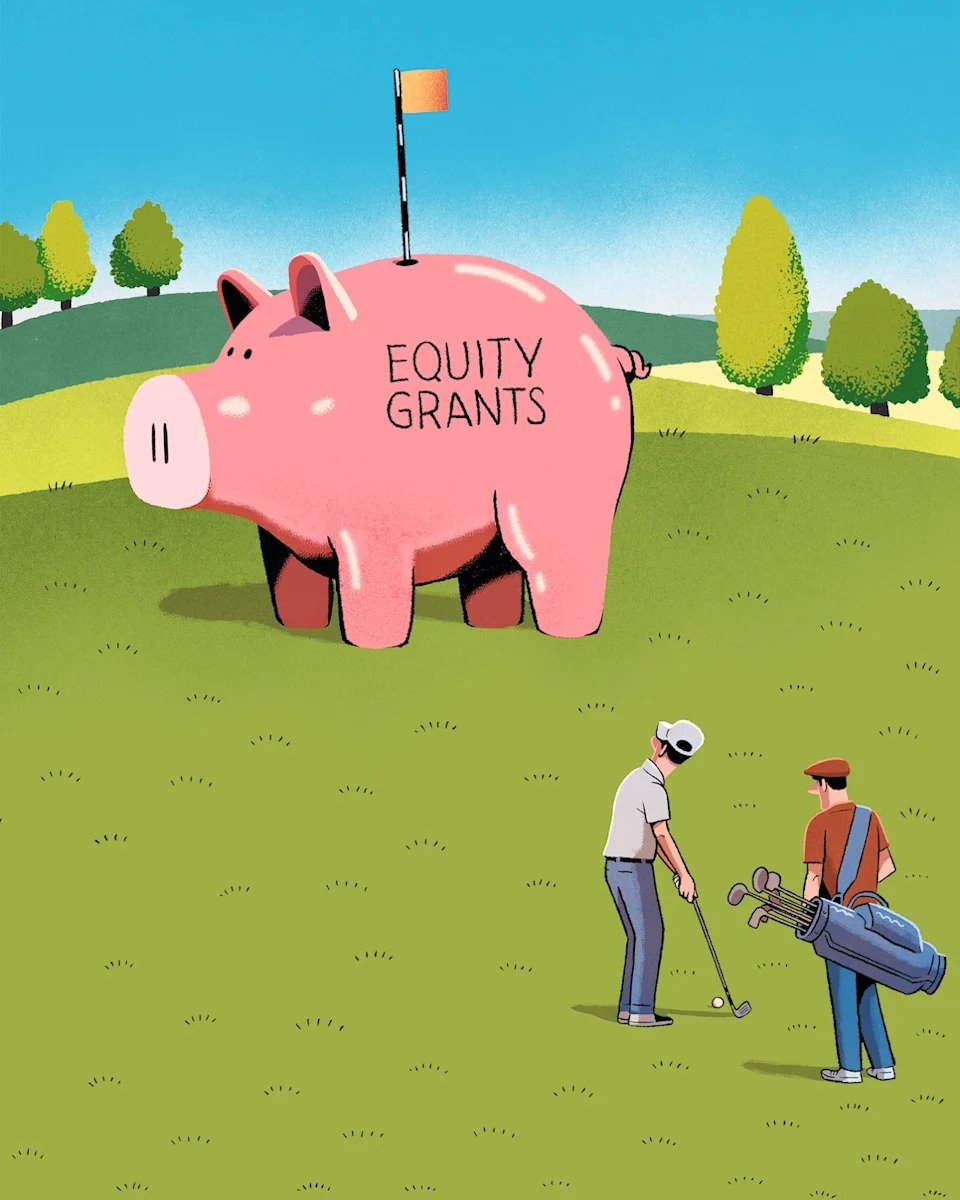
Read just the headlines when Brooks Koepka rejoined the PGA Tour earlier this year and it seems like the five-time major winner forfeited as much as $90 million to comeback after three years playing LIV Golf. Dig into the details and it reveals something more interesting about the newest addition to the PGA Tour retirement plan: equity grants. These have been awarded to a select group of top players, and Koepka had to give up five years’ worth. Their growth is calculated in a way that is steady but not spectacular. That’s not how private equity typically works, however, and certainly not how private investments in sports work. Funds are set up to be high growth for the high risk.
To be fair, the PGA Tour has had a really good retirement program for its players for decades. On paper, the new grants offer a ton of upside, but what they mean for recipients is far from clear, from how much that upside will be worth to how recipients might cash in decades down the road.
Advertisement
Symbolic Values
/content/dam/images/golfdigest/fullset/2026/2/GD0626_FEAT_PENSION_02_rev.jpg
Koepka’s penalty was meant to send a message about what price players would pay for having abandoned the PGA Tour. As one long-time golf agent with a deep allegiance to the PGA Tour said, “I don’t think it’s about the value of the equity grants. It’s more the message of what it could be. It’s symbolic.”
Koepka’s lost 2026 FedEx Cup Bonus of up to $23 million is speculative—he would have to win the FedEx to get all of it and play really well to get most of it. Also, a part of that headline number is FedEx’s contribution to player retirement. Once you’re out of the top 50, the contribution is less than $200,000 and bottoms out at $100,000 from No. 101 to No. 125 on the points list, so that $23 million number shrinks in size quickly for a middling season.
Advertisement
The second part of his penalty was the $5 million charitable contribution. If you consider it against his accumulated wealth and annual earnings, he’s going to be just fine. On the wealth side, he’s made more than $44 million on the PGA Tour and, in 2023, he said LIV paid him more than $100 million to come play.
Then there is how charitable contributions are treated as a deduction against your annual income. If Koepka has $5 million in income this year and donated $5 million out of his savings, his tax bill would be effectively zero. If he earns $2 million but donated $5 million, his tax bill would be zero and the other $3 million would carry over to future years, when it would again reduce his tax bill.
But it’s the third part that sheds light on the newest, brightest addition to the PGA Tour retirement offerings. From its assumptions, the tour said Koepka would be forfeiting between $51 million and $63 million in recurring equity grants. That’s a ton of money—but it’s only a ton of money in the future if the return forecasts are correct and there’s a way for players to sell their grants.
By the tour’s own return estimates, Koepka is today giving up far less than those headline numbers—perhaps no more than $9.3 million, if not less, using present-value calculations. Here’s how that works:
Advertisement
First, he was 35 when he was penalized, so he would have to wait until age 50 to cash in the grants he’s not getting.
Second, and more importantly, the PGA Tour’s return assumptions on those grants needs to be correct. PGA Tour Enterprises assumes a 10- to 12-percent annual return on the grants, which is in line with the Standard & Poor’s 500 return. That’s what normal weekend golfers should strive for.
However, that’s fairly low for these types of grants. Private equity is an investment in an entity with potential that is going to take many years to be realized, in this case the rejiggered PGA Tour. That’s why the investment is private, as in not something that you can buy or sell at any minute on the public markets. It needs time to grow.
It’s only a ton of money in the future if the return forecasts are correct and there’s a way for players to sell their grants.
Here’s the downside: Besides being volatile and illiquid, most private-equity deals lose all their value or barely perform. The most successful private-equity managers plan for one or two investments out of dozens to be runaway winners and compensate for the great ideas that fail.
Advertisement
While Koepka might seem to be forfeiting the potential for a windfall in the future, a lot of things have to go right for these grants to work out, not least of all the tour’s sponsors, media partners and advertisers paying much more for the PGA Tour product.
If we assume everything happens as the tour predicts, then $9.3 million invested today at that rate would be worth approximately $51 million in 15 years. That’s called a present-value calculation, where you take an amount today, apply the assumed rate of return over a fixed number of years, and see what it’s worth. For the grants to be worth any amount, there needs to be a way to sell or borrow money against them. How they could be sold is still in the works, since the grants don’t begin to vest until July 2028.
“We don’t attribute a value to [the equity grants] in preparing for retirement in a financial plan,” said Frank Marzano, an adviser to many PGA Tour players. “There isn’t enough information out there on it to understand the benefits. There are vesting requirements, but they’re also restricted.”
All to say, it’s hard to believe a centimillionaire like Koepka is going to lose much sleep over a $9 million penalty today and a fully deductible $5 million charitable deduction, most of which is going to foundations run by his PGA Tour friends.
Advertisement
MORE: How do private destination clubs survive the next recession?
It’s Not a Pension
/content/dam/images/golfdigest/fullset/2026/2/GD0626_FEAT_PENSION_03_rev.jpg
Putting the new grants aside, the PGA Tour retirement plan is well-established and solid. It’s not a pension plan where you receive a fixed amount in retirement until you die, but a souped-up 401(k) plan, where what you put in grows tax-free until you withdraw it at retirement.
If you hear some golf nut claim that the PGA Tour owes gazillions to Tiger and Phil, it’s not true. All the retirement money they earned is held by a custodian, like Schwab, not by the tour itself.
“Even around here [PGA Tour HQ], people refer to it as a pension plan,” said Jay Madara before he retired as the tour’s chief financial officer in March. “It’s an IRS-approved defined-contribution plan.”
Advertisement
That means the tour is at arm’s length for any investment decision players make with money that is in their retirement accounts. (For players who have less than a certain amount, Schwab holds all the assets. When their retirement balances top $5 million, they have other options.)
It also means that the tour can’t in any way restrict withdrawals from those plans by former members who are playing elsewhere. So, yes, Phil Mickelson could’ve been collecting his PGA Tour retirement while teeing it up on LIV Golf.
“The legacy PGA Tour retirement plans are really beneficial plans for the players,” Marzano said. “If you can put together a long career on the PGA Tour, there are rewards over time.”
Chris Gotterup said as much after winning the 2026 Sony Open. In January press conference, he mentioned that the exemption that came with his win would keep him on tour past five years, which is a mark to qualify for retirement benefits.
Advertisement
The PGA Tour’s retirement plan is actually four separate plans. There’s the general retirement plan that anyone at the tour can have, the cuts-made plan, the FedEx Cup plan (where the company puts in retirement money), and now the new equity plan.
Each plan works differently. The general retirement plan is akin to a typical 401(k) plan held by an average Joe. The FedEx Cup plan is a sliding scale. As part of the FedEx Cup, a portion of the bonus pool goes into player accounts. Last year FedEx Cup winner Tommy Fleetwood got $1 million, and it went down to the 50th player. Then everyone from 51 to 125 got $100,000 in his retirement plan.
A lot of things have to go right for these grants to work out, not least of all the Tour’s sponsors, media partners and advertisers paying much more.
When it comes to the cuts-made plan, if you’re a player like Beau Hossler, who finished 104th on the FedEx Cup points list in 2025, you’ll likely care more about the plan than if you’re Scottie Scheffler. That’s because the contributions are capped, so they mean more in relative terms for players at the lower end of the PGA Tour rankings than those at the top. At the end of the season, the tour essentially looks at the number of cuts that were made that year and pays out a fixed amount of money per cut. Right now, it’s about $5,000 per cut. Scottie Scheffler, who in 2025 made 20 cuts at $5,000 a cut, got an additional $100,000 last year.
Therein lies the rub. Putting $100,000 into a retirement plan for any regular worker in America would be quite a boost, but for someone like Scheffler, who earned $27 million from those 20 tournaments, that benefit could easily be overlooked. Hossler, on the other hand, had $1.53 million in winnings. He played in 29 events and made 21 cuts, so he received $105,000, a more meaningful sum relative to his on-course earnings.
Advertisement
“In 2025 and 2026, we’ve allocated $15 million to the cuts plan, which is tour funded,” Madara said. “Whoever makes the cut coming out of Friday gets a contribution of one credit to the plan. At the end of the year, we determine how many cuts people make and pay it out.”
Like most things retirement-related, it’s not that simple. PGA Tour members need to play at least 15 official events, while veteran status members (150 cuts made during in their career) need to play in at least five, and there are elevators after milestone markers for years played and cuts made.
By that math, a player ranked like Hossler could have put away $228,500 tax-free for retirement last year based on the cuts-made plan, the FedEx Cup contribution and maxing out the tour-sponsored 401(k) to the IRS limit for his age. That is quite a benefit.
Projecting what an individual player has in his retirement account is tough to do with any accuracy, so we asked a large brokerage firm to model out an average tour player’s retirement. The assumptions that went into the calculation were as follows: The player stayed on tour for 10 years and made 10-12 cuts each year, which is the average. Each year $60,000 was contributed to the cuts-made plan and the rate of return was set at 7 percent with inflation at 3 percent. After 10 years of playing, this theoretical player had $754,674 in the account. With no further contributions, he would have $2.55 million when he began drawing on his retirement 25 years after that.
Advertisement
More From Golf Digest

Golf Digest Logo How are indoor clubs profiting from the golf boom?

Golf Digest Logo Welcome aboard the most exclusive trip in golf

Golf Digest Logo The Undercover Pro: An insider’s look at poker games on tour
The Waiting Game
/content/dam/images/golfdigest/fullset/2026/2/GD0626_FEAT_PENSION_04_rev.jpg
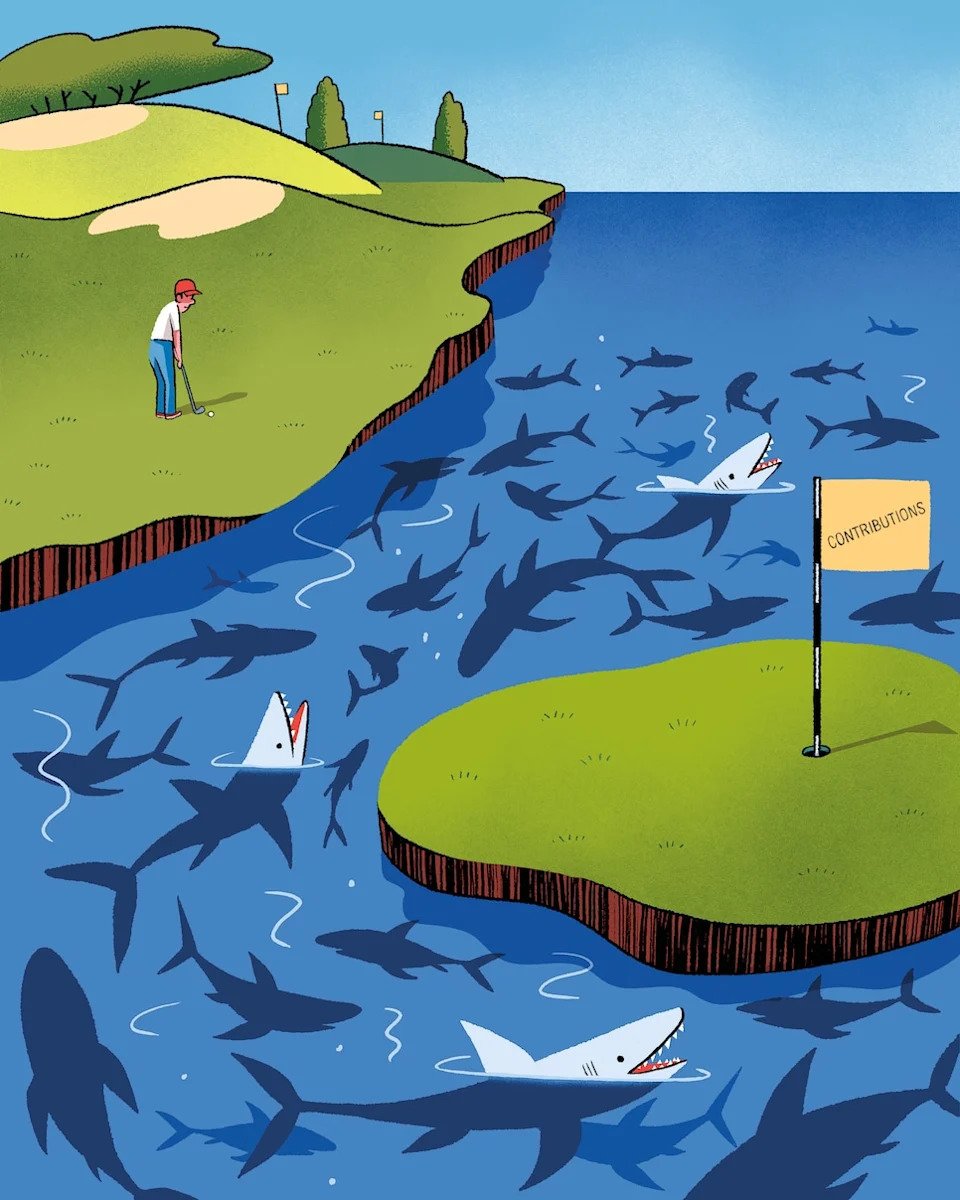
There’s a lot we don’t know about the new PGA Tour equity grants, and that’s not uncommon. Private equity, by definition, is not public. The hope is always that investments like these will grow exponentially.
“Equity grants will help people’s net worth rise, but the amount will vary from one player to the next,” said Mason Champion, a financial advisor and member of the global sports and entertainment practice at Morgan Stanley. “Established, marquee players can carry the risk of the equity grants, namely their illiquidity and volatility, and the grants have the potential to be a legacy asset for their families.”
Advertisement
Players without decades of tour winnings under their belt may have to think differently. “For new and up-and-coming players, those grants represent more of their net worth and total asset allocation, and they come with illiquidity risk,” he said.
What this means is if the equity grants significantly outweigh the liquid assets someone has, there is a risk that a player might not have access to the retirement he thinks he has.
Also, no one is sure what the grants are going to be worth in 10, 15, 20 years when they’ve vested. What market will exist to sell the grants and to whom also remains an open question, since there isn’t a secondary market at this point.
There is a risk that a player might not have access to the retirement he thinks he has.
Right now, players who received the initial grants will own half their value in four years, three-quarters in six and the full value in eight years. Champion, who is also a PGA of America member, put it bluntly: “Vesting does not equal liquidity, and the vehicle to sell the equity grants is also unclear.”
Advertisement
Some players are already skeptical. “Publicly players are showing support,” he said. “Privately they’re weighing the implications of illiquidity and later, dilution, when more grants are given out.”
Champion advises his PGA Tour players to deeply discount the value of the grants and assume their risk is akin to pure speculation. For retirement planning, he’d rather players assume the grants were worth much less and focus instead on the other retirement options.
MORE: How golf companies that manufacture in the U.S.A. survive
A New Era of Investing
These are challenging times for investing for retirement. It wasn’t always like this. When the PGA Tour created its retirement plans in the 1980s under commissioner Deane Beman, it was at the start of one of the greatest bull markets in history, not that anyone knew it at first. The stock market began a run in 1982 that lasted, with dips and surges, until 2008. It was a sustained rally that made passive investors rich just by owning blue-chip companies.
Advertisement
Today’s investors are looking for different asset classes that will have less volatility than stocks and bonds but also grow at a rate that allows investments to compound. In this environment, tour players have it great if they understand what they have and what the risks are.
The retirement plan is merit-based. It gives players the option to contribute from their weekly checks, as if they were traditional office employees, and earn tour contributions through making cuts.
The equity grants given PGA Tour players offer all the potential pop and sizzle of any private equity investment that could one day be worth a fortune … or be worthless.
At the end of the day, players need to look at their retirement benefits along with their other investments with the same focus on fundamentals that they bring to their golf swings.
Advertisement
It’s a good lesson for the rest of us.
More From Golf Digest
Voices LIV Golf is dying. The damage is permanent
Golf Digest Logo It’s already time to start preserving modern courses

Golf Digest Logo Like it or not, Jim Furyk was the best possible choice for 2027 U.S. Ryder Cup captain. Here’s why
Read the full article here