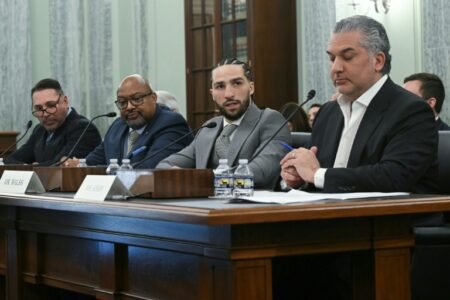



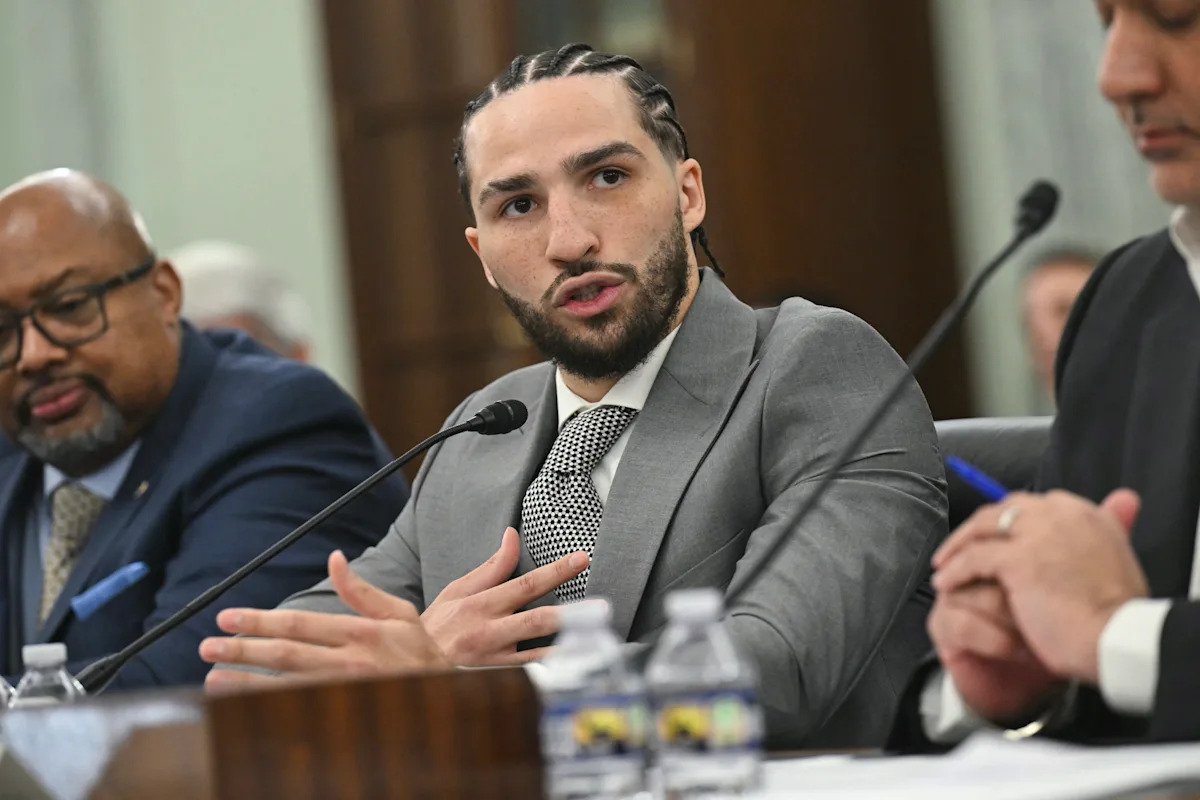
Former six-division champion turned boxing promoter Oscar De La Hoya and Nico Ali Walsh, the grandson of Muhammad Ali, spoke out against the bipartisan Muhammad Ali American Boxing Revival Act at Wednesday’s U.S. Senate Commerce, Science and Transportation Committee hearing in Washington.
The controversial bipartisan bill, which is supported by TKO Group — the parent company of UFC, WWE and Zuffa Boxing — passed the U.S. House of Representatives by voice vote last month and will soon be introduced into the Senate by Ted Cruz.
Advertisement
De La Hoya and Walsh have been key adversaries of the bill. Many in boxing are of the belief that it could hand TKO monopolistic control of a third combat sport because the Ali Revival Act would allow the formation of Unified Boxing Organizations (UBOs).
UBOs remove the separation between promoters and sanctioning bodies and could allow TKO to control the ranking system, the belts, and also organize the events in which fighters would fight on. This level of control is similar to what TKO has in the UFC.
“The Ali Act was built on a simple principle,” Walsh began. “The people controlling fighters should not also control the entire marketplace those fighters depend on. The separation exists to prevent conflicts of interest and exploitation. The new Muhammad Ali Boxing Revival Act would undermine that principle by allowing one entity to operate across promotion, management and matchmaking. It removes independence.”
WWE President Nick Khan, who also spoke at the hearing, insisted that the Ali Revival Act would lead to more money entering into the sport, however both De La Hoya and Walsh pointed to the strong margins the UFC business operates under, as well as UFC fighters’ well-documented dissatisfaction with the model.
Advertisement
“The UFC and its parent company agreed to a $375 million anti-trust settlement after fighters accused them of suppressing wages and restricting competition,” De La Hoya said.
“Boxing is not broken,” Ali Walsh added. “If it were, UFC champions — at the height of their careers — would not be actively targeting boxing fights because of the fair pay. That movement is rarely seen in reverse due to the UFC’s centralized pay structure.
“Boxing has never been perfect but one of its strengths has always been competition. Multiple promoters competing for fighters creates leverage and fair market value. When that competition is consolidated to one system, that leverage disappears.”
UFC fighters are generally believed to make around 20% or less of the revenue generated by the events in which they fight on, while in boxing, atheltes often command the vast majority of the finances.
Advertisement
Fighters in the UFC and Zuffa Boxing are also required to wear plain company-branded shorts, which removes the possibility of fighters earning sponsorship money and takes away from their individuality. Walsh argued that fighters’ freedom to bring sponsors and to express themselves through their fight outfit creates more income streams for them outside of the ring.
(L-R) Oscar De La Hoya; Timothy Shipman, President of the Association of Boxing Commissions and Combative Sports; professional boxer Nico Ali Walsh; and Nick Khan testify during Wednesday’s Senate committee hearing.
(SAUL LOEB via Getty Images)
Khan claimed the new bill will ultimately leave boxers with more choice because those who are unhappy with the UBO model are welcome to continue with the current system.
Walsh warned that while the UBO model is being presented as an option, “choice becomes theoretical, not real” when one entity controls access to opportunities, adding that fighters may not feel the impact immediately but could lose meaningful choice “five years down the line.”
Advertisement
The current Ali Act requires financial transparency, allowing main-event fighters to access key revenue figures from the events they headline — including the value of media rights deals — helping them negotiate fair purses. Critics argue UBO structures would reduce those disclosures, potentially limiting fighters’ leverage in negotiations.
De La Hoya warned that the creation of rival systems could divide the sport and make cross-promotional fights more difficult to make. Fighters with UBOs would not be able to take fights outside of that UBO.
In the current boxing model, fighters with different promoters can and do fight each other.
Advertisement
“[By] creating the UBO, it’s segregation, basically,” De La Hoya said. “[Some] fighters are going to want to stay in the current system and [other] fighters are going to want to fight for TKO or for Zuffa. Therefore, we will not see the very best fighting the very best.”
Walsh concluded by saying that if the bill passed, it should not have Muhammad Ali’s name on it because it represented everything the legendary champion stood against.
“If this bill is passed in its current form, it should not have my grandfather’s name on it, as it would betray the principles his Act was created to protect,” Walsh said.
Read the full article here