

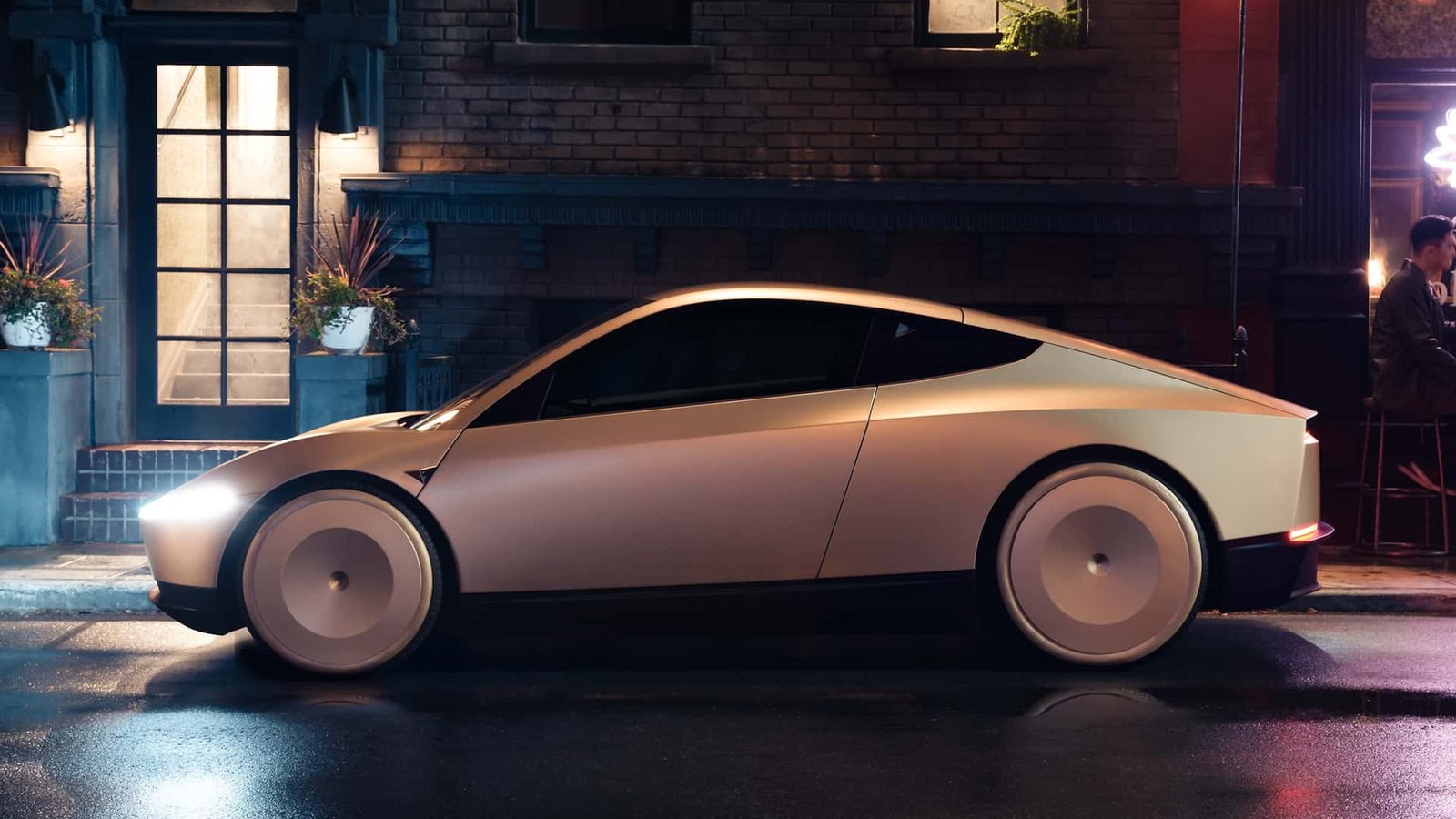
- EPA document reveals new details about the Tesla Cybercab.
- It has a 48.0-kWh battery and a 219-horsepower electric motor.
- The EV only weighs 3,113 pounds.
The Tesla Cybercab may not be in mass production yet, but new details about its battery, powertrain, and more are now publicly available. Thanks to an application from the Environmental Protection Agency, we have more details on Tesla’s tiny coupe.
The certificate of conformity application was first spotted by Car and Driver, revealing crucial information about the autonomous robotaxi that was previously unknown. Here are the most important things to know about the Cybercab:
- 219 Horsepower
- 418.2 Miles Of Range (est.)
- 3,113 Pounds
- Single Electric Motor
- 48.0-Kilowatt-Hour Lithium-Ion Battery
Photo by: Tesla
Tesla Cybercab In Detail
Unlike any previous Tesla vehicle, the Cybercab is a single-motor electric vehicle driven by the front wheels only, likely for maximum efficiency. Tesla doesn’t have to worry about driving enjoyment here since there is no driver. The document mentions one AC three-phase permanent-magnet electric motor generating 219 horsepower with a lithium-ion battery measuring approximately 48.0 kilowatt-hours.
The Cybercab tips the scales at 3,113 pounds, making it one of the lightest EVs on the road. For comparison, a Tesla Model 3 weighs around 3,800 pounds even in rear-wheel-drive configuration, while the 2027 Chevrolet Bolt is a bit lighter. Even a well-equipped compact sedan like the Honda Civic or Toyota Corolla can exceed 3,100 pounds in the right trim.
Thanks to that low curb weight, the Cybercab should go pretty far on a charger despite its diminutive battery size. The EPA depleted the Cybercab’s range to achieve 418.2 miles, a truly staggering number with such a small pack, but that is not how the agency calculates its range numbers.
The number you see on a vehicle’s window, at least for EVs, is calculated in a laboratory on a dynamometer. An EV is driven until the battery is depleted, the drive distance is recorded, and then it is repeated again for city and highway cycles. Real-world factors such as air conditioning are taken into consideration by using a factor of 0.7 to adjust the range. A 200-mile range would be adjusted down to 140 miles as an example.
These documents do not reveal the official range number for the Cybercab, but it should at least get close to Tesla’s original prediction of “around 300 miles.” There are still many details we don’t know about this car, including how quickly it will charge and how much it will cost. Perhaps most importantly, when will it be widely available?

29
Source: Tesla
Motor1’s Take: Tesla has shown that a small, lightweight EV can deliver range and performance numbers that are far from laughable; the only thing missing is a steering wheel and pedals. We’d love to see more small commuter vehicles like this, built at an affordable price point.
Read the full article here