

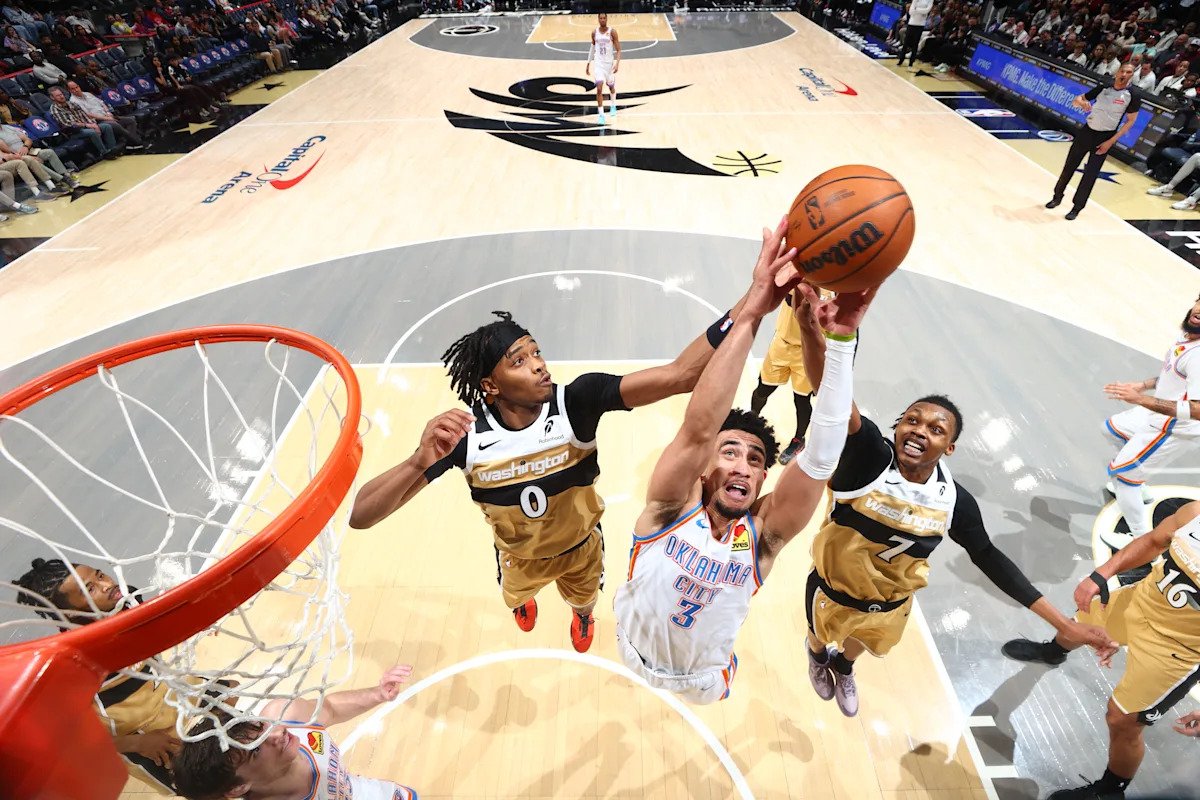
If you skipped watching this game and just saw the box score, you’d probably think this was a pro forma elite team stomps on tanking team NBA win. And you wouldn’t be totally wrong: Oklahoma City Thunder scored 132 points, won by 21, and got 40 points from Shai Gilgeous-Alexander and 20 rebounds and 10 assists from Isaiah Hartenstein.
But the details? Worth the watch.
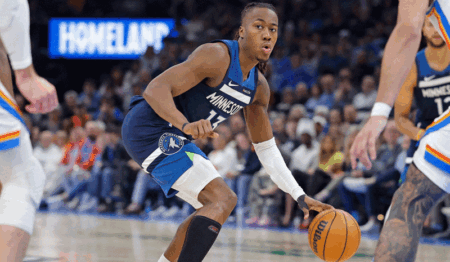
Wizards wing Bilal Coulibaly carried the team’s offense in the third quarter of their loss to the Oklahoma City Thunder. | NBAE via Getty Images
First, the Wizards stayed close for three quarters because they made seemingly every open three-pointer they got, and even a few that weren’t open.
Advertisement
Second, the first half closed with I think the weirdest out-of-nowhere “fights” I’ve seen since I started watching the NBA. In 1978.
It was a competitive affair, but well- and fairly played. No obvious cheap shots or cowardly shoves or even much of the grifter bull butter that can grate on an opponent’s nerves.
And then, Oklahoma City’s Jaylin Williams and Justin Champagnie bumped into each other after Washington scored. And for whatever reason, they both decided that what really needed to happen was that they should bump into each other again. And then push each other.
The two separated, Bilal Coulibaly went over to Champagnie to calm him down, and a ref rushed in to defuse the skirmish. All routine pissing match stuff.
Advertisement
And then, Ajay Mitchell thought it would be a good idea to run up and yell at Champagnie while pushing Coulibaly and Champagnie. To which Champagnie responded by pushing Mitchell in the face. For some reason, Mitchell took umbrage, and he went after Champagnie — somehow kinda getting past Coulibaly, whose reflexes surely rank in the top 1% in all of human history.
At which point frigging everyone on the court and all the assistant coaches from both teams and arena security piled up in a huge scrum that spilled into courtside seats and…well…looked bad, at least live. The actual fight-fight was mostly a few guys pushing and shoving and a bunch of guys trying to break up the fight. While the whole group staggered into the mostly-deserted seats.
As an aside, big-time kudos to the man in black who shielded the woman sitting next to him from the incoming tsunami of NBA players by holding up his drink. Even bigger kudos to the woman, who never flinched from a ton-plus of humanity spilling off the basketball court directly at her.
Another aside: if the team didn’t give the man in black a replacement drink after Anthony Gill accidentally slapped it out of his hand, Gill needs to send the guy a $20.
Advertisement
Anyway, the refs reviewed the footage and emerged from their conclave to announce the ejections of Champagnie, Mitchell, Williams, and Cason Wallace. In the whole fracas, Mitchell and Wallace were the only guys interested in genuine conflict. Even Champagnie mostly seemed like a cranky unc who just wanted people to get out of his way and leave him alone.
My guess is that tomorrow, the NBA will fine and suspend Champagnie, Mitchell and maybe Wallace. It’d be a stretch to turn that push into a punch, but Champagnie’s hand did touch Mitchell’s face in anger, which is a big no-no. So, I’d be surprised if Champagnie gets less than two games. I’d guess one for Mitchell, and maybe two or three for Wallace, who provided much of acceleration of force that moved the conflict from the baseline into the stands.
Oh yeah, there was a game. The general gist of this one was that from the first quarter, it felt like the Wizards would be quickly vanquished if they ever cooled off from three-point range. In the meantime, Oklahoma City bludgeoned Washington on the boards, clowned them with skilled passing, and rode elite scoring from Gilgeous-Alexander. The Wizards started missing in the fourth quarter, and they were quickly vanquished.
How quickly? The Thunder didn’t need to bring Gilgeous-Alexander back in the game, but they did it anyway while up 18 so he could get to 40.
Advertisement
Thoughts & Observations
-
What is the decision-making process that has the Wizards celebrating “Cherry Blossom Night” and the team NOT wearing those cherry blossom uniforms? Lemme just say, “BOOOOOO!” Those pink cherry blossom duds were the best ones the team has had, maybe ever.
-
Kinda weird considering Gilgeous-Alexander went for 40, but I didn’t think the Wizards defended him badly. He’s just that good.
-
The preceding bullet should not be construed as me saying the Wizards defended well. They did not.
-
Odd and interesting offensive possession at 5:10 of the first quarter. The Wizards set a pindown screen for Coulibaly. For some reason, Gilgeous-Alexander top-locked (sought to deny Coulibaly from getting the ball from the off-ball screen). Coulibaly went back door, Sarr hit him with the pass, and Coulibaly converted the layup. Why was Gilgeous-Alexander trying to deny the ball? I have no idea. Most teams are happy to concede threes to Coulibaly. Perhaps Oklahoma City was working on something for a different opponent.
-
At 1:37 of the first quarter, the Wizards ran a nifty backdoor action that got Anthony Gill an and-one. I rewound the play, wanting to give credit to Gill for the cut and Cooper for the pass only to learn that it was a case where OKC simply didn’t guard Gill. Seriously, Alex Caruso matched up with Jamir Watkins and let Gill go by…and there was no one behind him. Oops.
-
General observation: OKC switches on defense are a work of art — and they weren’t even at their best last night.
-
Coulibaly got aggressive offensively in the third quarter — repeatedly attacking and carrying the Wizards offense. Check out the possession at 4:27 of the third — he attacked off the bounce with multiple moves (made necessary by Tristan Vukcevic getting in the way on his first drive attempt). He kept his dribble alive despite aggressive pressure defense from Gilgeous-Alexander, and then finished by snaking past Kenrich Williams for a floater. That was high-level stuff.
-
NBA defenders have a lot of trouble staying in front of Coulibaly when he goes into attack mode.
-
The more he plays, the less like an NBA player Sharife Cooper looks.
-
Cool moment: Early in the fourth quarter, Caruso turned down an open three and Oklahoma City had to reset after Washington nearly got a steal and knocked the ball out of bounds. During the stoppage, Hartenstein came over to Caruso and told him he needed to take that shot.
-
The Wizards commit a lot of dumb and pointless fouls.
-
Amusing moment: Gill erased a Coulibaly score by hanging on the rim while Coulibaly’s shot was in the cylinder. OKC broadcaster Michael Cage called it a youthful mistake.
-
This victory marks 11 in a row for Oklahoma City. The loss is Washington’s 15th in a row.
Four Factors
Below are the four factors that decide wins and losses in basketball — shooting (efg), rebounding (offensive rebounds), ball handling (turnovers), fouling (free throws made).
The four factors are measured by:
-
eFG% (effective field goal percentage, which accounts for the three-point shot)
-
OREB% (offensive rebound percentage)
-
TOV% (turnover percentage — turnovers divided by possessions)
-
FTM/FGA (free throws made divided by field goal attempts)
|
FOUR FACTORS |
THUNDER |
WIZARDS |
LGAVG |
|---|---|---|---|
|
eFG% |
59.7% |
53.8% |
54.3% |
|
OREB% |
40.5% |
19.1% |
26.1% |
|
TOV% |
12.8% |
14.7% |
12.8% |
|
FTM/FGA |
0.226 |
0.143 |
0.208 |
|
PACE |
102 |
99.3 |
|
|
ORTG |
130 |
109 |
115.4 |
Stats & Metrics
PPA is my overall production metric, which credits players for things they do that help a team win (scoring, rebounding, playmaking, defending) and dings them for things that hurt (missed shots, turnovers, bad defense, fouls).
PPA is a per possession metric designed for larger data sets. In small sample sizes, the numbers can get weird. In PPA, 100 is average, higher is better and replacement level is 45. For a single game, replacement level isn’t much use, and I reiterate the caution about small samples sometimes producing weird results.
Advertisement
POSS is the number of possessions each player was on the floor in this game.
ORTG = offensive rating, which is points produced per individual possessions x 100. League average so far this season is listed in the Four Factors table above. Points produced is not the same as points scored. It includes the value of assists and offensive rebounds, as well as sharing credit when receiving an assist.
USG = offensive usage rate. Average is 20%. Median so far this season is 17.7%.
ORTG and USG are versions of stats created by former Wizards assistant coach Dean Oliver and modified by me. ORTG is an efficiency measure that accounts for the value of shooting, offensive rebounds, assists and turnovers. USG includes shooting from the floor and free throw line, offensive rebounds, assists and turnovers.
Advertisement
+PTS = “Plus Points” is a measure of the points gained or lost by each player based on their efficiency in this game compared to league average efficiency on the same number of possessions. A player with an offensive rating (points produced per possession x 100) of 100 who uses 20 possessions would produce 20 points. If the league average efficiency is 115, the league — on average — would produced 23.0 points in the same 20 possessions. So, the player in this hypothetical would have a +PTS score of -3.0.
Players are sorted by total production in the game.
|
WIZARDS |
MIN |
POSS |
ORTG |
USG |
+PTS |
PPA |
+/- |
|---|---|---|---|---|---|---|---|
|
Bilal Coulibaly |
34 |
72 |
133 |
20.0% |
2.5 |
142 |
4 |
|
Anthony Gill |
26 |
55 |
135 |
17.0% |
1.8 |
133 |
-13 |
|
Jamir Watkins |
26 |
55 |
134 |
17.1% |
1.7 |
121 |
-5 |
|
Bub Carrington |
33 |
69 |
125 |
19.2% |
1.3 |
88 |
-7 |
|
Alex Sarr |
22 |
47 |
109 |
32.9% |
-0.9 |
109 |
4 |
|
Jaden Hardy |
19 |
41 |
149 |
15.6% |
2.1 |
114 |
-22 |
|
Justin Champagnie |
14 |
29 |
127 |
9.6% |
0.3 |
76 |
-2 |
|
Will Riley |
28 |
60 |
81 |
20.9% |
-4.3 |
-26 |
-21 |
|
Sharife Cooper |
19 |
40 |
58 |
15.3% |
-3.5 |
-73 |
-19 |
|
Tristan Vukcevic |
20 |
42 |
54 |
29.6% |
-7.7 |
-94 |
-24 |
|
THUNDER |
MIN |
POSS |
ORTG |
USG |
+PTS |
PPA |
+/- |
|---|---|---|---|---|---|---|---|
|
Shai Gilgeous-Alexander |
32 |
68 |
131 |
40.2% |
4.2 |
246 |
11 |
|
Isaiah Hartenstein |
25 |
53 |
137 |
23.6% |
2.7 |
272 |
11 |
|
Chet Holmgren |
27 |
57 |
158 |
18.5% |
4.5 |
177 |
24 |
|
Ajay Mitchell |
15 |
32 |
139 |
27.1% |
2.1 |
273 |
-5 |
|
Jared McCain |
28 |
60 |
125 |
21.0% |
1.2 |
121 |
15 |
|
Kenrich Williams |
14 |
29 |
174 |
19.8% |
3.3 |
207 |
7 |
|
Cason Wallace |
15 |
31 |
185 |
10.3% |
2.2 |
135 |
1 |
|
Alex Caruso |
20 |
42 |
120 |
11.9% |
0.2 |
86 |
19 |
|
Isaiah Joe |
31 |
65 |
104 |
12.9% |
-0.9 |
42 |
12 |
|
Brooks Barnhizer |
5 |
11 |
255 |
2.2% |
0.3 |
150 |
1 |
|
Jaylin Williams |
9 |
19 |
0 |
3.8% |
-0.8 |
32 |
8 |
|
Aaron Wiggins |
21 |
44 |
50 |
16.8% |
-4.8 |
-65 |
1 |
Read the full article here