

TKO’s antagonistic entry into boxing through Zuffa Boxing has raised many eyebrows and ruffled plenty of feathers, including that of WBC president Mauricio Sulaimán.
Dana White, Zuffa Boxing’s co-founder, announced ambitious plans for a boxing league last year that would exclude the sport’s four major sanctioning bodies and rival promoters, and exclusively feature boxing’s original eight weight classes. Although those plans haven’t fully materialized yet, Sulaimán has not taken too kindly to the powerful company’s plans to exclude his 60-year-old organization.
Advertisement
Sulaimán detailed his thoughts on Zuffa and his experiences of dealing with them thus far this week on Uncrowned’s “The Ariel Helwani Show.”
“[Zuffa] has come in with some actions that are highly difficult to understand,” Sulaimán said.
“When they announced last year that there was going to be a partnership [between White, Saudi Arabian fight financier Turki Alalshikh and WWE President Nick Khan], the WBC immediately came out and said, ‘Welcome to boxing. We hope it is good for the sport.’ Anything that comes into boxing, we welcome and support. And they have been changing — too aggressive. … Bullying. I was treated so bad in Las Vegas [for Saul “Canelo” Alvarez vs. Terence Crawford, where TKO was the lead promoter].
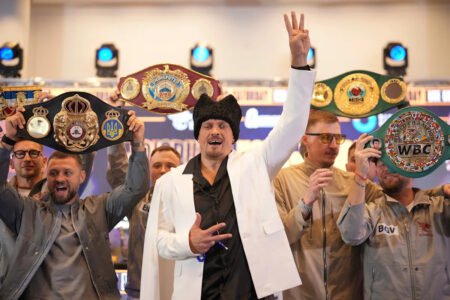
“Me and the other three organizations — WBO, WBA, IBF — we were not even given a credential. We were told we could not get into the ring. We were not allowed to go into the dressing room. We were not allowed to be at the commission desk. When we go to a fight, we go to work. It is not a vacation or fun or like a fan or a reporter that goes to a fight, we’re there to work. They are fighting for our championships. The fight was undisputed for the four belts, and it was very, very disappointing.”
WBC rules state that the president is entitled to a suite, front-row tickets, a credential, access to the ring, and an ample number of tickets, among other things, when working fights that are contested for WBC titles. Although TKO provided Sulaimán with a hotel room, Sulaimán explained that he believed he needed a suite, as a regular hotel room was not sufficient for him to hold meetings while in Las Vegas with key boxing figures.
Advertisement
Sulaimán was also initially told he was not allowed to get in the ring after the main event so he could present Crawford with the WBC title, as is common practice, but Sulaimán insisted on entering the ring anyway. He complained that by sitting with the regular public for the fight rather than the technical zone — where officials can observe instant replay technology, among other things — he was unable to do his job as a WBC supervisor for the fight.
“To try to portray that into me being arrogant or being demanding, it’s such a low-class action,” Sulaimán said.
“How low can you go to use that as ammunition instead of talking about boxing things?”
Considering Zuffa’s long-term plan of creating its own belt, the company’s attempts to ignore and devalue the sanctioning bodies before making that move aren’t surprising. Zuffa’s signing of Jai Opetaia, for example, made no reference to his status as an IBF cruiserweight world champion.
Advertisement
Although White entered the sport with an anti-belt approach, he has since backtracked on those comments to some extent, insisting he will not stand in the way of Zuffa fighters achieving their long-held dreams, which for Opetaia has been to hold all four sanctioning body belts as an undisputed cruiserweight champion.
“I felt very sorry for Callum Walsh,” Sulaimán said of Zuffa’s approach to belts. “He was the WBC Continental Americas champion, the WBC USA champion before that. Unbelievably nice kid who I’ve seen many times — his dream is to be the WBC [world] champion. His social media is full of videos with his belt and pushing, saying it’s a dream, blah, blah, blah, blah.
“Now he’s in that [Zuffa] league and he has to fight at middleweight, because they don’t have super welterweight, and he didn’t look good [against Carlos Ocampo at Zuffa Boxing 1] — I don’t know if he can be built into a middleweight. So that example of Callum Walsh — I felt sad for him.”
TKO is in the process of trying to push the Muhammad Ali Revival Act through Congress in the United States, so it can create a “Unified Boxing Organization,” which would not have to abide by the principles set by the original Muhammad Ali Reform Act. This would allow Zuffa to award its own belts, much like the UFC does, and remove the need to disclose revenue to fighters.
Advertisement
The Guardian reported this past week that Zuffa’s deal with Paramount+ is for $100 million per year over 12 fight nights, which means the rights fees for each card potentially exceed $8 million. With its first two shows already in the books and a third announced for Feb. 15, it’s understandable why Zuffa does not want fighters to realize how tiny of a percentage of the company’s revenue they are receiving.
“[The Ali Reform Act was created] mostly to protect fighters in the United States,” Sulaimán said. “To have representation with their managers, to demand from the promoters full transparency and disclosure, to protect and have a wall between promoters and boxing commissions, promoters and managers, promoters and organizations, for the protection of the fighter and to reduce any possibility of any wrongdoing. The WBC has to disclose any sanction fees that are charged, any movements in the rankings when we change a fighter every month. Every year, we submit a report to the [Association of Boxing Commissions].
“Mostly, it has brought the opportunity for fighters to make the most money they can make. They have the opportunity to choose between promoters and managers in a free market. So everything that is trying to be introduced [by Zuffa is to take away that ability]. MMA doesn’t have to abide by the Muhammad Ali Act. That’s why the UFC controls television, sponsorship, [the fighter’s] manager, the promoter, rankings, titles — everything is one universe. …. Around 80% of the revenue goes to the fighters [in boxing] and 20% to the promoters, which is very, very different from MMA.”
While the majority of the revenue goes to the talent in boxing, it is thought to be the opposite in MMA. White has long spoken about boxing’s “broken” business model, where every event is essentially “a going-out-of-business sale” because promoters attempt to maximize revenues for fighters from each individual show rather than reinvesting those earnings into building the infrastructure of the sport.
Advertisement
Zuffa Boxing shows also do not allow fighters to have sponsors on their trunks or walkout outfits because they are required to wear Zuffa uniforms, which takes away another revenue stream for fighters.
Overall, Sulaimán is unhappy with the approach Zuffa has taken to their boxing efforts and how different it is from the traditional sport.
“There’s no need to be so arrogant and so aggressive and say, ‘I am the man and I am the one,'” Sulaimán said. “It is a completely different world, boxing and the UFC. Here, it’s about the boxers. … In [MMA], it’s not. It’s [about the UFC], it’s about the money. I do no like the arrogant way, the bullying way, the aggressive way — there’s no need. They have great power, multi-billions.
“They claim there are no sanction fees in Zuffa. Of course there are no sanction fees, because they take all the money. It’s ridiculous. It’s something that is very elemental. If you compare one to the other, it’s not apples to apples.”
Read the full article here