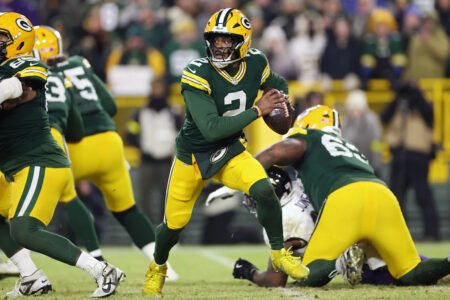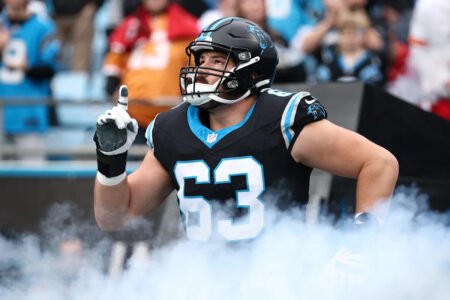


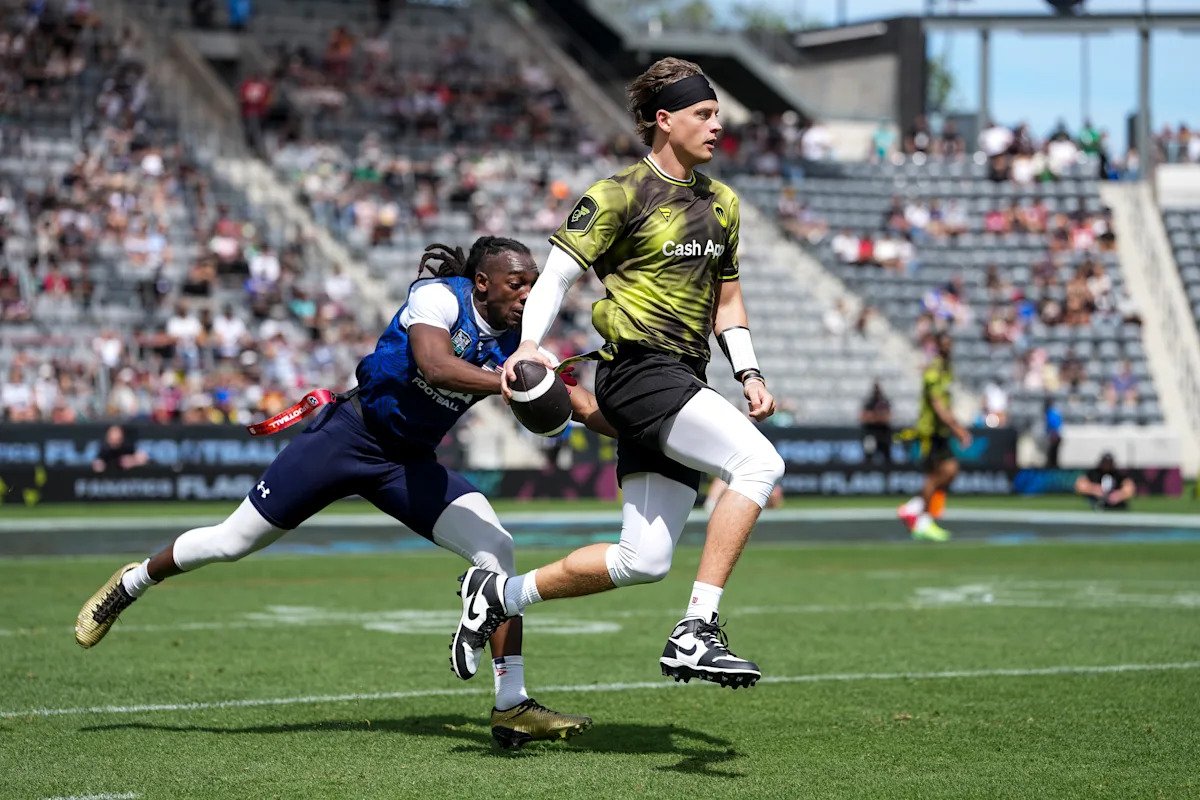
With one minute left in the first half of the Fanatics Flag Football Classic championship, Team USA quarterback Pablo Smith dropped back and hit wide receiver Velton Brown Jr. in the left flat.
Brown stutter-stepped then zigged across the field to his right, hips swiveling elusively along the way. Pro Football Hall of Fame Luke Kuechly and three-time All-Pro NFL wide receiver DeAndre Hopkins grabbed for Brown’s flags but missed as Brown instead slithered between them with a bend so deep he’d have qualified for the limbo championships. Brown regained his balance well enough to advance toward the end zone until, 2 yards out, three-time All-Pro NFL defensive back Jalen Ramsey pulled Brown’s flag. Team USA would need another play to finish its go-ahead scoring drive.
The U.S. men’s national flag team would still win this tournament championship just as it won the last five flag football world championships.
Advertisement
But moments like Brown’s acrobatics proved as eye-catching because of their athleticism as they are for the context they finally give a growing NFL conversation: How viable are NFL players for the 2028 U.S. Olympic flag football team?
Draft your Yahoo Fantasy Baseball team for the 2026 MLB Season
The NFL helped advocate for the inclusion of flag football (known colloquially as “flag”) in the Olympics, where it will debut for the 2028 Games in Los Angeles. And the NFL passed a resolution last year that allows a limited number of league players to compete in the Olympics, continuing the NFL belief that flag is the ideal way to expand football globally in an accessible way.
But as last weekend’s classic showed — by accident, actually — the brand of football headed for the Olympic stage varies drastically from the brand dominating TVs across America each Sunday in the fall. The tournament that was initially scheduled to be played in Riyadh, Saudi Arabia, among NFL greats and celebrities, was moved to Los Angeles due to regional conflict and security concerns in the Middle East.
Advertisement
On Feb. 23, as event organizers pivoted, USA Football leaders asked their men’s national team about playing in the March 21 event. Most players arrived three days beforehand to practice four times before they dominated a showcase to which they were not originally invited.
Team USA swept the NFL-laden rosters in round-robin games concluding 39-14 and 43-16, USA ultimately also beating Joe Burrow and Jayden Daniels’ Wildcats 24-14 in the tournament championship game.
Some of the most-decorated current and former NFL players suited up, from Tom Brady and Jalen Hurts to Saquon Barkley and Odell Beckham Jr. They couldn’t hang with the reigning world champs.
The quiet part can now be said out loud: The five-on-five, noncontact flag football coming to the Olympics is not the sport NFL players have grown up playing. And while the chance of NFL players cracking the Olympics team in 2028 did not evaporate, the reality of an uphill battle was on full display for league decision-makers and stars to see.
Advertisement
“It was never about shutting the door on that conversation; it was about providing some clarity and some education on the differences,” said Callie Brownson, USA Football’s senior director of high performance and national team operations. “I think we were able to really create some clarity around the fact that it does take some time.”
Charles Torwudzo, USA Football’s head of player personnel, echoed the sentiment.
“There’s not going to be a scenario or even a world where a guy has never played flag and they think that they’re going to come onto the U.S. National Team and be competitive at this level because this is serious,” Torwudzo told Yahoo Sports this week. “It’s like anything, no different than if you’re an underwater basket-weaver: You’re not going to just one day pick up and say, ‘OK, I’m going to be able to go do this.’ No, you have to be able to practice.
“Otherwise, you’re going to get exposed. Because there’s people that do it at a very high level.”
Advertisement
While time in the NFL will hone players’ athleticism, professional tackle football doesn’t introduce them to many of the general nor specific skills the International Federation of American Football’s (IFAF) flag game requires.
The 2028 Olympic flag football fields will stretch 50 yards long between end zones (70 total) and 25 yards wide, compared to the 100- (120 total) by 53 1/3-yard fields of the NFL. Five players on offense face five players on defense, with no special teams periods. Teams can front two quarterbacks on a play if they wanted, though all quarterbacks must beware the unimpeded rush that flag rules allow. And versatility is key: The U.S. National Team has traveled with 12 players for international tournaments, requiring players to step in at other positions if one player goes down. Think receivers doubling as defensive backs, expected to run precise routes on one side of the field while backpedaling rapidly on the other. Think quarterbacks expected not only to throw deep but also to manipulate space as ball-carriers.
In the Olympics, versatility will be even more crucial: The U.S. will get to bring only 10 players to the Olympic Village.
Advertisement
“A lot of our athletes now have been spending this offseason making sure that they’re sharpening their sword in their secondary position,” Brownson said. “Position versatility, even on the same side of the ball, is extremely important.”
Then there are the two constructs in flag most different from tackle football: the noncontact rule and flag-pulling.
When Olympic rules dictate no contact, they don’t simply mean no tackling — they mean no contact of any kind. NFL players who have spent decades training their reflexes to embrace physicality must suddenly eschew that.
“Their skillset was very different than anything we’ve seen in the game of the NFL,” Kuechly, who earned seven Pro Bowl berths in eight NFL seasons, told reporters after Saturday’s games. “The speed, the quickness, the ability to create space. Our inability to put our hands on those guys made the game very difficult.”
Advertisement
Kuechly acknowledged that linebackers similar in size to the 6-foot-3, 238-pound frame he brought to the NFL are not best fit for flag. Cornerbacks and nickel corners are best equipped for the quick-twitch moves on defense, while skill players and especially receivers have the cleanest transition to offense. Even former tackle players who excel in quick twitch get frustrated at times with the need to sanitize their physicality, said Jorge Cascudo, head coach of the U.S. Men’s National Flag Football Team. The breakdown and re-engage technique for a tackle differs from the mechanics of locating the flag, added Brownson: While NFL tacklers will break down and then load up to tackle, flag football defenders must move laterally after the breakdown, all while possessing sufficient hand-eye coordination to nab the flag in motion.
“Your eyes got to be in the right place and you really have to track that flag,” Kuechly said. “What these guys do such a tremendous job of is sinking lower and you miss that flag. So I think the technique that we learned as the game went on was: attack that near hip, play with our eyes directly on that flag, and then anticipate them dropping. That’s what they’re so good at.
“It was, quite frankly, very difficult for us to get those flags today.”
Biggest question about NFL players’ Olympic chances isn’t their skill
Perhaps unsurprisingly, Brady advocated Saturday after the tournament, for “a little modification to some of the rules to bring a little more passing into it.”
Advertisement
The seven-time Super Bowl champion had started his day strong, eluding the rush and then hitting Stefon Diggs on an explosive play downfield for the game’s first touchdown. Brady would also hit his longtime teammate and tight end, Rob Gronkowski, for the 2-point conversion.
Team USA nonetheless came back to win, 43-16.
Brady’s plea might sway athletes around the world. But it won’t shift the five-on-five, noncontact Olympic framework.
“NFL players, if they want to go to the Olympics, they got to change their game to these type of rules because the Olympics aren’t going to change the rules for them,” Cascudo said. “As much as they don’t like them, those are the rules. They’re not changing them for them or anyone because it’s all around the world. So we got to just focus with those rules and got to continue moving forward with those.”
Advertisement
NFL players who want to chase gold will need to commit time and energy to train their muscles and minds.
At least one former NFL first-round draft pick appears to be chasing that goal, Robert Griffin III announcing Thursday that he’ll be one of 24 players on Team USA’s 2026 training camp roster. Only half of those 24 will compete in the international championship in Germany this year.
Will active players take the time to study flag and compete in flag tournaments, which almost certainly will be necessary to acclimate them to the game’s highest level? Will quarterbacks practice throwing into the phone booth-like field that’s half as wide and long, receivers practice dipping their hips rather than muscling their way for extra yards, and defensive backs rep flag-pulling on the go ad nauseam?
Advertisement
The time and energy considerations for players who already feel like their own sport demands plenty could dissuade them from participation. The timing of the Olympics falling just before 2028 NFL training camps could beg questions, too, about the injury risk after a hamstring injury sidelined Gronkowski early in the classic and Burrow worried Bengals fans with his backyard-level carefree style of play.
The Olympic flag football door, as Brownson said, is open to NFL players. Crossing its threshold will take work.
“No different than how those guys are elite at the NFL level, there’s that same potential for them to be as elite at flag football,” Torwudzo said. “It’s just a matter of, again, time on task like anything else.
Advertisement
“It was a long time coming for us to have this matchup that we finally got to see. And our guys took advantage of it.
“They put on for the flag football community and the flag world in a lot of ways.”
Read the full article here