

In the first two parts of this series, we looked at how elite players train connection and balance to build a swing that holds up under pressure. In this third installment, the focus shifts away from the swing itself and onto something that often gets overlooked: how the body prepares to turn before the club ever moves.
During the 2025 Walker Cup, my student Jase Summy, a standout at the University of Oklahoma, regularly used a simple resistance-band stretch to prepare his body for one specific goal: creating enough internal rotation in his trail (right) hip to make a full, athletic turn behind the golf ball.
Advertisement
At first glance, the stretch looks basic. In reality, it addresses one of the most common limitations in the modern golf swing, and one that affects amateurs far more than they realize.
Why internal hip rotation matters
Many golfers assume a short or restricted backswing is a swing flaw. In reality, it’s often a mobility issue. When the trail hip can’t internally rotate, the pelvis struggles to turn freely. The body then looks for motion elsewhere, often showing up as a sway off the ball, an arm-driven backswing or a rushed transition.
Elite players understand this distinction. They don’t force a bigger turn; they create the physical capacity for one.
Advertisement
By improving internal rotation in the trail hip, the pelvis can rotate around a stable base instead of sliding laterally. That allows the upper body to coil more naturally, setting up better balance and sequencing as the swing transitions toward impact.
Internal hip rotation stretch
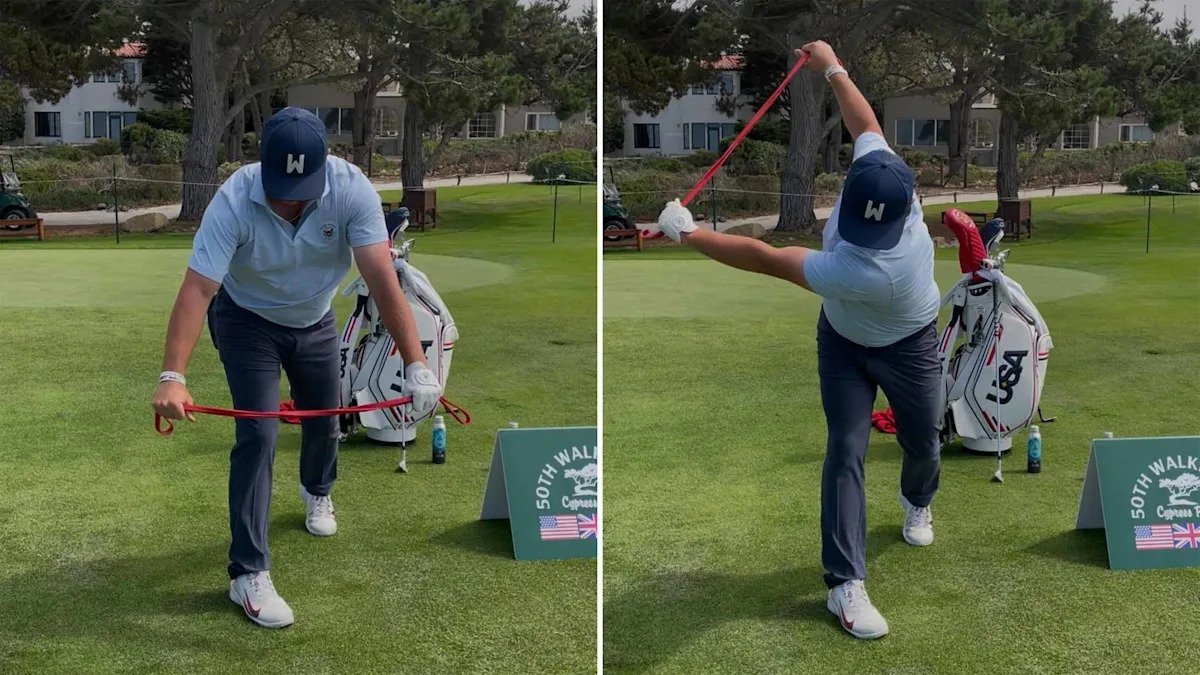
In the drill (pictured above), Summy anchors a resistance band and uses it to guide his trail hip into internal rotation while maintaining posture. The movement is controlled and deliberate, not aggressive. The goal isn’t to stretch harder, it’s to prepare the body to move correctly.
One subtle but important detail is his trail foot position. Rather than letting the foot flare outward, Summy slightly pinches the trail foot inward. This small adjustment increases the demand on internal rotation in the right hip and deepens the stretch, making it easier to feel the pelvis turning behind the ball rather than drifting sideways.
Advertisement
As the band creates gentle resistance and the foot stays slightly turned in, the stretch encourages a true coil. The hips rotate, the upper body loads, and the motion stays centered — exactly what elite players want to feel at the top of the backswing.
This is a stretch Summy uses not just during warm-ups, but throughout the day, especially before practice sessions and competitive rounds, because it directly supports how he swings the club.
How it can help recreational golfers
For everyday golfers, the takeaway is simple: Better swings often start away from the ball. If making a full turn feels restricted or forced, the issue may not be mechanics at all.
Advertisement
Spending a few minutes improving trail-hip mobility (while paying attention to simple details like foot position) can make it easier to rotate without effort, reduce compensations and create a backswing that feels more connected and controlled.
Elite players like Jase Summy don’t rely on flexibility alone. They prepare their bodies to move the way the swing demands. By improving internal rotation in the trail hip, and using subtle setup details to deepen the stretch, they create the freedom to turn fully, stay balanced and repeat their motion under pressure. For golfers at any level, this stretch is a reminder that a better turn often starts before the club ever moves.
Tomo Ninja Kit Divot Tool
Tomo Ninja Kit Divot Tool
Not lethal, but not not lethal.
$30.00 from Fairway Jockey
View Product
The post This stretch is trusted by elite amateurs. You should use it, too appeared first on Golf.
Read the full article here