



The best ideas often come from the most frustrating moments. For golf instructors Robert Propper and Stacy Keisler, that moment arrived during a rain delay when they found themselves discussing the same problem they’d been battling for 20 years: how do you get students to stop coming over the top?
“Stacy and I were in a rain delay, discussing the challenges of getting people to swing in the slot as opposed to coming over the top,” Propper recalls. “We discussed the ball being a clock with the 12 facing down the target line. Everyone is trying to hit the ball at 6 o’clock. We discussed rerouting the club to come down and hit the ball at 7 o’clock to get people in the slot.”
Advertisement
That conversation sparked a 3.5-year journey that would result in The Golf Clock, a visual training system now used by over 500 golfers and backed by a U.S. Utility Patent.
The Problem With Traditional Golf Instruction
After decades of teaching, Propper and Keisler had identified a fundamental flaw in how golf is typically taught. Students were leaving lessons feeling overwhelmed and frustrated.
“After many years of teaching, it really came down to students feeling like this was an expensive game of Simon Says and trying to remember 35 commands and being totally frustrated at the end of a lesson,” Propper explains. “We knew there was a simpler way.”
Advertisement
The issue wasn’t that students weren’t trying. It was that verbal instructions and mechanical training aids weren’t giving them what they actually needed: a way to see what they were supposed to do.
“Right-handed golfers that slice the ball to the right cannot imagine or see that swinging out to the right can be feasible,” Propper says. “When we introduced The Golf Clock, it clicks and makes perfect sense. Our students say for the first time I can see what I’m supposed to do.”
Why Visual Training Changes Everything
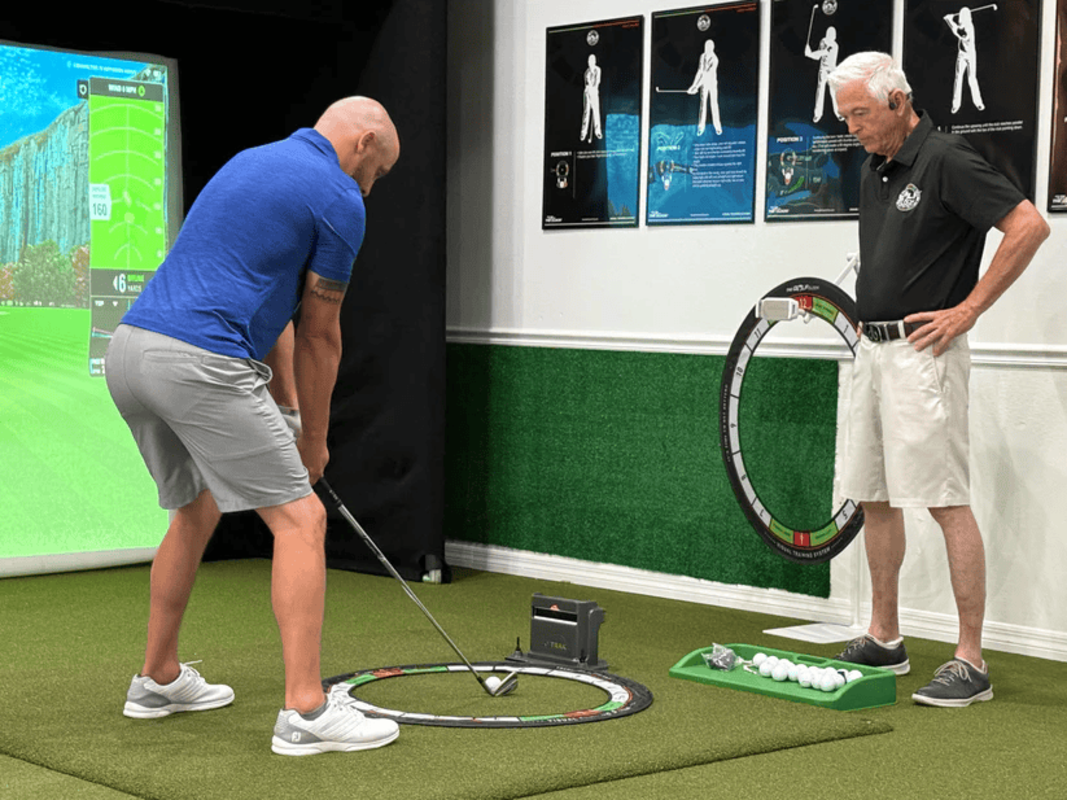
The Golf Clock isn’t a strap-on device or a mechanical restrictor. It’s a flat training aid that sits on the ground, creating a 360-degree visual reference system that shows golfers exactly where their club should be at every point in the swing.
Advertisement
The key position? Six o’clock on the backswing.
“Taking the club back over the six allows golfers to feel the club reroute by dropping the right elbow back to your side, which allows connectivity and the perfect 7 to 1 in-the-slot swing,” Propper explains. “Most golfers have heard about dropping the club in the slot but have no idea what that means. With The Golf Clock, they totally get it.”
The difference between visual and verbal instruction is dramatic. What used to take Propper and Keisler 3.5 to 4 hours to teach, they can now communicate in 45 minutes.
Advertisement
“Your eyes learn faster than your ears,” Propper says simply.
The Golf Clock
(The Golf Clock)
Real Results From Real Golfers
The proof isn’t just in the concept. It’s in the results. One student, Michael B., experienced a breakthrough that every golfer dreams about.
“He was an average player who did his first lesson on The Golf Clock and hit a draw for the very first time, about 20 to 25 yards further with every club,” Propper recalls.
That kind of immediate improvement isn’t unusual with The Golf Clock system. Because the visual feedback is constant and clear, students can make corrections in real time rather than trying to remember a list of verbal cues from their last lesson.
Advertisement
PGA professionals have also taken notice. The system has simplified instruction across all aspects of the game.
“All disciplines have been simplified with this visual,” Propper says. “Feet position, head position, posture, alignment, ball position. The full swing start to finish including all the fundamentals in perfect order.”
The Patent Journey
Turning a rain delay conversation into a patented product wasn’t simple. The process took 3.5 years and went through eight different prototypes.
Advertisement
“One of the biggest challenges was writing and rewriting the eight-step process to put it in the simplest terms,” Propper explains.
But the effort paid off. The Golf Clock was granted a U.S. Utility Patent earlier this month, covering both the physical design and the swing method. While co-inventor Stacy Keisler holds four patents total across his inventions, including three for a separate putt training aid, this newly granted patent represents the sole intellectual property protection for The Golf Clock. According to Propper, their patent practitioner was impressed by how smoothly the process went.
“He commented to us that he has never seen a product go through this process so seamlessly,” Propper says.
Advertisement
The patents protect what makes The Golf Clock unique: its ability to provide visual feedback for every fundamental of the golf swing in a single, portable training aid.
Building a Legacy Beyond the Product
Propper and Keisler aren’t just selling a training aid. They’re building a teaching methodology. At their KP Golf Studio in Wesley Chapel, Florida, they offer instructor certifications to golf professionals who want to adopt The Golf Clock method.
Advertisement
“We’re thrilled about our legacy being driven by simplifying the game of golf for all people,” Propper says.
The vision is ambitious but clear: create a standardized teaching method that instructors can adopt nationwide, giving golfers everywhere access to the same visual training system that’s producing results in their Tampa Bay studio.
Why It Works
The Golf Clock succeeds where other training aids fail because it addresses how humans actually learn. We’re visual creatures. We need to see patterns, not just hear about them or feel them through restrictive devices.
Advertisement
The clock face provides an instant reference point that makes abstract concepts concrete. “Swing from the inside” becomes “take the club back over 6 o’clock and come down over 7.” “Release through the ball” becomes “finish between 12 and 1 o’clock.”
These aren’t just easier instructions to remember. They’re instructions you can see yourself executing correctly or incorrectly with every practice swing.
At $89.99, The Golf Clock sits in the middle of the training aid market. It’s more expensive than basic alignment sticks but far cheaper than complex mechanical trainers. More importantly, it’s designed to be used anywhere: garage, backyard, driving range or even a hotel room.
Advertisement
“The Golf Clock is portable, affordable and delivers the visual approach that makes complex swing mechanics simple to understand,” Propper says.
For golfers who’ve spent years fighting a slice, tried countless YouTube tips and burned through expensive lessons without lasting results, The Golf Clock offers something different: a way to finally see what they’re supposed to do.
And sometimes, that’s all it takes to make everything click.
Related: ReelATHLETE Is Changing How Junior Golfers Get Recruited — And Mental Performance Training Just Became Part of the Package
Related: The Apex Target: Sometimes the Simplest Ideas Are the Best Ideas
Related: Why MILESEEY Golf’s GeneSonic Pro Was the Talk of PGA Show 2026
This story was originally published by Athlon Sports on Feb 16, 2026, where it first appeared in the Golf section. Add Athlon Sports as a Preferred Source by clicking here.
Read the full article here