



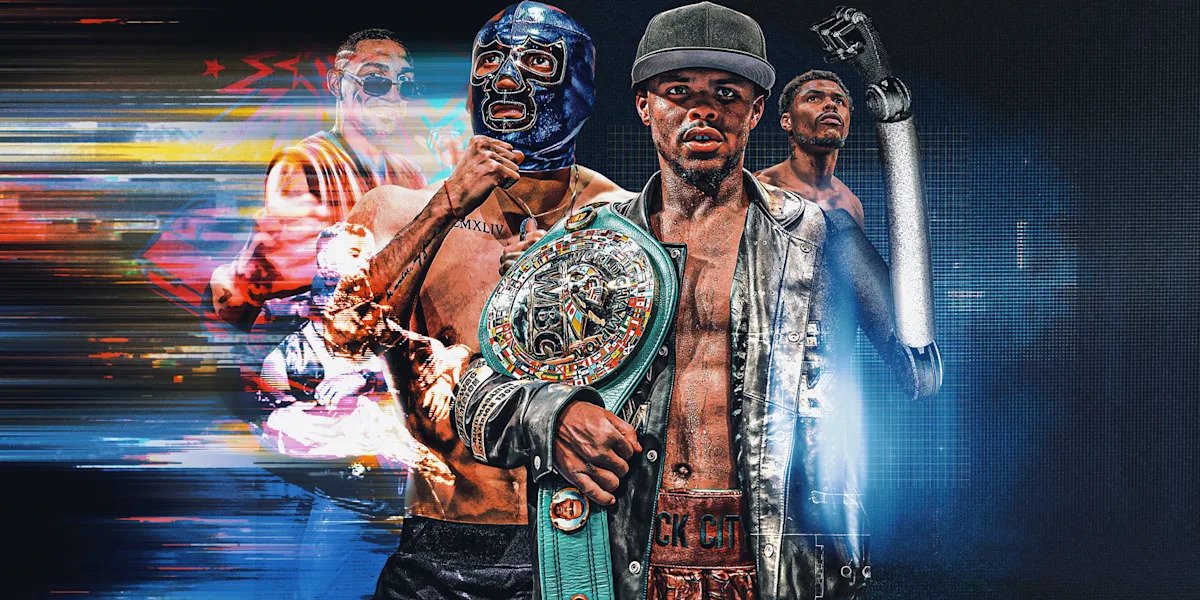
Writing is thinking, they say. Yet all we knew back in December was that Teofimo Lopez was writing.
As for what he was writing, we could only guess. It could have been anything, really. A grocery list. A pound-for-pound list. A hit list. A shortlist. A bucket list. A list of the 10 Best Pizza Joints in New York. It could even have been a poem. A love letter. A goodbye note. It could have been a script he planned to follow, or merely a transcript of what his opponent was in the process of saying. It could have been just an act — the equivalent of spamming buttons on a cellphone to give the impression one is busy, preoccupied. It could have been an attempt to look smart. Or instead, an attempt to look normal, human. It could have been an attempt to convince us that he is a thinking man.
Advertisement
Not until Chris Mannix, the host of that New York press conference, asked Lopez to explain himself would we have any idea. “I’m just doing some self-work, that’s all it is,” said Lopez in response, with his opponent Shakur Stevenson appearing bemused. “Nevertheless, shoutout to the [New York] Knicks. NBA semifinals against Orlando Magic, that’s coming soon. Let’s go Knicks! I’m excited for that.”
We may not have known what he was writing, or thinking, but Lopez had us curious all the same. Pen down, there was now a pregnant pause and a mischievous smirk. There was suspense. An element of mystery. Suddenly we were reminded why Lopez is one of the few boxers whose press conferences are worth actually watching these days. That’s not because he screams charisma, offers insight, or even has charm. It’s simply because he possesses the one thing most other boxers lack: Unpredictability. You see, whereas many of Lopez’s peers seem distracted and diminished by their desperation to thank whichever man or nation is paying them, Lopez leans the other way. Meaning that when he speaks, you have no clue what he will say. You wonder if he even knows. “Is that the reason why he writes?” you ask yourself.
“I’ll jiggle your balls,” he said to Stevenson that day, disappointing anyone who expected better from him. He then repeated the comment when Stevenson requested clarification before pulling his middle finger from the inside of his jacket and flashing it at Stevenson — yes, like a child.
Advertisement
Seeing that, it was natural to assume Lopez had been thinking nothing all along. Perhaps, had we been privy to his writing, we would have found only squiggles, empty speech bubbles and stick men. Perhaps he was writing lines like Bart Simpson in detention: I will not belch the national anthem; I will not sleep through my education; I will only provide a urine sample when asked.
“I’ve already figured your ass out,” said Stevenson in an effort to take the power back.
“Every fight is a different version of me,” countered Lopez. “I love it because even the people out there don’t know what they’re going to get from me. He can be studying and doing a lot of things, but he’s not going to know until the day of the fight.”
The truth is, not even Lopez himself knows which version of Teofimo Lopez will turn up on the night. Some nights the version we see is good enough to disarm and outpoint Vasiliy Lomachenko and Josh Taylor as though, for him, shutting down world-class southpaws is the easiest thing in the world. Then, on other occasions, you get the version of Lopez who flattered to deceive against George Kambosos Jr., who beat Lopez in 2021, and Sandor Martin, who almost beat him the following year. Some nights he seems to have it all under control, whereas on other nights control is the very thing Lopez lacks.
Advertisement
Away from the ring he is no more consistent. In fact, he is, like many boxers, much harder to read and control away from the ring. Inside the ring he is safe, ironically, but away from the ring the same cannot be said. Away from the ring Lopez lacks direction, purpose, control. He also lacks the spotlight and attention, so will often do all he can to reclaim it, usually through imprudent means. He speaks before he thinks, in other words. He forgets to write it all down first.
A mural depicting American Honduran boxer Teofimo Lopez in Tegucigalpa, Honduras.
(MARVIN RECINOS via Getty Images)
In 2023, Lopez came under fire when alleging that Top Rank, his promoter, favored Black fighters on their roster. He then refused to apologize for the comment, telling Punsh Drunk Boxing, a YouTube channel, “I wouldn’t be Teofimo if I did apologize. I don’t apologize for any of the stuff that I say. If you take it wrong, that’s on you because I don’t take it to that extreme. I know my place. Trust me, brothers. Trust me, sisters. I know my place. I just speak a certain kind of way, strategically, on one specific thing. But others will turn my words and switch it around.”
Strategic or not, by 2025 Lopez had developed a strange obsession with monkeys and bananas and was choosing to bait fighters like Terence Crawford, Gervonta Davis and Keyshawn Davis without reason or thought. He was also accused of sending a banana to Keyshawn Davis’ hotel room ahead of his fight with Denys Berinchyk, which Lopez vehemently denied.
Advertisement
“We’re all racists,” he said in a media huddle that year. “Do you know why? Because we’re against the one true race that matters the most: The human race. We’re all divided, all of us. Ten thousand religions, all of us. We’re all Black. I got Africa right there. [Lopez showed reporters a tattoo on his back.] They said the first human being was a monkey named Lucy. I’m everything, bro. I’m God. I’m sent by God. I’m not racist, that’s not racist. It’s how y’all take it. A banana’s potassium. You guys added the stereotype. All I did with the banana was eat and laugh at it. You thought that I sent that stuff. I’m not racist. God is Black.”
Later that same year Lopez attended a press conference following Terence Crawford’s win over Saul “Canelo” Alvarez in Las Vegas and masqueraded as a beat reporter. He did so while wearing a navy captain’s hat and a T-shirt and at one point stood to ask Crawford a question. Once that question had been answered, Crawford then turned the tables on Lopez and asked him if he intended to sign a contract to fight his “little brother,” Shakur Stevenson. “Yes, I will fight him right now,” said Lopez. “But they want to wait until January or February.”
The date in the end was Jan. 31 — Saturday at Madison Square Garden in New York — and that is about the only thing we can say with any degree of certainty. Beyond that, each of us is guessing. We are guessing which of the many versions of Teofimo Lopez will turn up on the night and we are guessing what type of fight will unfold when Lopez, the WBO super lightweight champion, welcomes Stevenson, the WBC lightweight champion, into a new weight class. All we know at this stage is that Stevenson (24-0, 11 KOs) is as fine a technician as you can find in boxing today — close to perfect, in fact — and that Lopez (22-1, 13 KOs) brings the kind of chaos and unpredictability that is sometimes perfection’s antidote.
We also know there is a fine line between genius and crazy.
Advertisement
“I think there’s something mentally wrong with him [Lopez],” Stevenson said on Uncrowned’s “The Ariel Helwani Show” in December. “I don’t think he’s all the way there mentally. I think he’s crazy. That’s my opinion.
“But that’s what makes him dangerous. Those guys are the most dangerous people: Delusional, crazy people who want to be the best and want greatness. I’ve got to respect it. But I think something’s definitely off with him.”

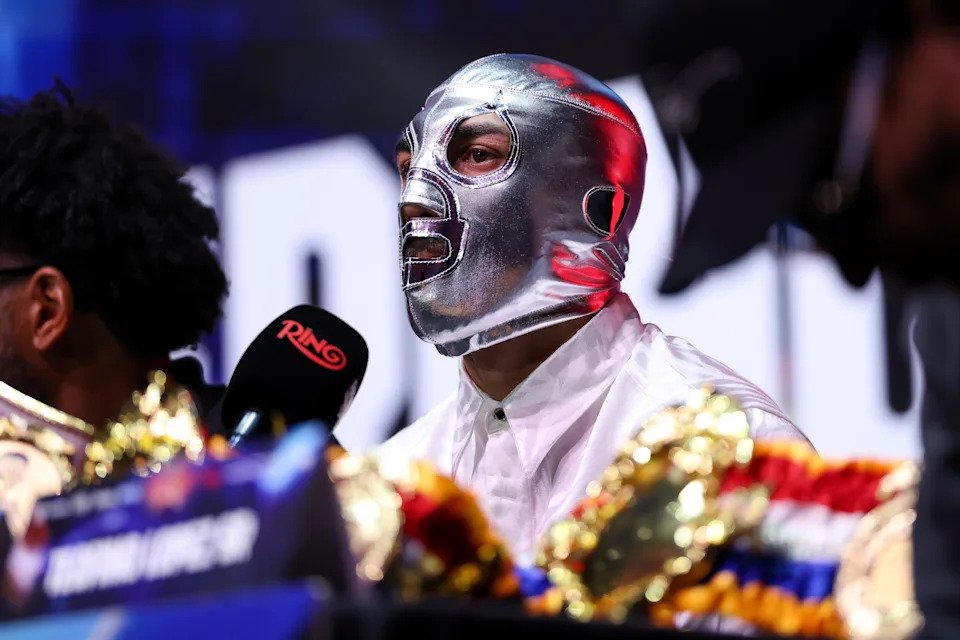
With Teofimo Lopez, you never know exactly what you’re going to get.
(Cris Esqueda/Golden Boy via Getty Images)
“I wanted to call the fight off,” said Chris Eubank on the night of his first encounter with Steve Collins in 1995. “I’m going into unknown territory. Forty-three fights in the past, I’ve always known what I was dealing with. I don’t know what I’m dealing with tonight. I’m fighting someone who is mechanically oriented and that is just an unknown area. It’s not fair that I should be put in this situation.”
Advertisement
No stranger to hyperbole, when Eubank said that Collins was “mechanically oriented,” what he referred to was the fact that Collins had employed a hypnotherapist to help him prepare for the fight and was therefore, in Eubank’s mind, unknowable. Collins had, by then, already spoken of the benefits of having a hypnotherapist, as well as the changes he had experienced, and now his opponent construed the whole thing as a form of black magic. It was, to Eubank, an alien concept, all this hypnotherapy stuff. He didn’t understand the practice itself and he now didn’t understand Collins, either. Worse, Eubank had lost all sense of control. He had allowed the fight to become something it wasn’t meant to be: A fight different from all the others.
“I had to beat him mentally,” explained Collins, reflecting on the night he took Eubank’s WBO super-middleweight title. “He always led the game when it came to the mental stuff and I’d see him beat opponents before he even stepped in the ring with them. He was the one everybody watched and he knew they were all watching him. I had to turn the tables on him and give him that inferiority complex a lot of his opponents had going into fights with him. Being the center of attention was one of his greatest assets and I had to remove that from the equation.”
For the months he spent preparing to fight Eubank, not once but twice, Collins never acted up or even acted out of character. He simply introduced a new element to the fight, something which at the time was new to both Eubank and the sport. By doing so, he then presented himself as a mystery man, an enigma. He made Eubank, the world’s greatest enigma, seem almost dull and ordinary by comparison. Not only that, he combatted Eubank’s pursuit of perfection — that coolness in the ring, those verbose monologues — with silence and unpredictability. He shut Eubank down. He made him start to wonder and worry.

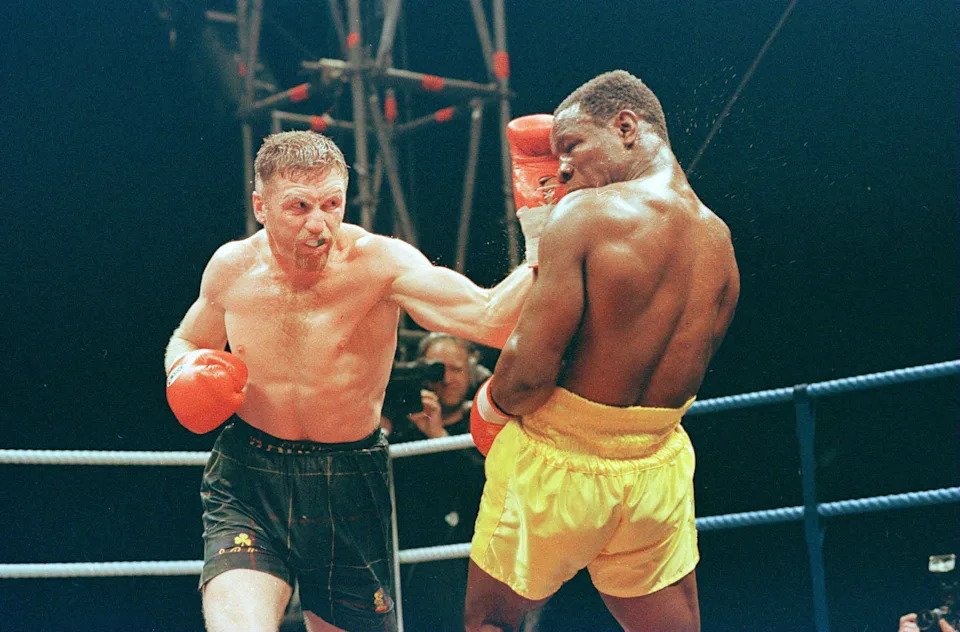
Sept. 9, 1995: Steve Collins does the unthinkable against a then-undefeated Chris Eubank.
(Holly Stein via Getty Images)
“When I made him uncertain and dragged the focus away from him, doubt started to creep in,” said Collins, victorious both times he fought Eubank. “I could see it written on his face. Every round was something new and unexpected. He didn’t know what was going to happen; he didn’t know what I was going to do. And Chris hated that. He loved being the one in control. He had never had that doubt before.
Advertisement
“Like any boxing match, if you take someone out of their comfort zone and put them in a place they’ve never been before, there’s a good chance they’ll break down and malfunction. Now, Eubank was very experienced in the ring and could do most things reasonably well. He could box and he could stand and punch. But nobody had ever tried getting into his head and fighting him outside the ropes first. Nobody had ever taken him out of that comfort zone. As a result, he didn’t see it coming. He thought he had me all figured out, just like all his other opponents.
“If something feels unfamiliar or not quite right, you burn up nervous energy and ask yourself questions. Add to that the fact that Eubank was a great thinker and you can imagine what was going on in his head. All of this weakened his focus and distracted him from the figure in front of his eyes. It’s like a bag of water with holes in it; all the water escapes until there’s eventually none left. That’s what Eubank felt like on the night of the fight. The whole thing was leaking and he didn’t know how to stop it. Before he realized what was going on, it was over. He lost his title.”
Collins was never an ignorant man — far from it — but he could see the value in presenting himself in that way when in the company of someone for whom ignorance was a naughty word. With the help of the hypnotist, or the mere threat of it, he was able to use Eubank’s intelligence against him and cause him to overthink at a time when a boxer prefers to be operating on instinct and, yes, with a degree of ignorance.

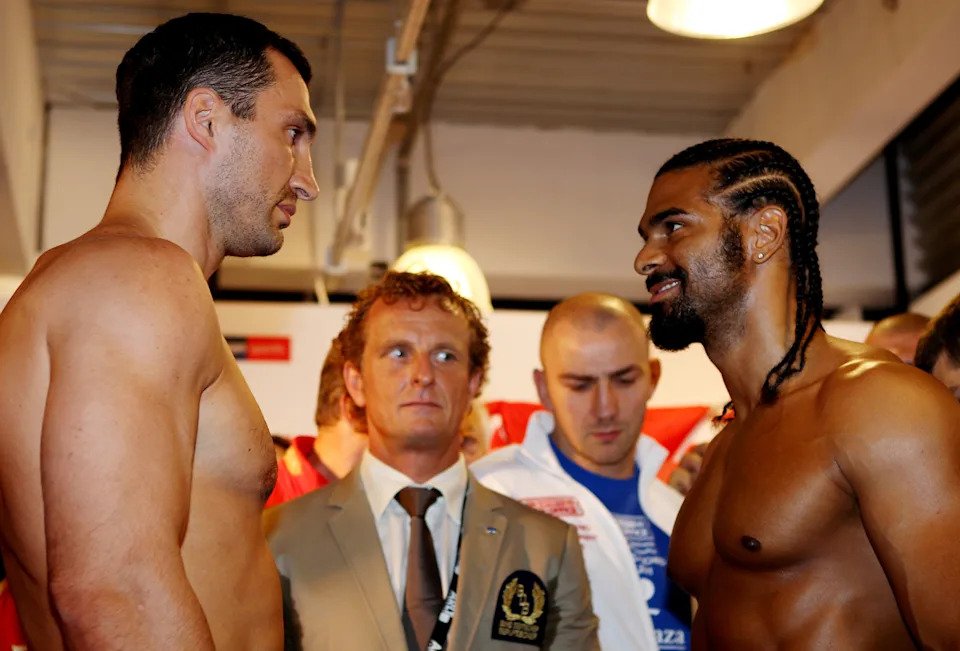
July 1, 2011: Wladimir Klitschko (L) and David Haye face off ahead of their heavyweight championship fight.
(Scott Heavey via Getty Images)
During his nine-year heavyweight title reign, the technically perfect Wladimir Klitschko faced plenty of opponents who tried to use ignorance to conquer his intelligence. One of those opponents was Britain’s David Haye, a WBA champion who, in 2011, showed up to a press conference wearing a T-shirt which depicted the two Klitschko brothers, Wladimir and Vitali, with their heads decapitated.
Advertisement
From a man who once said he would beat Jean-Marc Mormeck “like Rodney King” and suggested his thrashing of Audley Harrison would be as “one-sided as a gang rape,” this stunt hardly came as a surprise to anyone familiar with Haye’s antics. However, the T-shirt design did feel different — more tactical than just provocative. Whereas in the past Haye had simply been trying to grab headlines and sell tickets, with Klitschko he was more interested in playing the lunatic to Klitschko’s straitlaced doctor. It didn’t matter how Klitschko reacted to the image on the Haye T-shirt, just so long as he did. If it angered him, great. If it upset him, even better. All that mattered, from Haye’s perspective, was that Klitschko would be changed by it in some way and that this change may then become a factor on the night of the fight. He also rather liked the idea of Klitschko being fearful of the unknown — that is, what Haye might do next.
“Boxing is very much like chess and we are all chess players,” said Klitschko. “Some of us know the moves and think things through, while others work on instinct. I like to take my time and make the right move. David Haye, he just moves. If we were pieces on the board, I’d like to think I would be the king and he would be the knight. He is a wild man with a cowboy style. The horse is one of the most dangerous pieces on the board; although it is not as powerful as the king, it can still do damage if you let it.”
As it happened, Haye was too small and too distracted by his own mind games to capitalize on his pre-fight shenanigans when in the ring with Klitschko that July. Yet, despite falling short, he did at least set — or lower — the tone for others.
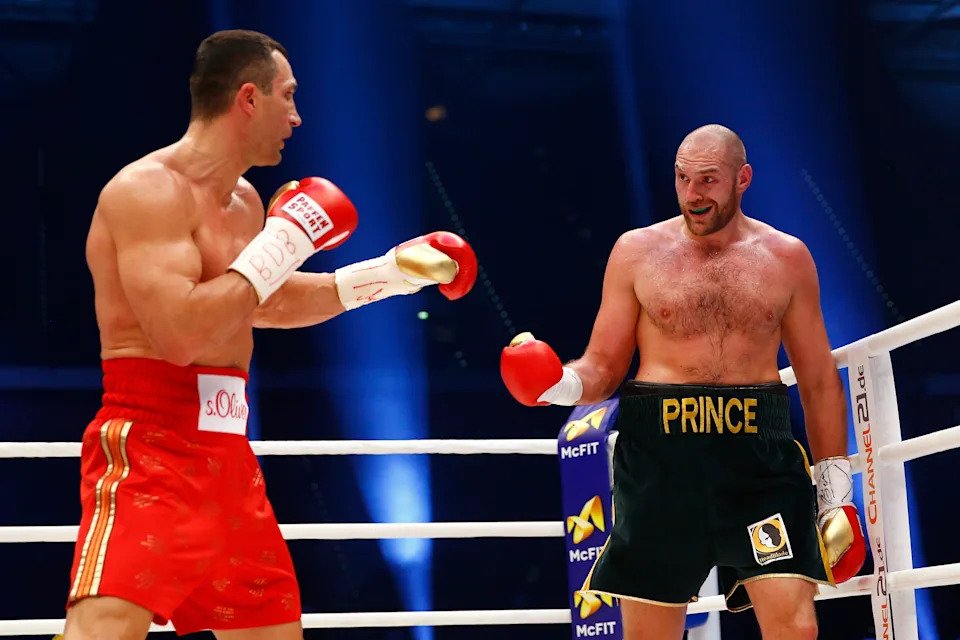
2015: Tyson Fury had Wladimir Klitschko befuddled before their fight even began.
(Reuters / Reuters)
Four years later, another Brit, Tyson Fury, adopted a similar approach to Haye’s, only Fury’s carried an authenticity Haye’s possibly lacked. That is to say, if Haye was very much playing the role of Joker to Klitschko’s Batman, Fury, knowing it was a part he was born to play, already possessed the costume and makeup. He need only hit his mark, remember his lines and act out his nature. By the time the fight came around, he was somehow both in Klitschko’s head and at the same time frustratingly out of reach. Try as he might, the Ukrainian just couldn’t land on the taller man, nor escape the sound of his voice in his head.
Advertisement
After the fight, as Fury sat in his changing room and picked at the blisters on the soles of his feet, he said: “Wlad didn’t know whether he was coming or going, did he? No, he didn’t know whether to stick, twist or go bust. Tied up in knots, he were.”
Until he won, Fury was perceived as not just an underdog, but delusional; a clown, a crazy person. Outsiders did not see the genius in his approach because it had not yet been explained in a language they could easily understand. They needed to see punches thrown and rounds won. They needed to see belts change hands. Only then would they accept that Fury was, on that night at least, more genius than crazy. And that the scariest thing for any human being is not the prospect of facing an adversary quicker, stronger, and more powerful than they are. It is to be confronted by something you do not understand.
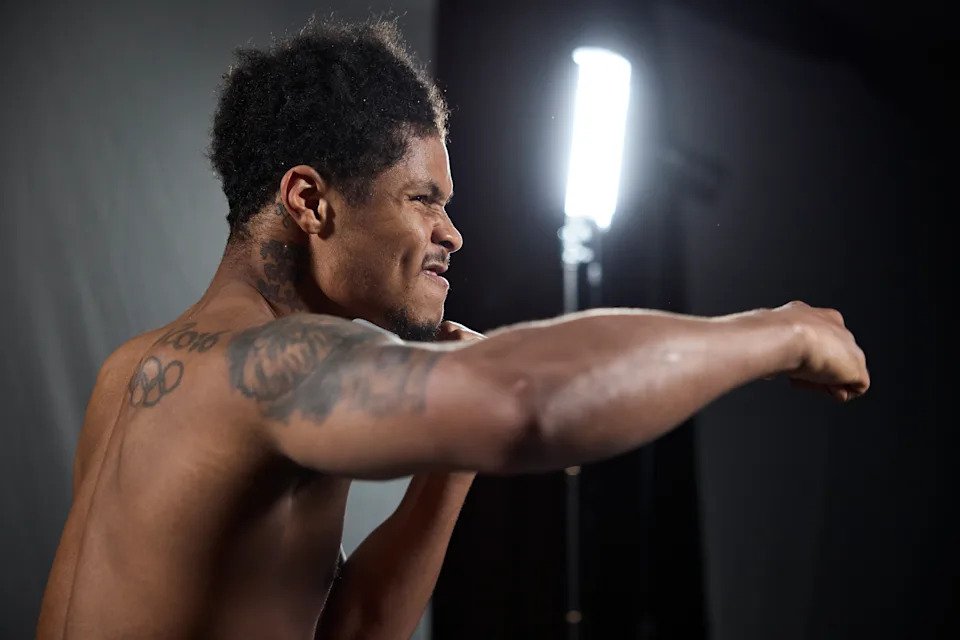
Shakur Stevenson is one of the most technically proficient fighters in modern boxing.
(Mark Robinson via Getty Images)
Having previously sparred Teofimo Lopez, Shakur Stevenson believes he has a complete understanding of the super lightweight champion he fights Saturday in New York. He may not know what he is thinking, but he at least understands how Lopez looks and behaves in the ring as an opponent. He is also quite adept at adjusting should he find himself surprised or forced to veer from his own game plan. He is smart in that respect. Sensible. Some have in the past even accused Stevenson of being too sensible; that is to say boring, or safe.
Advertisement
Vigilant might be a better word. In this instance Stevenson is clearly showing signs of that. In fact, by virtue of him acknowledging Lopez’s unpredictability ahead of time, he not only removes that as a Lopez weapon but will presumably expect nothing less from Lopez when the pair meet this weekend. That, for any perfectionist set to encounter chaos, is perhaps key. The rest is just technical.
“We’ve never lost to any southpaw — and I’m talking amateur and pro, over 200 fights,” said Teofimo Lopez Sr., Lopez’s father and coach, during that same New York press conference in December. “This is not going to be the No. 1.”
To which Stevenson, the southpaw in question, then replied: “He [Lopez Sr.] said Teo never lost to a southpaw. Well, I never lost to an orthodox [fighter], so it ain’t no different.”
Yet if, according to its dictionary definition, orthodox means either “something of the ordinary or usual type; normal,” it would surely be wrong to apply the term to Teofimo Lopez. In his case, “orthodox” both begins and ends with how he shapes up in the ring: Left foot forward, right foot back.
Read the full article here