




- The company’s Chief Creative Officer is against the screen-heavy dashboard trend.
- Massimo Frascella prefers a mix of analog and digital controls.
- Future models will avoid screen overload.
- Audi pledges a return to form in terms of interior quality.
Screens have taken over car interiors for several reasons. Cost-cutting is the most obvious one, since it’s cheaper for automakers to remove physical controls and funnel access to most functions through the infotainment system. However, there’s more to it than that. China, the world’s largest car market, overwhelmingly prefers smartphone-like dashboards. Volkswagen’s boss in China said last year that local buyers want “AI-first, connected vehicles, with seamless voice control and smart cockpits.”
Even if legacy automakers are on a slippery slope in China, it remains a massive market. Ideally, carmakers would develop different dashboard layouts depending on regional preferences, but that costs money. Instead, screens have taken over globally, even in Europe, where VW is now bringing back buttons after realizing that’s what people really want. Better late than never, right?
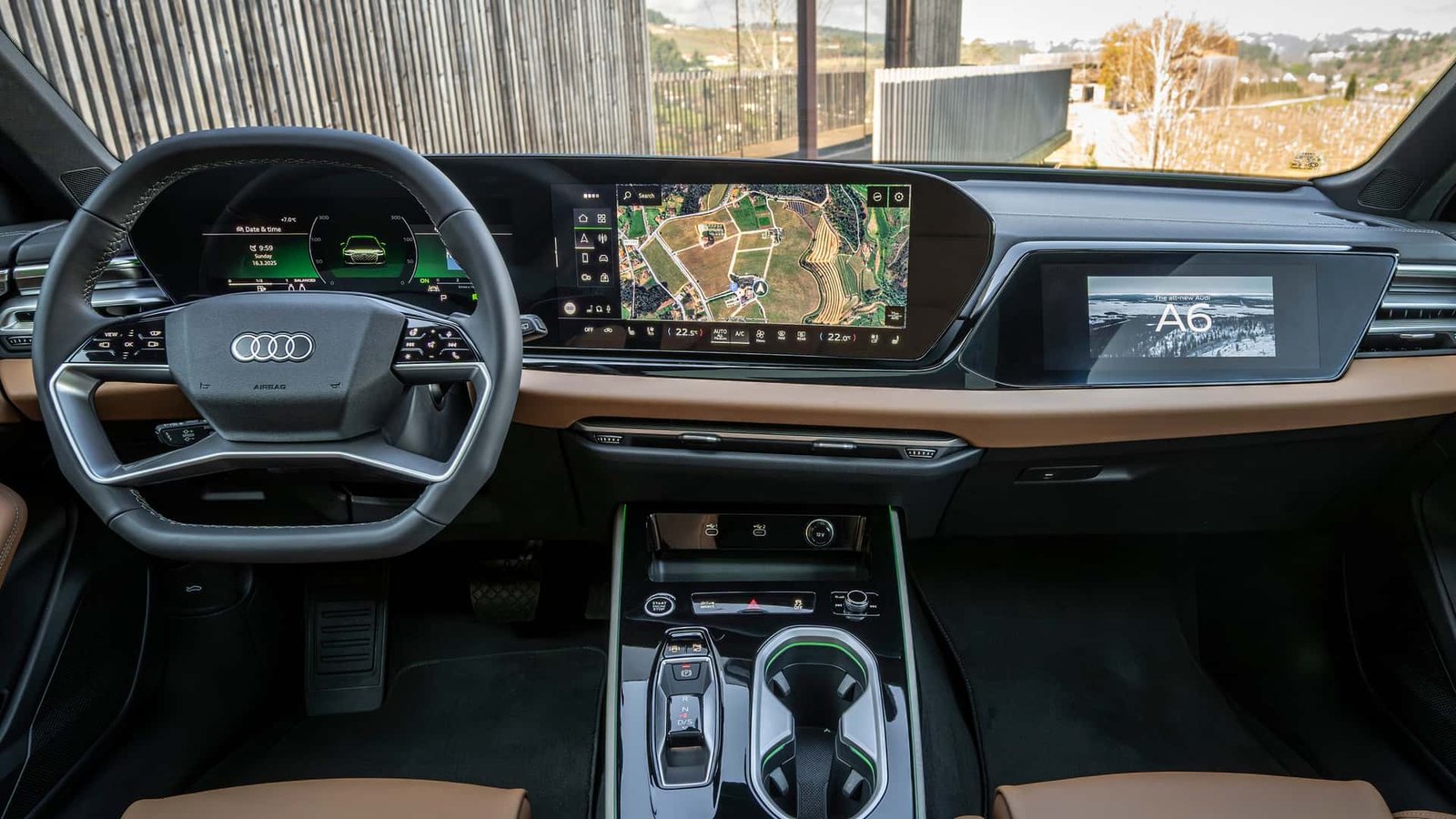
The situation is similar at VW’s luxury arm, Audi, as Ingolstadt also sadly went all-in on screens. Some of its latest models even feature an extra display for the front passenger, as shown above on the new A6 Avant. However, the company’s Chief Creative Officer wants to bring back what once made Audi interiors great: quality materials and a touch of that so-called “Audi click” a well-built cabin used to have in previous-generation models.

Speaking with Top Gear magazine, Massimo Frascella said what most of us are thinking: “Big screens are not the best experience. It’s technology for the sake of technology.” The Concept C points toward not only an electric sports car but also a return to form in terms of Audi-ness inside. It still has a central display, but it’s been downsized to 10.4 inches and can be folded into the dash, as was the case with many models from the last decade.
How much of the Concept C’s goodness will trickle down to future production Audi models remains to be seen. However, Frascella gives us hope that the overreliance on screens and the sea of glossy black plastics will become a thing of the past with next-generation vehicles:
“It’s not about taking things out, it’s just offering the technology and the functionality in a way that’s beneficial for the customer. And is premium. This mix of digital and analog, the tactility, the perception of quality that is so important for Audi, the precision, the metal parts… we talk about the Audi click. These made Audi what Audi is.”
This is not the first time a high-ranking Audi official has admitted interiors used to be better. Head of Product and Technology Communications Oscar da Silva Martins told our colleagues at Motor1 Germany in an interview last year that “we have certainly been better in terms of quality in the past, but we will get there again.”

77
Source: Audi
While Audi pledges to move away from today’s screen bonanza, Mercedes sees things differently. Outgoing design chief Gorden Wagener claims “we want to have a visual reference on the screen, or you might want to watch a movie and stuff like that. So yeah, you need big screens.” He went as far as taking a jab at Audi and its Concept C, saying the “interior looks like it was designed in 1995. It is a little bit too known, and there is too little tech.”
Audi refused to respond, instead opting to focus on how it will shape tomorrow’s models. Expected to go on sale in 2027, the Concept C will usher in a new era. Meanwhile, the next-generation Q7 and first-ever Q9 will stick closer to the current formula when the SUVs arrive later this year. Massimo Frascella was appointed Chief Creative Officer in June 2024, so his influence on new models won’t be truly felt until the electric sports car lands next year.
Motor1’s Take: Frascella gets it. Most of us don’t have a problem with screens per se. However, an interior becomes overwhelming and distracting when the dashboard turns into a near pillar-to-pillar display. Adding screens also tends to make cabins look cheap, which is especially problematic in the luxury segment, where buyers expect higher material quality.
While Audi appears to be moving in the right direction, one can’t help but wonder whether nicer interiors will make cars even more expensive. It’s logical to assume that adding buttons and improving fit and finish will command a premium. Then again, Audi needs to further distance itself from the mainstream VW brand, which is also reintroducing physical controls while upgrading materials.
Read the full article here