

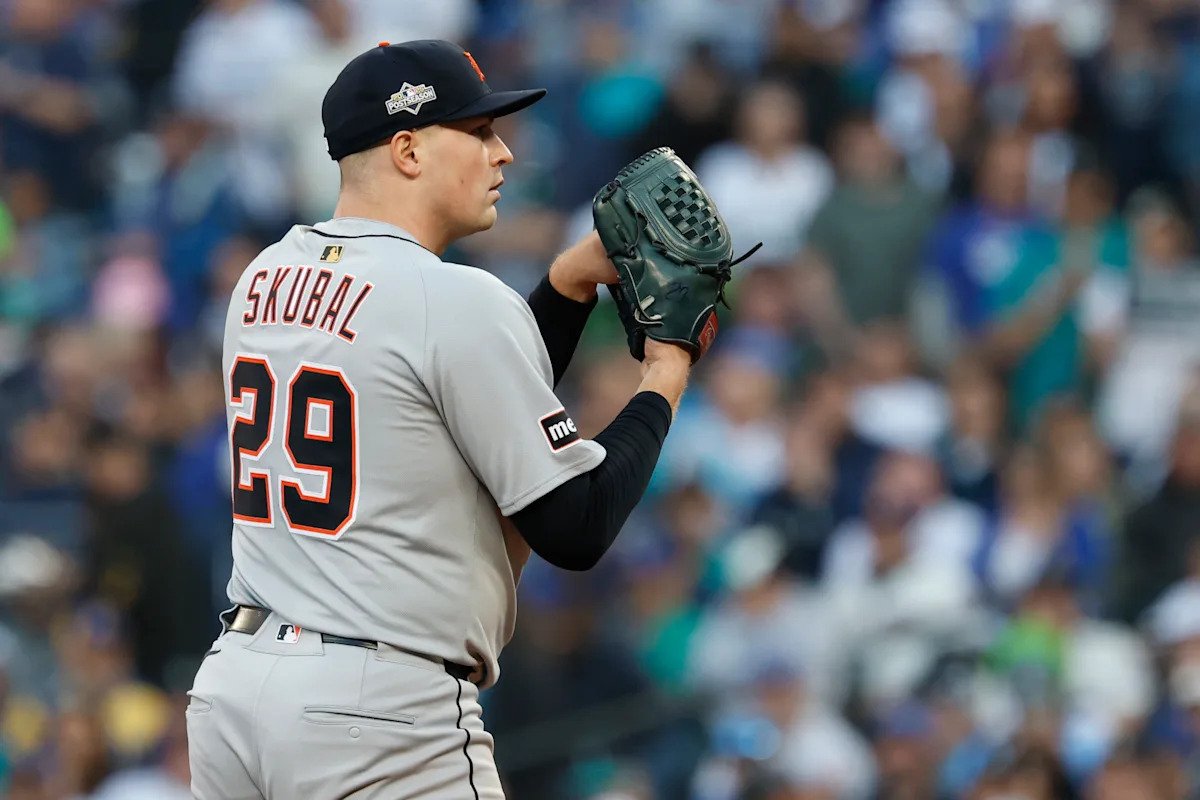
It’s late January, many MLB stadiums are submerged in snow, and Opening Day is two months away. Yet the best pitcher on Earth is actively trying to make history.
Tarik Skubal, the back-to-back American League Cy Young Award winner, is currently embroiled in a fascinating contract dispute with his employer, the Detroit Tigers. The 29-year-old hurler wants $32 million. The team would prefer to pay him $19 million. And while Skubal’s true, open-market value is closer to, and likely even beyond, the former number, MLB’s pre-free-agency salary scale caps his earning potential and complicates the conversation.
Advertisement
When he hits free agency at the end of 2026, Skubal will command a staggering sum. He is just the 12th pitcher in MLB history to win a Cy Young in consecutive seasons. Since the start of 2024, Skubal’s 2.30 ERA is a third of a run lower than the next-lowest qualified tally (Zack Wheeler at 2.63). Only two other players (Cristopher Sánchez and Hunter Brown) are even under 3.00. Over that span, Skubal has the second-highest strikeout rate (31.2%) and third-lowest walk rate (4.5%) among qualified starters. No matter how you crunch the numbers, his greatness is difficult to debate.
But in the cattywampus world of MLB arbitration, debate is exactly what will happen.
To understand why Skubal’s situation is so noteworthy, one must first understand the convoluted world of “arb.” Here’s an oversimplified overview.
Advertisement
When a player steps onto the diamond to make his MLB debut, he simultaneously starts a clock for control of his services. Depending on when in the season he debuts, a player is under team control for either six or seven seasons. For those first three seasons, big leaguers make the league minimum or close to it. There are various ways they can increase their earnings, but let’s not get trapped in the weeds here.
Entering Years 4, 5 and 6 in the majors, players gain eligibility for salary arbitration, a process that about 150 players go through each winter. In arbitration, agents negotiate salaries on players’ behalf until an early-January deadline. At that point, most players agree to terms with their clubs. The handful who don’t hurdle toward a hearing, with both the player and the team filing a salary number with the league office. After that, the two sides are permitted to continue discussing terms. However, some organizations maintain a policy referred to as “file-and-trial,” which, well, you’re probably smart enough to figure that out.
The arbitration hearing itself, usually conducted in late January or early February, is a bizarre, outdated ritual of corporate theater. In a nondescript hotel conference center or rented boardroom, representatives for the two parties state their cases in front of a three-person panel of independent arbitrators. That trio listens to the arguments from both sides and decides whether the player is worth a dollar above or a dollar below the financial midpoint. The result: The player is paid either his proposed sum or the team’s proposed sum. There is no in-between, no splitting the difference.
[Get more Detroit news: Tigers team feed]
That means unless Skubal and the Tigers find common ground ahead of their hearing date, the ace’s 2026 contract will be either $19 million or $32 million. To be clear, both of those sums are livable wages. Skubal will be able to splurge for guac on his burrito bowl no matter what. But the difference is staggering.
Advertisement
And the prevailing opinion around the industry is that Skubal and the Tigers will not settle before their hearing. Detroit is a file-and-trial team, though it made an exception last winter with hurler Casey Mize. Then again, the financial disparity in that circumstance — $25,000 — was relative peanuts compared to where things stand with Skubal.
His case’s $13 million gap, the largest ever in arbitration, is almost certainly unbridgeable. Skubal and his team are arguing from different ideological paradigms. A few phone calls between Tigers president of baseball operations Scott Harris and Skubal’s agent, Scott Boras, can’t untangle that reality.
Typically, final decisions rely entirely on comparables from the arbitration process, with judges comparing the player in question to players from previous seasons of a similar ilk, skill set and tenure. However, a rarely used clause in the collective bargaining agreement that allows players with “special accomplishments” to compare themselves to all players — not just previous arbitration-eligible players — likely emboldened Skubal and Boras to file such a large figure. It’s a huge ask, but Skubal’s back-to-back Cy Youngs would certainly qualify as “special accomplishments.”
Advertisement
Skubal’s aggressive filing makes this case something of a toss-up, as a $32 million salary would break Juan Soto’s record for the highest salary ever for an arbitration-eligible player, at $31 million. The current record for a third-year-arb pitcher salary is $19.75 million, which, coincidentally, was given out by the Tigers to David Price in 2015. Accounting for inflation and Skubal’s superior track record, Detroit’s $19 million filing this go-around looks like a massive underpay.
Crucially, arbitration cases are based on a player’s previous year salary. Skubal made $10 million last season. A jump to $32 million would be, far and away, the largest year-over-year raise for a starter in arbitration history. That record is currently held by Jacob deGrom, who went from $7.4 million to $17 million in his final year of arbitration after winning the 2018 Cy Young. Through this lens, the arbitrators siding with Skubal would represent an enormous break from precedent.
Had the Tigers filed a few million higher or Skubal a few million lower, it might be easier to pick a winner. Obviously, that’s not what happened. The result is a $13 million mystery box.
Will this situation have a discernible impact on Skubal’s future in the Motor City? It’s possible, but not likely. Sometimes arbitration hearings foster bad blood between a player and a team; Corbin Burnes and the Brewers are a notable example. That’s understandable, considering the team is spending time, resources and energy to craft an argument centered on a player’s flaws.
Advertisement
But usually, money fixes everything. Star first baseman Vladimir Guerrero Jr. and the Toronto Blue Jays went to a hearing before the 2024 season. Guerrero signed a 14-year, $500 million contract with Toronto the next year.
Barring injury, Skubal will enter free agency next winter and sign with whichever team offers him the biggest bag of riches. The outcome of his arbitration hearing won’t change that. That doesn’t mean Skubal vs. Detroit is important to only Skubal and Detroit.
If Skubal wins, it could dramatically alter future arbitration cases for frontline starters. For instance, Paul Skenes, the 2025 NL Cy Young winner, will enter his first year of arb next winter. How the judges rule on Skubal’s situation will surely impact how Skenes’ arbitration plays out. Both players are also on the MLB Players Association executive subcommittee, an eight-player group heavily involved in labor negotiations. Because Major League Baseball’s Labor Relations Department plays a large role in helping craft teams’ decisions ahead of arbitration, one could view Skubal’s face-off with Detroit as part of the larger discord between league and union.
Advertisement
But the most tangible upshot of Skubal’s upcoming hearing is how it has left Detroit’s offseason in a total holding pattern. Multiple Yahoo Sports sources believe the Tigers are waiting to learn if Skubal will earn $19 million or $32 million this year before deciding whether to make additional expenditures this winter. That dynamic helps explain why Detroit, one win away from the ALCS last fall, has undertaken such an underwhelming offseason.
The Tigers extended a qualifying offer (one-year, $22.025 million) to second baseman Gleyber Torres, who accepted. Harris and Co. also re-signed reliever Kyle Finnegan to a two-year deal and added legendary closer Kenley Jansen and Drew Anderson, a former Phillies prospect coming off a stellar year in South Korea, on one-year contracts. Even in the transactionally inactive AL Central, that’s an unsatisfying haul.
A handful of free agents remain available — starters Zac Gallen and Lucas Giolito, third baseman Eugenio Suárez — and would be significant upgrades for a Detroit team that should be going full-throttle in what might very well be Skubal’s last year in town. Unfortunately, there’s a good chance the moment has passed, with so many of the impact free agents having already signed with new teams.
Detroit’s organization remains in a healthy place. The Tigers — who appeared to be running away with the division in 2025 before a late-summer collapse — boast a quality batch of young position players, a dynamite bullpen and one of the better farm systems in baseball.
Advertisement
And for all the drama swirling around his future, Skubal is still on the roster. No matter how his arbitration case turns out, no matter the price attached to his name, the Tigers should be more aggressive in crafting an unimpeachable roster around their generational talent. Detroit tumbled out of October the past two seasons despite a slew of iconic Skubal outings because the lineup wasn’t good enough.
Finding a way to upgrade that unit while Skubal is still around feels like a worthwhile course of action either way.
Read the full article here