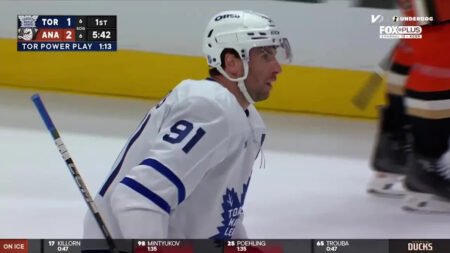


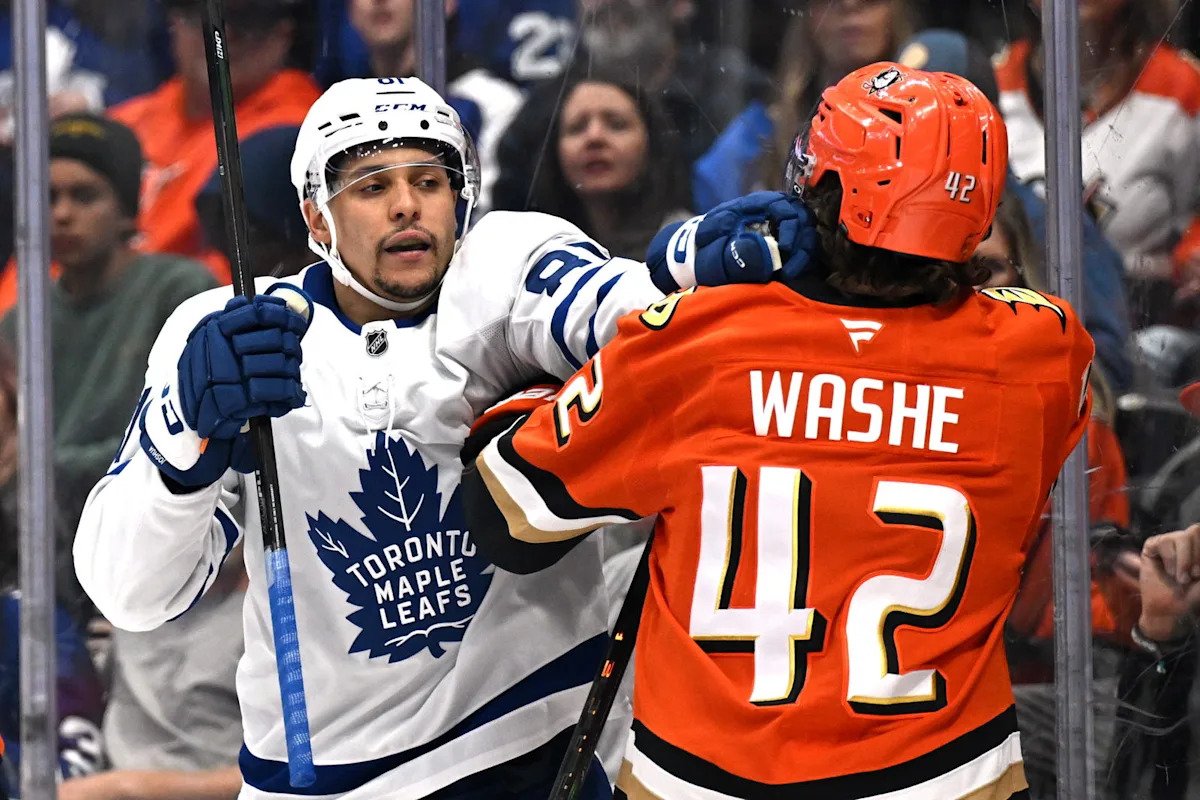
After notching four of a possible six standings points on their three-game Western Canadian road trip, the Anaheim Ducks returned to Orange County to host the Toronto Maple Leafs in a game that had a surprising amount of built-up tension heading in.
The biggest storyline before the puck dropped was how the Leafs were going to respond to their lack of physical response following the injury to their captain, Auston Matthews, who suffered a season-ending knee injury at the hands of Ducks captain Radko Gudas a few weeks ago.
Advertisement
Game #74: Ducks vs. Maple Leafs Gameday Preview (03/30/26)
Ducks Radko Gudas to Play Monday against the Maple Leafs, Expecting “Intense Game”
This interconference game didn’t have much standings implications, as the Ducks entered having had their four-game winning streak snapped on Saturday by the Edmonton Oilers. They sat with a three-point lead in the Pacific Division standings.
Toronto entered with the sixth-best odds to win the NHL Draft Lottery and were coming off a 5-1 loss to the St. Louis Blues on Saturday.
Radko Gudas exited the Ducks’ 3-2 OT win against the Calgary Flames on Thursday with a lower-body injury, forcing him to miss the team’s previous game, but he returned for this one. Pavel Mintyukov also missed the Ducks’ last game against the Oilers with a lower-body injury and returned on Monday. Nathan Guacher, Frank Vatrano, and Drew Helleson served as healthy scratches.
Advertisement
Here’s how the Ducks lined up to start this game:
Kreider-Carlsson-Terry
Killorn-Granlund-Sennecke
Viel-Poehling-Gauthier
McTavish-Washe-Moore
LaCombe-Trouba
Mintyukov-Carlson
Zellweger-Gudas
Ville Husso got the start in this game for the Ducks and saved 23 of the 28 shots he faced. Former Ducks backup netminder Anthony Stolarz opposed him in the Toronto net and stopped 28 of 32.
“Reminds me of exactly what happened in Toronto,” Joel Quenneville said. “We had a comfortable lead, we were in a good spot, and they’re dangerous off the rush. We turn pucks over, and they’re gone. That was their recipe there.”
Advertisement
Game Notes
This game was sloppy between the whistles and resembled a playoff game after them. The emotions mentioned earlier gave way to scrums and altercations, halting game flow and leading to multiple man-advantage opportunities for each side.
Radko Gudas received a ten-minute misconduct after participating in an opening faceoff fight with Toronto forward Max Domi. He only saw 7:10 TOI in this game. Ducks forward Cutter Gauthier left the game in the first period after scoring a goal to extend the Ducks’ lead to 2-0. He only played 3:20.
Ducks center Leo Carlsson gave a scare after colliding with Troy Terry and William Nylander simultaneously, sending him briefly to the locker room. He wound up playing 18:51 in this game.
Advertisement
This one only saw 37:25 of 5v5 action. The Ducks won the possession battle in those minutes with 57.14% of the shot attempts, despite generating 48.48% of the shots on goal, and wound up with 52.55% of the expected goals.
Power Play: The Ducks converted on one of their six power play chances, including a failure to convert on a two-minute 5v3 in the opening two minutes of the contest. Their 5v4 chances were more cohesive and dangerous than their long 5v3. While on the 5v3, they collapsed on the Leafs’ triangle in an attempt to shorten passes and get Stolarz moving, but could open any seams.
At 5v4, they were utilizing their net front and bumper to disrupt Toronto’s penalty killing structure, and added some creative wrinkles, including banking flank shot-passes off the endboards to find the net front forward on the back post.
Beckett Sennecke: Sennecke is one of the most volatile NHL rookies in recent memory, and learning how to mitigate his mistakes while amplifying the aspects of his game that make him special will be a challenge throughout the early parts of his career.
Advertisement
He can singlehandedly create scoring opportunities from his own goal line, as displayed by the Ducks’ third goal, where he cuts back on an aggressive pursuer and sends a picturesque sauce outlet to Jackson LaCombe 120 feet away, in the neutral zone.
He can also cost his club points here and there with careless offensive zone turnovers. He’s making ambitious decisions to create opportunities when simple plays are available. He turned a puck over at the offensive blueline on a cycle that sprung Nylander on a breakaway and allowed Toronto to tie the game late.
He didn’t see the ice following that play at the 10:14 mark of the third period or in the overtime frame. If the coaching staff had played him, perhaps the Ducks would have come away with the extra point, but at this stage in the season, they viewed the lesson as more important than the standings point.
Leo Carlsson: When Carlsson briefly exited the game, the air was sucked out of Honda Center. Upon his return, halfway through the third period, he was back to generating scoring chances at will, both off the rush or cycle.
Advertisement
He displayed a few aspects of his game that, if they become more consistent, will help round out his attacking ability and add to his repertoire as a 200-foot impact player. He manufactured a number of turnovers with clever defensive angles and stick lifts, which he then turned up ice into quick offense.
He was also more willing to engage puck carriers through their hands, getting his 6-foot-3 frame between them and the puck, to muscle possession away. With these added elements, he can continue his climb into the conversation of the NHL’s elite centermen.
The Ducks will hit the road for a brief trip to Northern California to face their division rival San Jose Sharks on Wednesday, as the Sharks find themselves within striking distance of the second wild card spot in the Western Conference playoff picture.
Takeaways from the Ducks 3-2 OT Win over the Flames
Ducks Forward Prospect Nathan Gaucher Recalled from AHL
Takeaways from the Ducks 5-3 Win over the Canucks
Read the full article here