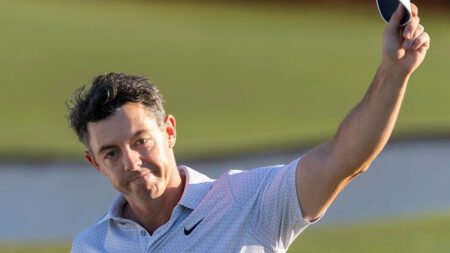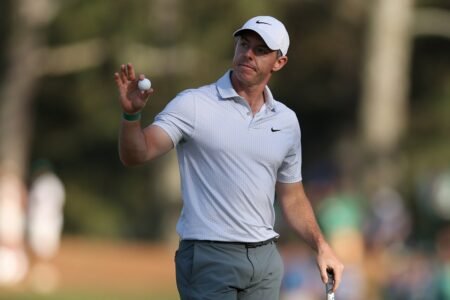


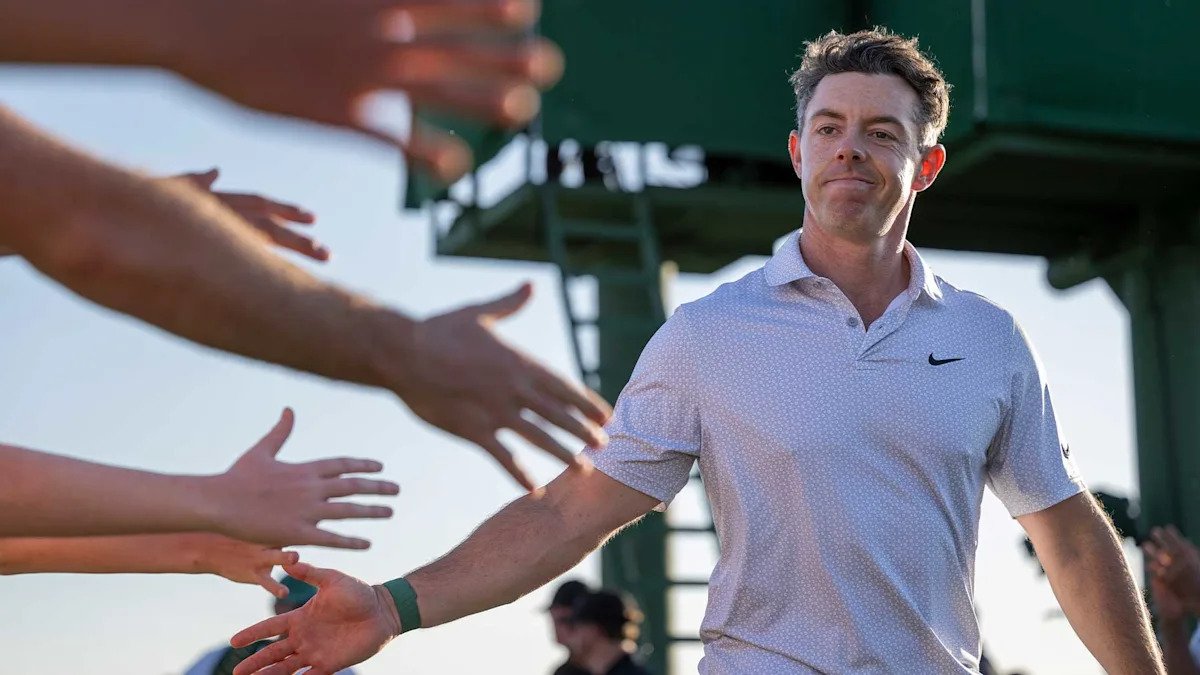
AUGUSTA, Ga. — Of the many people who spent the first two days of the Masters watching Rory McIlroy with the silent awe of a tourist tottering over the edge of the Grand Canyon, perhaps nobody was more gobsmacked than Mason Howell.
The 18-year-old has been looking forward to watching McIlroy at Augusta National on Thursday and Friday for months. When the excitement began on the first tee box, he was so excited that he briefly lost control of his limbs.
Advertisement
“I mean, I wouldn’t say I was nervous going into it, but I was when I got to the first tee yesterday,” Howell said with a laugh on Friday afternoon. “I couldn’t feel my arms and hit it in nine fairway.”
If you haven’t put it together yet, Howell was not just a witness to McIlroy’s throat-stomping over the first two days at Augusta National — he was a victim of the crime, competing in McIlroy’s grouping thanks to his status as reigning U.S. Amateur winner. The 18-year-old Howell admitted on Friday afternoon that he began thinking about the potential of playing alongside McIlroy — honoring a long-standing club tradition pairing the reigning U.S. Amateur winner and reigning green jacket winner — before he’d even been crowned the champion (right after the semifinal match, to be exact).
And what, in his wide-eyed youth, did Mason Howell see?
Only the most dominant opening 36-hole performance in Masters history.
Advertisement
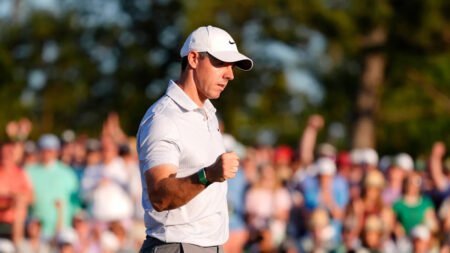
McIlroy has endured many stretches of great golf at Augusta National, but few have raised to the level of unconsciousness the 35-year-old displayed on Friday afternoon, when he birdied six of his last seven holes to move six shots clear of the field, the largest halfway point lead in Masters history.
Over the first two days at this Masters, the reigning green jacket-winner (12 under) beat the reigning U.S. Amateur (nine over) by 21 shots. He beat his old nemesis, Bryson DeChambeau, by 18. And he beat everyone else so badly that only 16 players are within ten shots as the sun sets on Friday evening at Augusta National.
Generally speaking, blowouts such as this one are not good for intrigue. But generally speaking, the golfers executing the blowouts are not Rory McIlroy playing in his first start at Augusta National since vanquishing his demons in grand slam-clinching, sport-altering fashion 12 months earlier.
In a strange way, McIlroy’s lead makes the story of the weekend at Augusta National both endlessly fascinating and impressively simple. The week began with a limitless scope of outcomes, but the weekend will begin with two: Either McIlroy cleared all of his Masters trauma last year only to spend the next Masters tearing the field limb from limb, or he cleared all of his Masters trauma only to discover a new, more terrifying kind of it.
Advertisement
If you want to believe we’re on the brink of witnessing a historical blowout, there’s plenty of evidence on your side. For one thing, Masters history is littered with examples of greats who seemed to improve with age at Augusta National. Phil Mickelson, who is missing just his second Masters since the turn of the century, is probably the closest historical analogue — he won two more green jackets following his maiden voyage major championship victory in 2004, and appeared to thrive at the course after finally kicking the door down. But he’s not alone as an example: Jack Nicklaus (who won at age 46 in 1986) and Tiger Woods (who won at age 44 in 2019) are also votes in support of the idea that age comes before beauty in Augusta green.
Of course, none of those golfers carried a six-shot lead into Saturday morning, which would only seem to further McIlroy’s case. As does the fact that McIlroy isn’t even playing particularly well. He lucked into a few big birdies on Friday afternoon, including on the 13th hole, when a badly wayward drive left a window to survive unscathed for the second straight day, resulting in a birdie.
In other words, if he really turns it on for the weekend, there’s reason to believe the current margin could grow even more lopsided — as even McIlroy admitted on Friday afternoon, when he suggested that his birdie-birdie-par-birdie-birdie-birdie-birdie finish probably wasn’t all that impressive to his amateur playing partner.
Advertisement
“Hopefully [Howell] saw that you don’t have to be perfect to shoot low scores,” McIlroy said. “Hopefully he saw someone that wasn’t perfect but was very efficient with how he scored.”
But before you go ahead and crown him on Friday night, it’s probably worth mentioning the other outcome. McIlroy is no stranger to Masters trauma — you might remember that his scar tissue at Augusta National was a considerable part of the story when he finally clinched the green jacket for the first time last spring — and blowing a six-shot lead would represent trauma of an entirely new kind, even for the golfer who has everything.
Even for the optimist, it is not difficult to point out that there is a lot of golf still to play. Thirty-six holes with the lead is a lifetime for any golfer, even Rory McIlroy, and the lead seems to do strange things to the players holding it. You might remember that a blown four-shot advantage — with only nine holes to go — remains the second-most notable finish in McIlroy’s Masters history, even if it occurred a lifetime ago, in 2011.
But forget a total collapse — it’s not particularly far-fetched to envision a world in which McIlroy’s lead slips from six shots to three on a crowded Masters moving day. Few people would bat an eye at such a development, and yet it would totally reorient the way McIlroy approached the final round at Augusta National. Is a three-shot comeback on Sunday at the Masters even that outrageous? McIlroy himself witnessed that lead disappear a year ago!
Advertisement
“Yeah, I’ll probably try to keep my mind off of it,” McIlroy said Friday. “That distraction is usually a good thing for me, especially with a late tee time and the lead.”
A little diversion is good, because whether McIlroy wants it or not, he’s once again become the story of Masters week. From many outcomes we are down to two — and even McIlroy’s competitors are taking their own bets.
“He has like a six-shot lead, I think. So that’s crazy,” Howell said on Friday night, as the patrons (and maybe even some of the players) were still buzzing from McIlroy’s 65.
“I mean, now he has all the weight off his shoulders. He’s playing so carefree, and I’ll be shocked if he doesn’t get it done this weekend.”
Advertisement
The post Rory McIlroy’s Masters repeat has 2 equally fascinating outcomes appeared first on Golf.
Read the full article here