
Three of the four tournaments on the mainland portion of the PGA Tour’s West Coast Swing feature poa annua greens. And just about every player would tell you that even at those venues, the way putts roll at eadch of them can be completely different.
MORE: This umbrella snafu at Riviera might be one of the images of the year
Advertisement
Torrey Pines’ two courses present probably the firmest test, though with all of the public play they get, they’re hardly pristine. Pebble Beach and Spyglass Hill play the softest because of the damp weather on the Monterey Peninsula. Northern Californian Aaron Oberholser once described them as “waffle irons,” even in tournament conditions.
As for Riviera Country Club, the greens are by far the best manicured at one of America’s most beloved tracks, but that hardly means they’re gettable. Between the subtle yet diabolical slopes created by George C. Thomas and the speed they can get them to—even after a few days of rain—Riv’s greens are its ultimate defense in this bomber’s age.
Two of the game’s best were again reminded of that in Saturday’s third round of the Genesis Invitational.
World No. 2 Rory McIlroy and No. 13 Xander Schauffele entered the weekend in Los Angeles with strong chances to win for the first time at Riviera. McIlroy was only one shot back of co-leaders Jacob Bridgeman and Marco Penge; Schauffele was three behind. But while Bridgeman, in his Riviera debut, seems to be making everything he looks at—and he did so on Saturday for a 64 that put him a whopping six shots into the lead at 19 under—the stars struggled badly to find any touch on the poa annua.
Advertisement
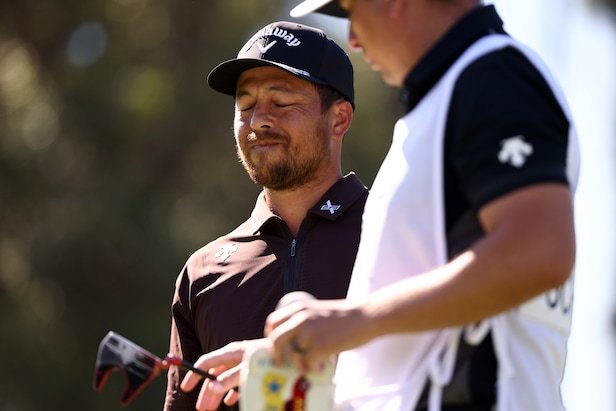
Schaffele, who was finally enjoying a strong performance after a slow start to the season, missed seven putts from 10 feet or closer (nearly all of them to the right), including three from four feet and in, and shot one-under 70 to drop nine shots behind. McIlroy didn’t fare as badly, finishing with a 69, but a couple of short misses put him on only the outskirts of contention. The Ulsterman is the lone player in second, at 13 under, and will play with Bridgeman in the final twosome on Sunday.
2262861930
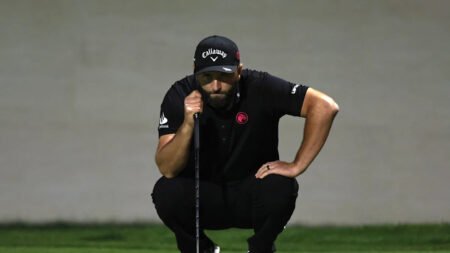
Rory McIlroy lines up a putt on the fifth green.
Mike Mulholland
Schaffele didn’t talk to the media afterward, while McIlroy spoke with a calm sense of resignation about what he endured on the greens, which were soaked earlier in the week by rain, but quickly dried under the abundant sunshine on Saturday.
Advertisement
“Yeah, a little frustrated, but at the same time, I was hitting good shots and I just felt like every putt I left myself … it was more of a defensive putt rather than something you could have a go at,” McIlroy said.
“The greens got really fast there at the end of the day. Then, it was just you couldn’t leave it dead. You’re grinding over three-footers and all of a sudden you get one that you think you can have a bit of a run at and if you hit it a little bit too hard … just I found the greens really, really difficult today.”
McIlroy didn’t have nearly as many short misses as Schauffele, but part of that was because he wasn’t dialed in enough with his irons to put many approaches close. He had few chances inside 12 feet. His two big putting misses came from five feet for par at the par-4 10th and four feet for birdie at the 17th.
The trouble at the drivable 10th was particularly frustrating because McIlroy didn’t like his tee shot there and then compounded his problems with a chunked chip. He pitched to four feet, and that’s when the trickiness of reading Riv’s greens came into play.
Advertisement
“I felt like I hit a decent putt for my third and it just went on by,” McIlroy said. “And, again, it’s hard just with how subtle these greens are. My putt going past the hole was right-to-left, but then I couldn’t really see any left-to-right with the one coming back. I’m, like, ‘OK, just trust it has to,’ and it didn’t [move that way].
“They can put the hole locations in really tricky spots out here,” he added. “You can start to really second guess your reads.”
McIlroy cited another confounding sequence at the par-3 16th, where he couldn’t convert a birdie try from 11 feet.
“They’re hard because you don’t want to hit them too hard, obviously, and then the softer you hit them, the more break they’re going to take early,” he said. “There’s a lot of double-breakers here, so my putt on 16 today was a great example. I had to hit it really soft; it was left-to-right early, but the last half of the putt was right-to-left. But it went so far right early because I hit it so soft, it never had a chance to come back.”
Advertisement
World No. 1 Scottie Scheffler sent up a warning flag about the greens earlier on Saturday, when he went out in the morning and shot 66 to climb into a tie for 22nd.
“The amount of traffic we have on them.” Scheffler said, “I know only 50 guys [are] in the field, but the greens are getting softer and they’re fast, which I think is a really good challenge. It’s kind of underrated how hard that is. And especially when you add a little bit of breeze, it can be really challenging to hole putts.
“I think,” Scheffler added, “you’ll see guys get a lot of looks, but you’ve still got to manage your way around.”
Of course, for all of that can be lamented, McIlroy was able to shoot a 65 in Friday’s second round, so he hardly seems lost. He would seemingly need a score like that again to put any pressure on Bridgeman. He would have to hope that fate on Riviera’s greens somehow evens out.
Advertisement
“I wish I was a few shots closer to Jacob,” McIlroy said, “but looks like I’ll be in the final group, at least I’ll be able to keep an eye on him and maybe get off to a fast start and put a little bit of pressure on him.”
Making some putts early would help.
Read the full article here