



SAN FRANCISCO — Four days into Super Bowl week and the New England Patriots are now 0-2.
In what became two of the worst kept secrets in the history of the Pro Football Hall of Fame, it was revealed Thursday night that Bill Belichick and Robert Kraft both failed to get the votes for induction with the 2026 class. It’s a moment that will be debated for the next 12 months for multiple reasons. There’s the flawed selection process that leaves seniors committee players fighting with coaches and contributors for votes. There’s punishment for the 2007 Spygate scandal, or to some conspiracy theorists, a perceived bias against the Patriots for a litany of factors.
Advertisement
I’ll leave you to choose your own rationale when it comes to Belichick and Kraft. But what you shouldn’t misconstrue here is that this is going to mushroom into an even bigger embarrassment. That somehow, some way, we’re seeing the bricks laid that will eventually become an unavoidable barrier — keeping the greatest quarterback in the history of the NFL from getting into the Hall of Fame on his first ballot. That’s not happening.
Brady is going into the Pro Football Hall of Fame in 2028. The first year he’s eligible. More than likely as a unanimous selection (although unanimous enshrinees are not revealed by the HOF). And if he doesn’t, I’m willing to bet you’ll see some voters resign from the process.
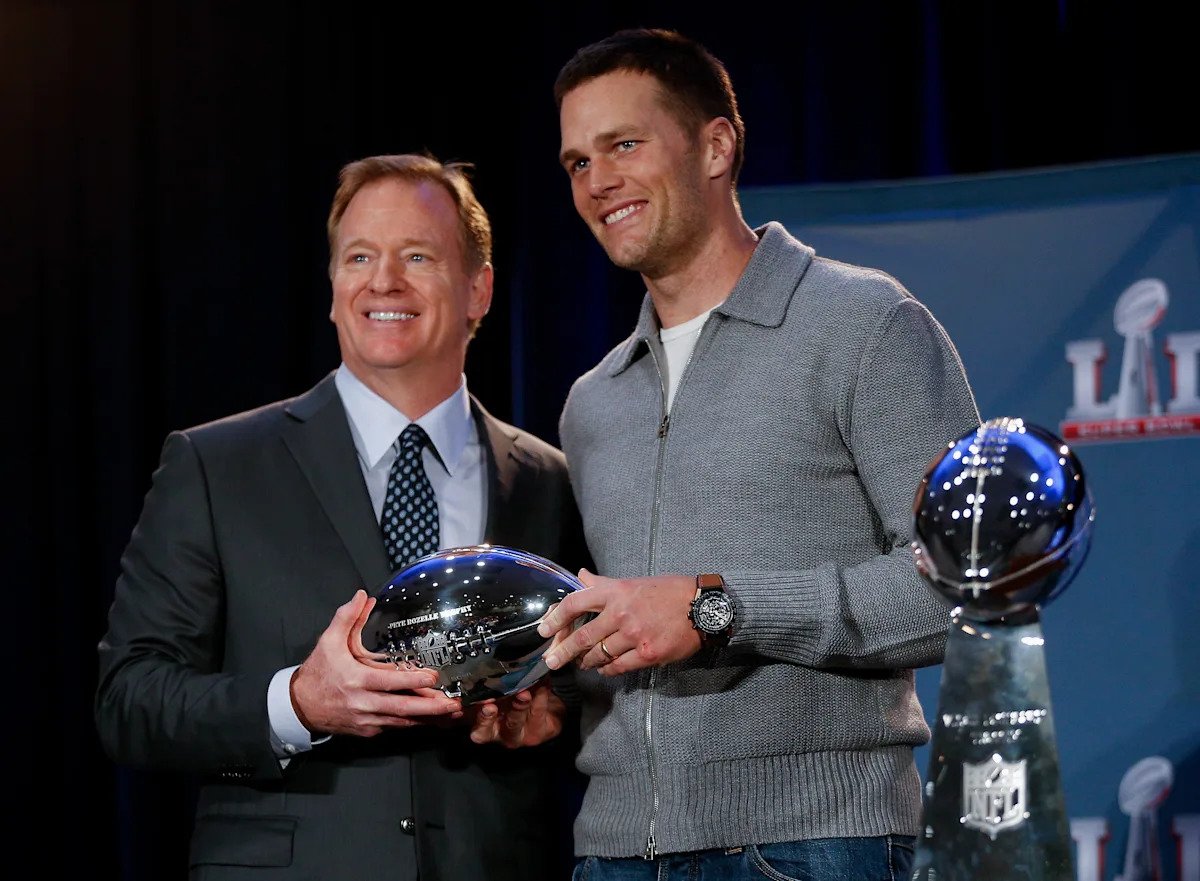
Tom Brady’s last Super Bowl triumph with the Patriots happened in 2019 when New England defeated the Los Angeles Rams in Atlanta. (Photo by Jim Davis/The Boston Globe via Getty Images)
(Boston Globe via Getty Images)
So we can dispense with the debate about his candidacy, which has been a combination of jokes, faux hand-wringing and deduction over the past few days. The trio that made the biggest headlines?
Advertisement
Brady telling Fox Sports’ Colin Cowherd — with a tongue in cheek tone that has not been reported enough when contextualizing this comment — “Maybe it’s not trending so well for ex-Patriots. Maybe I should be a little concerned here.”
Brady’s friend and former teammate, Rob Gronkowski, sarcastically joking to Fox News Digital — “I think Tom Brady now is going to be a fourth-ballot Hall of Famer.”
And then there was HOF wideout Terrell Owens — who has had a bone to pick with voters since it took three ballots to get him enshrined — telling multiple media outlets that Brady’s candidacy should be held to the same standard as that of Belichick and Kraft. If you take the time to actually listen to Owens and not just read the quotes, he wasn’t being bombastic when he made the statements. Instead, he framed it as a matter of reasonable deduction, given Belichick’s first-ballot exclusion, which Owens labeled a “travesty” when speaking to Sports Illustrated on Radio Row.
Owens’ most succinct reasoning came in a Radio Row sit-down with the California Post.
Advertisement
“Honestly, if you’re looking at it, if Belichick doesn’t go in and Robert Kraft doesn’t go in first-ballot, Tom Brady shouldn’t go in,” Owens said. “I’m just being real. It’s nothing against him. How can you have Tom Brady go in when he’s up in 2028? Why would he go in if Robert Kraft and Bill Belichick don’t go in on the first go-around? Because to be quite honest, yeah — is Tom Brady a good quarterback? Yeah. He’s not the quarterback he is without Robert Kraft drafting him. He’s not the quarterback he is without Bill Belichick. They all go hand-in-hand. So to me, why would he go in and those two don’t? He shouldn’t go in [first-ballot], either.”
Owens’ comments drew the most attention, of course. But his line of deduction and reasoning is indeed the core of the debate. But it’s also flawed when it comes to Brady — because Brady’s candidacy isn’t subject to the same vote-for-three-of-five candidates structure that played at least a part in what happened with Belichick and Kraft.
We’ll get to that in a moment.
First, we have to circle back to the lack of voter transparency when it comes to the Hall of Fame, which only promotes conspiratorial theories about what exactly is going on with Patriots candidates. Maybe that ballot transparency changes over the next few years. Perhaps votes are publicized and accountability is pushed to the forefront for the 50-member panel. Regardless of that happening, the outside world should understand that this year’s results aren’t part of a package deal. There are only assumptions rather than proof of a grand conspiracy here, allowing for a notion that a cabal of voters is banding together in a Machiavellian master plan to take punitive measures against Belichick, Kraft and eventually, Brady.
In reality, if you talk to voters — and I’ve spoken to a few — what happened this year is simply the intersection of circumstance and flaws in the system. Consider the math:
Advertisement
You have 50 HOF voters. They were charged with selecting three candidates from a pool of five: Belichick (coach candidate), Kraft (contributor candidate) and a trio of players put forward by the seniors committee in Roger Craig, L.C. Greenwood and Ken Anderson. With the 50 voters allowed to pick only three candidates, that equates to 150 available votes.
It takes 40 votes to win enshrinement. Roger Craig got at least 40 — evidenced by his being the only one of the five to make the Hall on Thursday night. That means there were, at most, 110 votes on the table — all of which were split among the remaining four candidates. Getting another 40 votes from the remaining pool of 110 is not an easy task, especially if you had some voters who made the error of thinking that Belichick or Kraft were definitely getting in, and that they would be one of the few outliers to use all three of their votes on the last-shot seniors committee players. This is where the flaw exposed itself in the system. And so do most of the voters I spoke with.

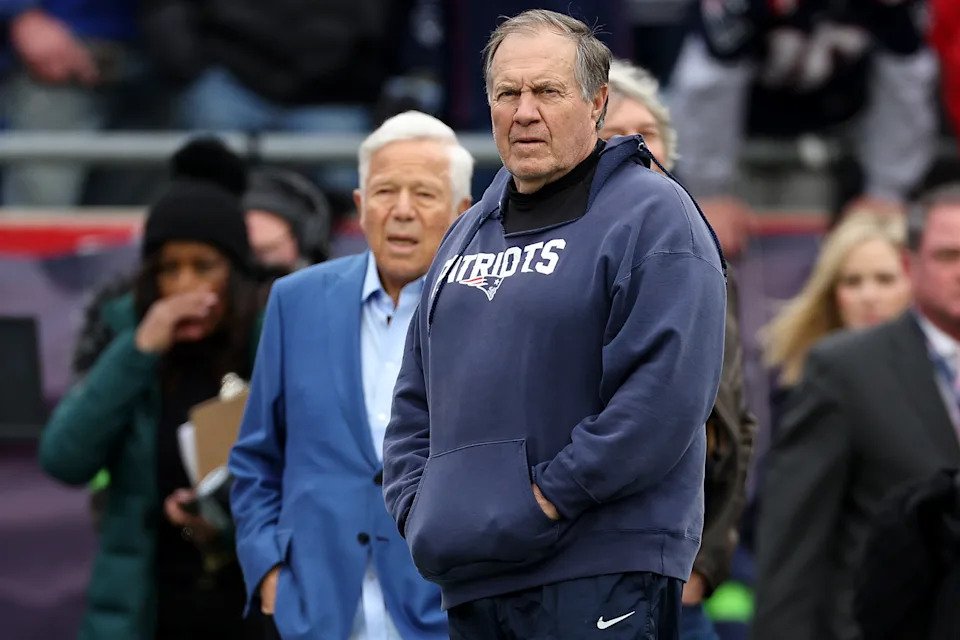
Bill Belichick and Robert Kraft will have to wait another year for a shot at the Pro Football Hall of Fame. (Photo by Maddie Meyer/Getty Images)
(Maddie Meyer via Getty Images)
That doesn’t mean some voters didn’t hold Spygate against Belichick or even Kraft to some extent. But it presents a very plausible counterargument to the idea that this is just a Patriots-related conspiracy. And we should note, Kraft has been eligible for the Pro Football Hall of Fame since the class of 2013. He made it as a finalist only in 2026, which is suggestive that his first-shot candidacy was not nearly the slam dunk that Belichick’s might have been.
Advertisement
Now, back to Brady. Let’s set aside that he’s arguably the greatest quarterback — and maybe the greatest player and winner — in NFL history.
One basic thing about Brady’s candidacy that clears the structural voting issues that stacked against Belichick and Kraft: He’s going to be on the ballot in 2028 as a modern era player. And Hall of Fame voters can vote for five of those candidates. Brady’s résumé is going to smoke every other modern era player who is in his class, so it shouldn’t be a struggle for him to coast in on the first ballot — if there isn’t some extenuating issue in play.
Of those, only Deflategate could be held against Brady. But here’s the issue with that being used against him:
-
Brady’s four-game suspension for Deflategate shouldn’t be an automatic first-ballot disqualifier for voters because defensive end Julius Peppers was a first-ballot selection in the 2024 class, and he was suspended four games during his rookie season for using a banned substance. And that wasn’t an inconsequential suspension, either. At the time, Peppers was leading the NFL in sacks, with 12.
-
Brady’s alleged lack of cooperation in the Deflategate investigation — which the league said was committed when he had an assistant destroy a cell phone containing text messages — also can’t be an automatic disqualified for first-ballot induction. Why? Because the NFL ruled that during the 2010 season, Brett Favre failed to fully cooperate in a league-run “sexting” investigation involving Favre and a New York Jets employee. Favre was fined $50,000 by the NFL for the lack of cooperation, and there was a belief that he could have faced a suspension in 2011 as well, but he retired following the 2010 season. Favre was still a first-ballot Hall of Famer.
And of course, none of this speaks to how Deflategate has looked in the rearview mirror for the league. It was an investigation rife with leaks from the league office and advanced science that looked less and less credible over time. Not to mention the reality that when the league took a season to measure the PSI in footballs one season later, the resulting data was destroyed rather than released to the public. That raised a larger question about whether football inflation levels are even reliable over the course of given games and in certain environments.
Advertisement
Even with that reality, Deflategate is always going to be a debated part of Brady’s history. But it also became a speck of sand in the middle of his career. He played another six seasons after the scandal. He won three Super Bowls after. He won a league MVP. He threw for 27,632 yards and 193 touchdowns after Deflategate. And the Super Bowl he won with the Tampa Bay Buccaneers had nothing to do with Belichick and the Patriots.
All of this is to say, he’s in his own category. Not lumped in with Belichick. Not even lumped in with Kraft. And certainly not lumped in with whoever is ultimately going to be sharing the ballot with him in 2028.
Advertisement
That’s why Brady is getting in. Any notion to the contrary between now and then is just wasting time and oxygen.
Read the full article here