

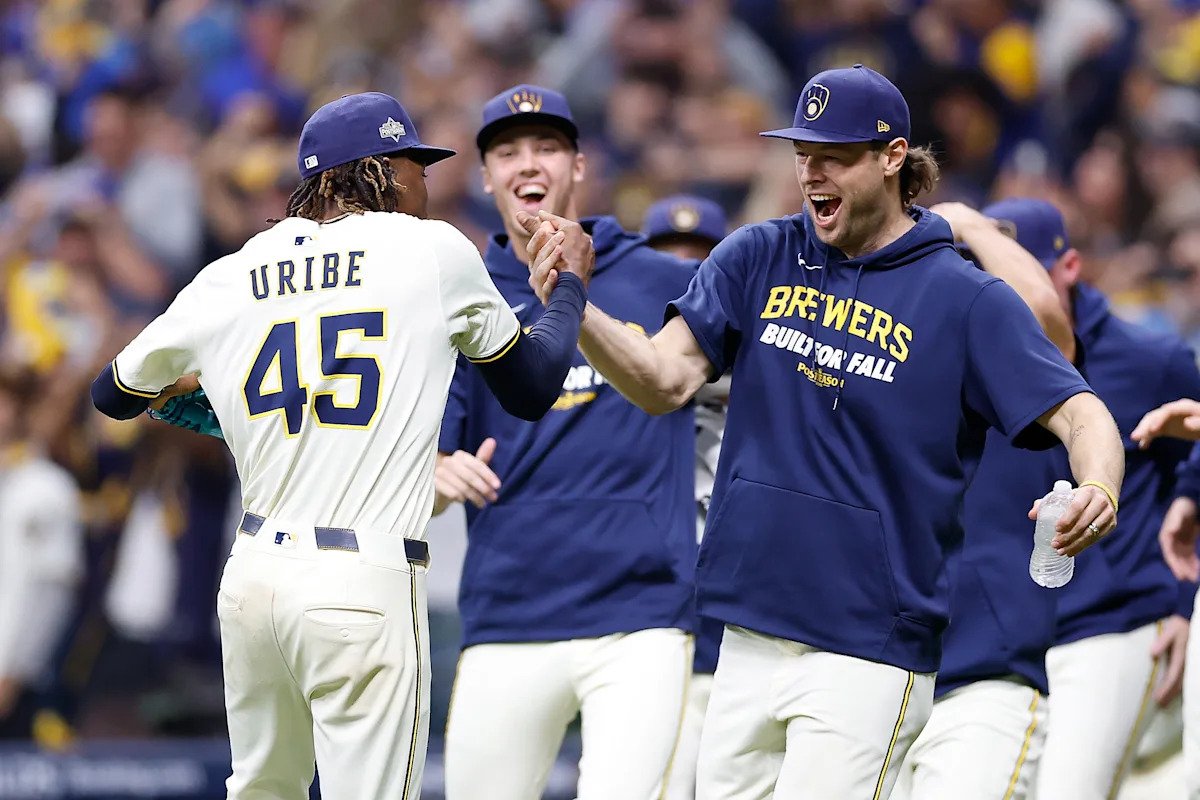
The Brewers enter 2026 with a good, if unusual, conundrum: they have two players who seem to have every right to close games.
But it’s not necessarily the closer(s) who will get a team to 90-plus wins. It’s the other guys. Fortunately for the Brewers, they’ve got other guys in spades, too.
Advertisement
Like every year, it’ll take a bit to see how everything shakes out in the Milwaukee bullpen, but there is no shortage of good options here. Let’s run them down.
The Closer(s)
Trevor Megill, working in place of the injured Devin Williams, saved 21 games in 2024 while pitching to a 2.72 ERA. He was even better in 2025, when he picked up 30 saves with a 2.49 ERA and upped his strikeouts by almost two per nine innings. He made the All-Star team. But then he got hurt; he went on the injured list with a somewhat troubling flexor strain (often a precursor to bigger, scarier injuries) in late August and made just one more appearance before the postseason started. But he was back in the playoffs, pitching wherever Pat Murphy asked him to — in his five appearances in the 2025 postseason, Megill appeared twice in the eighth inning, once in the seventh, once in the fifth, and once as the opener. He allowed one run on two hits with five strikeouts in four innings.
Typically, you’d just say that Megill — now recovered, and having done nothing but be a good sport since his injury late in the season — would step right back into the closer’s role. But Abner Uribe, who filled in, is not just anybody. He is one of the best relievers in the sport. From Megill’s last appearance before his IL stint on August 24 until the end of the season, Uribe was 5-for-5 in save chances, and he went scoreless in 12 of 13 appearances, the only blemish being a couple of runs in the top of the ninth of a tie game versus the Phillies on September 1.
Advertisement
Uribe continued in the closer’s role in the postseason, too — he pitched the ninth in a four-run (non-save situation) game in game two of the NLDS, then picked up a two-inning save in a 3-1 game five victory. He did scuffle against the Dodgers; three walks and an earned run that proved meaningful in game one, and an RBI double to Enrique Hernández in game two.
But in the bigger picture, there’s no question that Uribe got better results than Megill last season. In considerably more innings (75 1/3 versus 47), Uribe pitched to a 1.67 ERA while striking out 90 batters. FIP, however, does slightly favor Megill, whose 2.50 mark was a quarter run lower than Uribe’s 2.75. Both throw extremely hard (Megill averaged 99.2 mph on his fastball last season, Uribe 98.8, both in the top 2% of all pitchers), but Statcast’s other underlying metrics tend to favor Uribe—batters seemed to just find it impossible to square him up.
Pat Murphy, when asked about this conundrum, said that Megill is likely to get the bulk of the save opportunities at the beginning of the year but that he’s not really thinking of it as having a single closer.
This is like when bad teams say they’re using a closer-by-committee because they don’t have anyone they trust, except good.
Advertisement
Other high-leverage options
Here’s a quick appreciation of Jared Koenig, whose career was revived in Milwaukee in 2024 and has been nothing but nails ever since. Before coming to Milwaukee, Koenig had made 10 major league appearances, five of them starts, and he had an ERA of 5.72. He had turned 30 before the 2024 season and was surely wondering if it was ever going to happen for him.
In the past two seasons, Koenig, a lefty, has thrown 62 and 66 innings, respectively. His ERA has been 2.47 and 2.86, a combined 156 ERA+. His strikeout numbers are pretty good. Statcast tells us that, like Uribe, hitters can’t barrel him up. It’s possible that some regression could be coming for the big lefty, but Koenig has been incredibly valuable to this team over the past two years, and I expect that will continue this year.
But in this section of the preview, we should talk about the Brewers’ bullpen’s swiss army knife, a player with the potential to make a huge impact out of the bullpen akin to Josh Hader in 2018. It’s very possible that Aaron Ashby starts the season in the starting rotation, but I don’t expect him to stay there. He’s got too much value as a guy that the Brewers can bring in whenever — whether that’s the start of the game or the end of it — and pitch one, two, or three innings. Last season, Ashby threw 66 2/3 innings in 43 appearances.
Advertisement
Ashby also didn’t make his first appearance of last season until May 24. Is it a coincidence that, when Ashby debuted, the Brewers were 25-28, and they then went 72-37 for the rest of the season? I’m not saying that Ashby was single-handedly responsible for the team’s turnaround. But having a weapon like Ashby, who can be deployed whenever the need is urgent, is a tremendous luxury for a team like this. I get that some want to see Ashby start to better justify his rising salaries, but he’s just so good out of the bullpen, and turning him into this kind of player could just be a different way of making him a star.
The Newcomer
There’s really only one new face who figures to factor into the Milwaukee bullpen early this season, and that’s Ángel Zerpa, who was acquired in a trade with the Royals. Zerpa is somewhat of a mystery to Brewers fans — he was okay last season with Kansas City, but if you were to just glance at surface-level stats, you might ask why the team traded Nick Mears, who had an ERA almost 0.75 better than Zerpa’s in 2025, for him, much less Mears and a starting outfielder in Isaac Collins.
But we’ve come to learn that when the Brewers see something they like, we should trust them, and there was obviously something they liked when it came to Zerpa. Aside from the fact that even basic underlying numbers, such as FIP, suggested that Mears and Zerpa were much closer together than their ERAs would suggest (hello, Brewers defense), Milwaukee was also clearly drawn to Zerpa’s 99th-percentile ground ball rate.
Advertisement
The Brewers look smart, thus far. In two February spring training appearances, Zerpa went six-up, six-down. He then went to pitch for the World Baseball Classic champs, for whom he pitched 5 1/3 scoreless innings over six appearances while striking out eight. It’s just spring, but it’s encouraging to see Zerpa pitch well in as high-leverage a situation as you’re going to find as a middle reliever in March.
I’m fighting the urge to just believe that Zerpa will be a complete lights-out arm. It feels like the Brewers know something about him that others don’t and that he’ll immediately be a stud. Maybe! But he also just might be a perfectly fine middle reliever, which would also be fine.
Other options
The Brewers return a few more players who pitched out of the pen at times last year: Grant Anderson, who will be a tough-on-righties option; DL Hall, who has to stay healthy and prove something but who could end up being a valuable long-relief option; and Easton McGee, whose opportunities last season were limited to 14 2/3 innings but didn’t look too bad despite a tough-luck 5.52 ERA.
Advertisement
Craig Yoho is still around waiting for another major league opportunity, but he’s a little behind after a calf injury delayed his schedule; he’s expected to be fully ready by the middle of April, but probably would have started in the minors even if he were fully healthy. Rob Zastryzny is out of minor league options, but the Brewers were able to push back making any decisions on him, as he will start the season on the injured list after a shoulder injury picked up while he was with Team Canada. Sammy Peralta is another guy the Brewers picked up over the offseason, but he’s had a bit of a rough spring and will start in the minors.
The other consideration here is whether any of the starting pitchers who aren’t pitching in the rotation end up in the bullpen. Milwaukee didn’t shy away from this option at the end of last season, as they used both Chad Patrick and Jacob Misiorowski as high-leverage long relievers in the playoffs. But right now, the numbers suggest none of the extra options for Milwaukee’s rotation will start in the bullpen; as of Sunday evening, Logan Henderson, Robert Gasser, and Shane Drohan had already been optioned and Quinn Priester was headed for the injured list, leaving the Brewers with five big-league starters, presumably (Brandon Woodruff, Brandon Sproat, Patrick, Misiorowski, and Kyle Harrison).
Where does that leave us?
It looks like the Brewer bullpen to start the season will consist of the following players:
Advertisement
High-Leverage: Trevor Megill, Abner Uribe, Jared Koenig, Aaron Ashby
Middle Relief: Ángel Zerpa, Easton McGee, Grant Anderson
Long Relief: DL Hall
Things will certainly change over the course of the season. Relieving is fickle and difficult to predict, even for players like Koenig who’ve had multiple good years in a row. Ashby or Hall might be needed in the rotation at some point. Someone we’re not expecting could impress in Nashville and earn an opportunity in the big leagues.
But the Brewers have generally been good at going with the flow in the bullpen, and they’ve got a handful of “tent post” types that we can be pretty sure they can rely on. In general, the bullpen should be a strength.
Read the full article here