

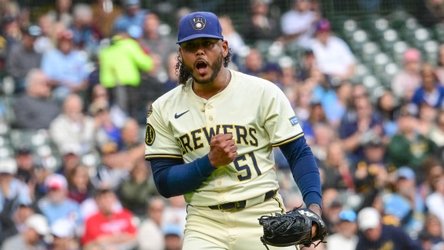
Kyle Tucker agreeing to sign with the Dodgers over the Mets and Blue Jays late Thursday night should’ve surprised no one.
The Mets had an outrageously good offer on the table (four years at $200 million, and later went to four years at $220 million). Meanwhile, reports were that the Blue Jays had extended a long-term offer, and that Toronto was willing to go as high as 10 years.
Advertisement
With that as a backdrop, it made no sense that Tucker was taking so long to reach a decision. And that’s why at 4:31 p.m. I typed this guess to my colleagues: “Tucker is going to the Dodgers.”
It took a while longer for that to happen, and the numbers were eye-popping: four years for $240 million (an insane $60 million AAV), with a $64 million signing bonus and $30 million deferred.
What happened was not a Steve Cohen failure or a David Stearns failure. And it was not a uniquely Mets thing.
There is next to nothing a team can do when a player seemingly wants a certain team and city. If the Mets went to $61 million annually (which they were right to not do), the Dodgers probably would’ve gone to $62 million.
Advertisement
Over the last handful of seasons, we’ve watched the same song and dance play out with Los Angeles and star players.
Shohei Ohtani wouldn’t even seriously consider the East Coast before agreeing to his contract with LA that included $680 million in deferrals.
May 23, 2025; New York City, New York, USA; Los Angeles Dodgers designated hitter Shohei Ohtani (17) reacts after tagging up and taking second base on a sacrifice fly by Dodgers shortstop Mookie Betts (not pictured) in front of New York Mets shortstop Francisco Lindor (12) and second baseman Luisangel Acuna (2) during the third inning at Citi Field / Brad Penner-Imagn Images
We heard how much Yoshinobu Yamamoto loved the Yankees. Didn’t matter. He, too, chose the Dodgers, with their more relaxed city and fan base (and incredible climate) coming along with that choice.
The same happened with Roki Sasaki, whose affordability made him a possibility for every team, but who went to the Dodgers anyway.
In a way, lots of these players are acting like Kevin Durant did when he decided to join the juggernaut Warriors. It isn’t fun for the other 29 teams. It isn’t really competitive. It’s certainly not good for the sport. But the Dodgers are playing within the rules. And until those rules change, perhaps as part of a lockout in 2027, they can keep doing this. To that end, would anyone be surprised if they traded for Tarik Skubal next?
Advertisement
As far as where the Mets go from here this offseason?
There seems to be a desire in the wake of Tucker spurning them to relitigate the decisions New York has made regarding the players they have let go this offseason.
In the case of Edwin Diaz, that’s fair. It seems apparent that something went haywire at the end of those negotiations, with the Mets losing a player who wanted to be in Queens.
Beyond that, it’s pretty clear that the Mets acted with conviction.
Trading Brandon Nimmo in order to get out of the last five years of his deal as he enters his age-33 season was prudent. The same goes for dealing Jeff McNeil, who wouldn’t have had a regular role in 2026 had he stayed.
Advertisement
The big one is Pete Alonso, and it can be argued without the benefit of hindsight that perhaps the Mets should’ve offered him four or five years and asked him to be their DH. But there’s no reason to wring your hands over the Mets not making him an offer. If they weren’t going to the level it took to keep him, extending an offer for the sake of it would’ve been pointless.
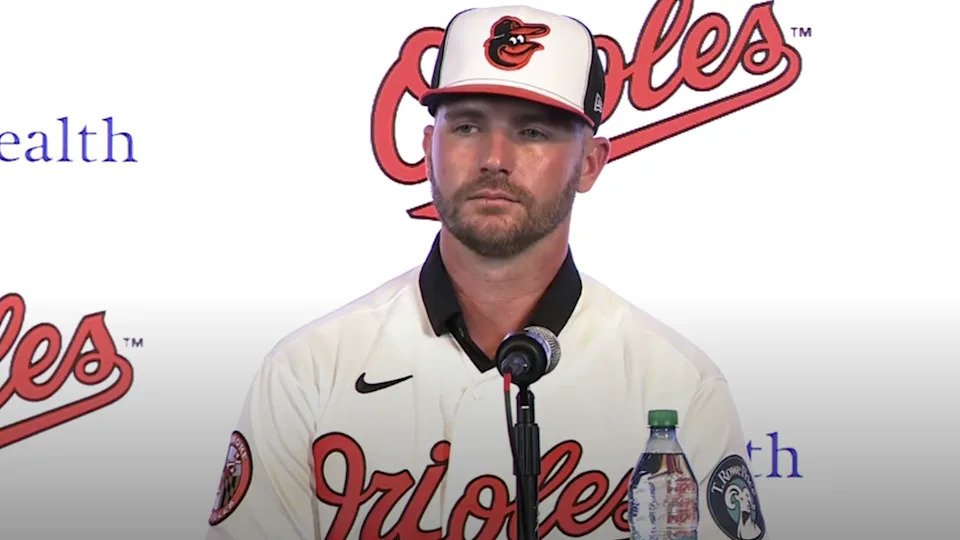
Pete Alonso wears a Baltimore Orioles uniform for the first time during his introductory press conference on December 12, 2025 / Screenshot via WBFF Baltimore
New York’s main additions this offseason have been Devin Williams, Jorge Polanco, Luke Weaver, and Marcus Semien. That is not nearly good enough, and there are likely significant moves coming.
As the Mets ponder what those moves should be, it’s instructive to look at the upcoming free agent classes after 2026 and 2027, when there will not be a single difference-making hitter available. The biggest ones next offseason could be Jazz Chisholm Jr. and a 37-year-old George Springer. The year after that, the boldest names are likely to be Jeremy Peña and Steven Kwan.
Advertisement
So, what now?
With the Mets in serious need in the starting rotation and outfield, here are two plausible scenarios:
Option A: Trade for Freddy Peralta and sign a bat or two
Peralta is there for the taking, and the Mets have the kind of players who should interest the Brewers.
And if Peralta is open to an extension, as Jon Heyman of The New York Post reported on Thursday, it could make trading for him even more palatable.
Could a deal centered around Brandon Sproat and A.J. Ewing work? Would the Mets be willing to trade Sproat and Jett Williams if they knew they were turning around and locking Peralta up long-term?
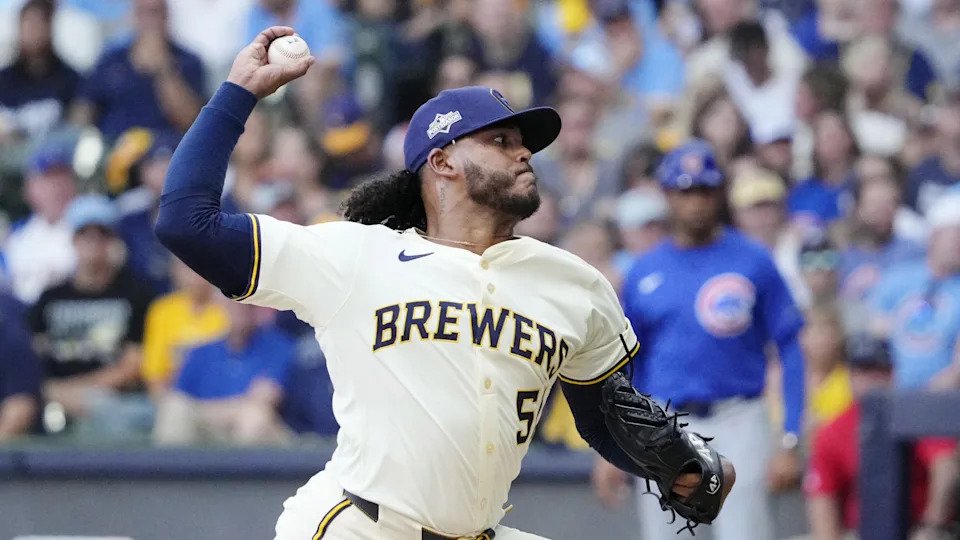
Oct 4, 2025; Milwaukee, Wisconsin, USA; Milwaukee Brewers starting pitcher Freddy Peralta (51) pitches against the Chicago Cubs during the second inning of game one of the NLDS round for the 2025 MLB playoffs at American Family Field. / Michael McLoone – Imagn Images
If the Mets can’t snag Peralta, they could try to engage the Twins on Joe Ryan. Or call the Padres about Nick Pivetta. They could also take a moonshot and attempt to entice the Tigers to trade Skubal, with a contentious arbitration hearing approaching.
Advertisement
As far as the free agent bats, there really aren’t many that are enticing.
The Mets could always try to snag Cody Bellinger from the Yankees, but that doesn’t feel likely. Beyond that, Bellinger’s year-to-year inconsistency and 2025 home/road splits should give any team pause.
Eugenio Suarez could make sense if New York wants to try to add serious power. But he profiles best at DH and strikes out a ton.
One sensible move could be turning to Bo Bichette, who is entering his age-28 season. The Mets could conceivably sign Bichette to play third base, slide Brett Baty to first base, and use Jorge Polanco as their primary DH.
Advertisement
Option B: Sign Framber Valdez and trade for an outfielder
With 30-year old Ranger Suarez signing a five-year deal, it’s possible the 32-year-old Valdez inks a three-or four-year contract at a decently higher AAV than Suarez’s $26 million. That would be right in the Mets’ wheelhouse, and give them a legit top of the rotation starter.
In a world where New York doesn’t add a starter via trade, Valdez winding up in orange in blue makes too much sense to not happen.
And if the Mets don’t use any of their best young players to trade for pitching, they could theoretically use them to acquire an outfielder instead.
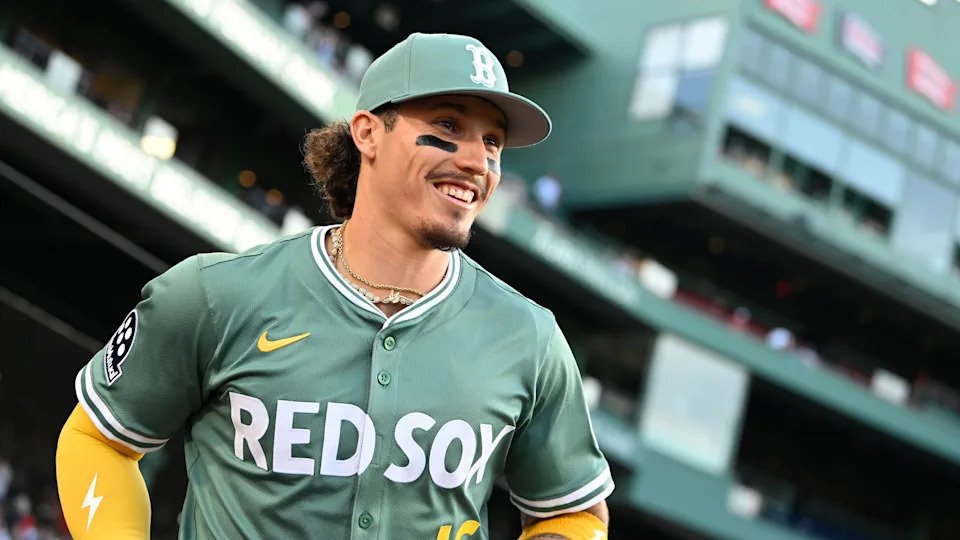
Boston, Massachusetts, USA; Boston Red Sox left fielder Jarren Duran (16) runs out of the dugout before the start of a game against the Atlanta Braves at Fenway Park. / Eric Canha – Imagn Images
Maybe they call the Red Sox about Jarren Duran.
Advertisement
Perhaps they try to pry Brendan Donovan from the Cardinals.
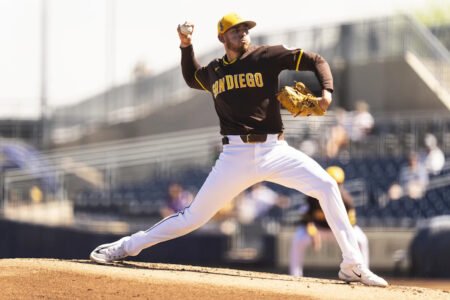
Another option could be snagging Ramon Laureano from the Padres — and maybe expanding that deal to include a high-leverage reliever like Jeremiah Estrada.
***
Before the Tucker gut punch, this had already been an offseason of seismic change for the Mets and their fans.
It has been unprecedented. It has been uncomfortable. It has been disappointing. But there is still time.
If the Mets have a similar roster 26 days from now when pitchers and catchers report to Port St. Lucie, it will be more than fair to wonder what happened.
But it seems far likelier the conversation will be revolving around how the Mets landed some big swings at the end of the offseason rather than how it all went wrong.
Read the full article here