


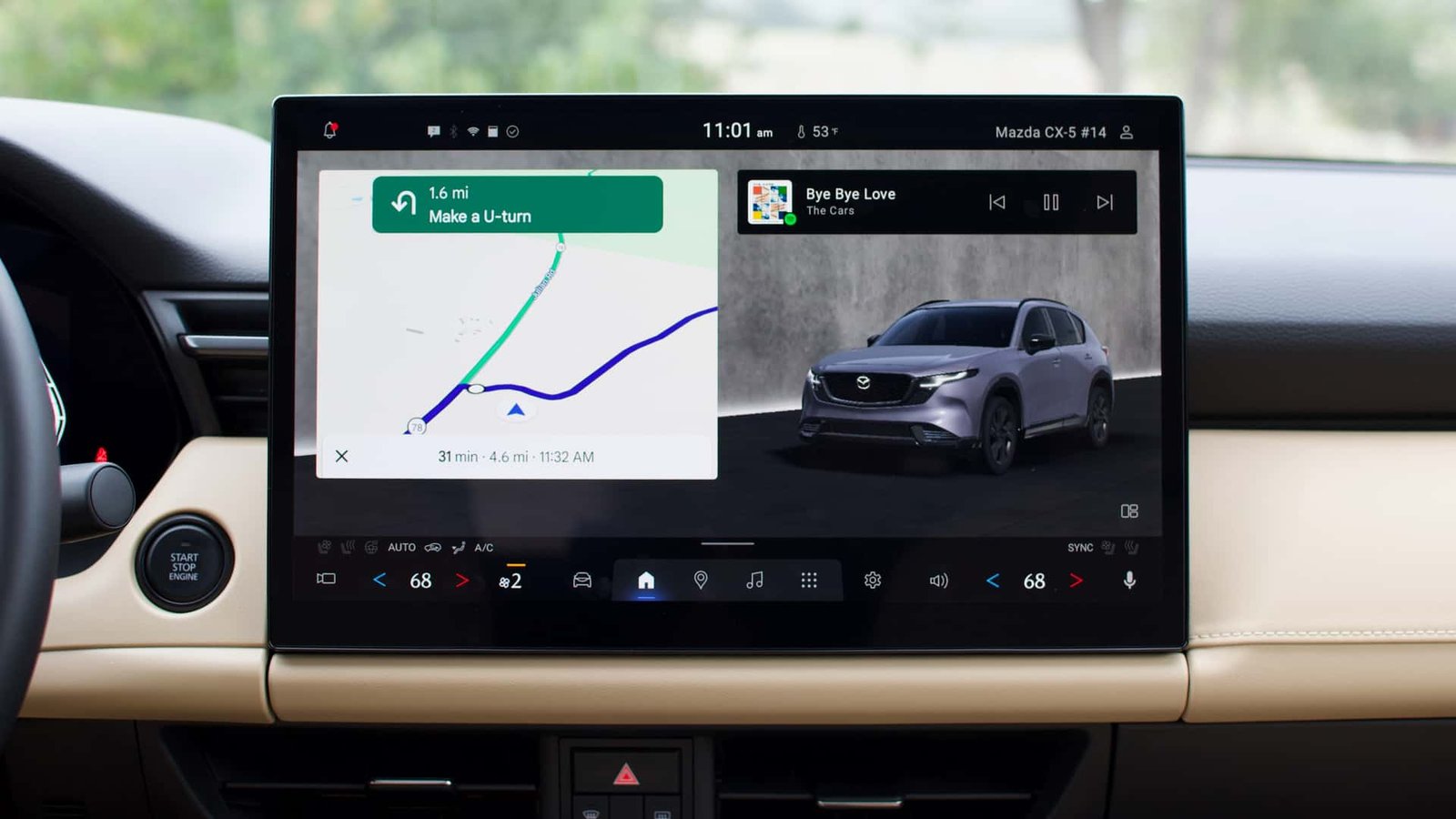
Mazda has a new infotainment system that ditches the commander knob it launched over a decade ago for a massive touchscreen instead. At the time, Mazda Connect was the company’s approach to controlling the infotainment screen in a way that “was developed to be a less distracting and more intuitive in-vehicle operating system.” Now, it’s gone.
Even without a knob, though, the new Mazda Connect with Google Built-In, which debuts in the 2026 CX-5, doesn’t abandon that philosophy, according to Matthew Valbuena, Mazda’s project manager of in-vehicle technologies and human machine interfaces. As Valbuena tells Motor1, the CX-5’s new technology aims to keep drivers focused.
“Mazda’s driving philosophy remains the same,” Valbuena says. “We are focused on minimizing driver distraction.”
Photo by: Anthony Alaniz / Motor1
Mazda does this by giving drivers multiple ways to control various vehicle functions, with the steering wheel and voice recognition playing major roles in that experience. The wheel has dedicated buttons for the available 360-degree camera, M-Drive, and media source selector, which Mazda displays in the gauge cluster along with the current track whenever it’s changed.
HVAC controls are on the touchscreen, unfortunately, but at least they’re always pinned to the bottom of the screen. That said, you can also use your voice while keeping your hands on the wheel and eyes on the road.
Valbuena compared the company’s two infotainment systems to the iPod Classic and iPod Touch. “Both can do the same things, but the iPod Touch has greater flexibility and can do more things than the iPod Classic,” he said.
‘Mazda’s driving philosophy remains the same. We are focused on minimizing driver distraction.’
And it’s that future flexibility of the Google-based system that appealed to the automaker, given that so much has changed in infotainment since 2013. Mazda Connect and its dial debuted before the launch of Android Auto and Apple CarPlay, two touch-based operating systems, and integration issues arose when Mazda added those features.
Neither was designed to be used with a dial, and the second-generation Mazda Connect that launched in 2019 lacked touch capability. After receiving feedback, the automaker fixed this with the CX-50, but the infotainment landscape and consumer expectations continued to evolve.

Photo by: Anthony Alaniz / Motor1
Google Built-In is also touch-based while providing access to over 350 in-vehicle apps, and Mazda did not want the hardware to constrain the vehicle’s capabilities. “Trying to control that great variety of apps with a singular command knob would be very difficult,” Valbuena said.
So, Mazda tried to find a balance true to its philosophy.
“Even though our approach to the solution may be different than what we have done previously, the goal is the same—it’s how do we give the driver the connectivity and the features they are looking for, but in a safe way that does not distract their driving,” he added.
Photo by: Anthony Alaniz / Motor1
Mazda also wanted to lower the learning curve for using its infotainment system. With a majority of adults owning a smartphone, they’re accustomed to touch-based systems.
“We didn’t want to have this super complicated user experience that required reading a massive owner’s manual,” Valbuena said. “We wanted that kind of jump in and go and discover, and this system delivers that.”
Valbuena wouldn’t elaborate whether this new system will roll out to other models. Mazda, like other automakers, doesn’t discuss future product plans. But he did say that consumers “will see both [Mazda Connect and Mazda Connect with Google Built-In] for quite a while, but the option is there.”
The company is confident in its new system, introducing it in its best-selling vehicle first. Valbuena believes that “consumer sentiment will bolster the demand for this to propagate through the lineup.”
58
Source: Mazda
Read the full article here